This image honors Father Ragheed Ganni and the three Chaldean deacons/subdeacons martyred with him in Mosul: Basman Yousef Daoud, Waheed Hanna Isho, and Ghassan Isam Bidawid.
Loyal friends and faithful servants of the Church, the three had begun accompanying Father Ragheed to church because of the growing threats against his life.
Even as Chaldeans in Mosul were being threatened, intimidated, and pushed to abandon their homes, they continued to stand beside their priest and serve our beloved Church with courage.
On June 3, 2007, after the Divine Liturgy at Holy Spirit Chaldean Church, they were with Father Ragheed when gunmen confronted them for refusing to close the church.
Their story reminds us that the Chaldean Church in Iraq survived not only through its priests, but also through the courage of deacons, lay servants, families, and ordinary faithful who refused to abandon Christ.
Servants of God Father Ragheed Ganni, Basman Daoud, Waheed Isho, and Ghassan Bidawid - pray for us. ✝️
#chaldean #chaldeans
19 years ago today, Father Ragheed Aziz Ganni celebrated his final Holy Qurbana in Mosul.
On June 3, 2007, he was martyred alongside three faithful deacons: Basman Yousef Daud, Wahid Hanna Isho, and Gassan Isam Bidawid.
They were killed for refusing to abandon the Church, the Eucharist, and the people of God.
“Without Sunday, without the Eucharist, Christians in Iraq cannot survive.”
Father Ragheed Pray for Us!
May their memory be eternal.
#chaldean #chaldeans
“How can I close the House of God?”
Servant of God Father Ragheed Aziz Ganni was a Chaldean Catholic priest serving in Mosul, Iraq, who laid down his life for Christ on June 3, 2007.
In the midst of escalating violence and constant death threats, he was repeatedly ordered to close his parish and cease celebrating Mass but bravely chose to continue his service.
We will never forger Father Ragheed and all Chaldeans who have paid the ultimate price for their Love of God.
#chaldean #chaldeans
Tomorrow, May 29, marks a historic moment for the Chaldean Catholic Church as His Beatitude Patriarch Paulos III Nona is formally installed as the new Patriarch of Babylon of the Chaldeans.
This is more than a ceremony - it is the beginning of a new chapter for one of the world’s oldest Christian communities, whose roots trace back to ancient Mesopotamia - the Chaldeans.
At a time when Chaldeans across Iraq and the diaspora face challenges to their identity, language, and homeland, the enthronement of a new patriarch represents hope for the future.
From Baghdad to Detroit, from Ankawa to Sydney, Chaldeans around the world will be watching as our new spiritual father takes up the mission of guiding and strengthening our people.
#chaldean #chaldeans
May 17th is Chaldean Flag Day. This date commemorates the liberation of Babylon by the Chaldean king Nabopolassar on May 17, 626 BC, marking a significant moment in Chaldean history!
The Chaldean flag, designed in the 1980s, is rich in symbolism that reflects the heritage and identity of the Chaldean people:
Two Blue Lines: These represent the Tigris and Euphrates rivers, central to the Mesopotamian homeland of the Chaldeans.
Eightfold Star: Situated at the center, this star symbolizes the Babylonian concept of law and justice, echoing ancient Mesopotamian traditions.
Yellow and Blue Circles: Encircling the star, the yellow represents the sun and the blue the moon, highlighting the Chaldeans’ contributions to astronomy and mathematics.
Red Rays and Wavy Blue Lines: Emanating from the central star, the red rays signify vitality and courage, while the wavy blue lines denote the rivers and the continuity of Chaldean culture.
This flag serves as a unifying symbol for Chaldeans worldwide, showing our rich history and enduring legacy!
#chaldean #chaldeans
Did you know many Chaldean churches are built in the style of ancient Babylon?
This style is called Babylonian Revival architecture.
These churches are not just designed to look beautiful, but to carry a deeper cultural meaning of both faith and identity.
For Chaldeans, our church architecture reflects a connection to Babylon, Mesopotamia, and the civilization our people have carried with them across the world.
#chaldean #chaldeans
Chaldean children of Iraq sing the traditional hymn “Baba o Brona”, which means “Father and Son” in Chaldean-Aramaic.
They are students at the Mar Qardakh International School in Ankawa, Iraq.
God bless our Chaldean children🙏🏼
#chaldean#chaldeans
Kidinnu Academy, named after the famous Chaldean mathematician, is one of the only schools in the world that teaches Chaldean-Aramaic as part of its core curriculum.
With three charter schools across the San Diego and El Cajon area, Kidinnu serves hundreds of students.
The Chaldean language is central to our identity as a people. Thank you, Kidinnu, for teaching and preserving it for the next generation!
#chaldean #chaldeans
Pope Leo XIV officially granted Ecclesiastical Communion to Mar Polis III Nona, the newly elected Patriarch of Babylon of the Chaldeans in an Official Letter.
In simple terms: the Chaldean bishops elected him, and the Pope formally recognized him in full communion with Rome.
Pope Leo’s letter also honors the Chaldean Church’s ancient apostolic roots, its martyrs, and its mission from Iraq to the diaspora.
May God bless the new Chaldean Patriarch and the future of the Chaldean Church.
#chaldean #chaldeans
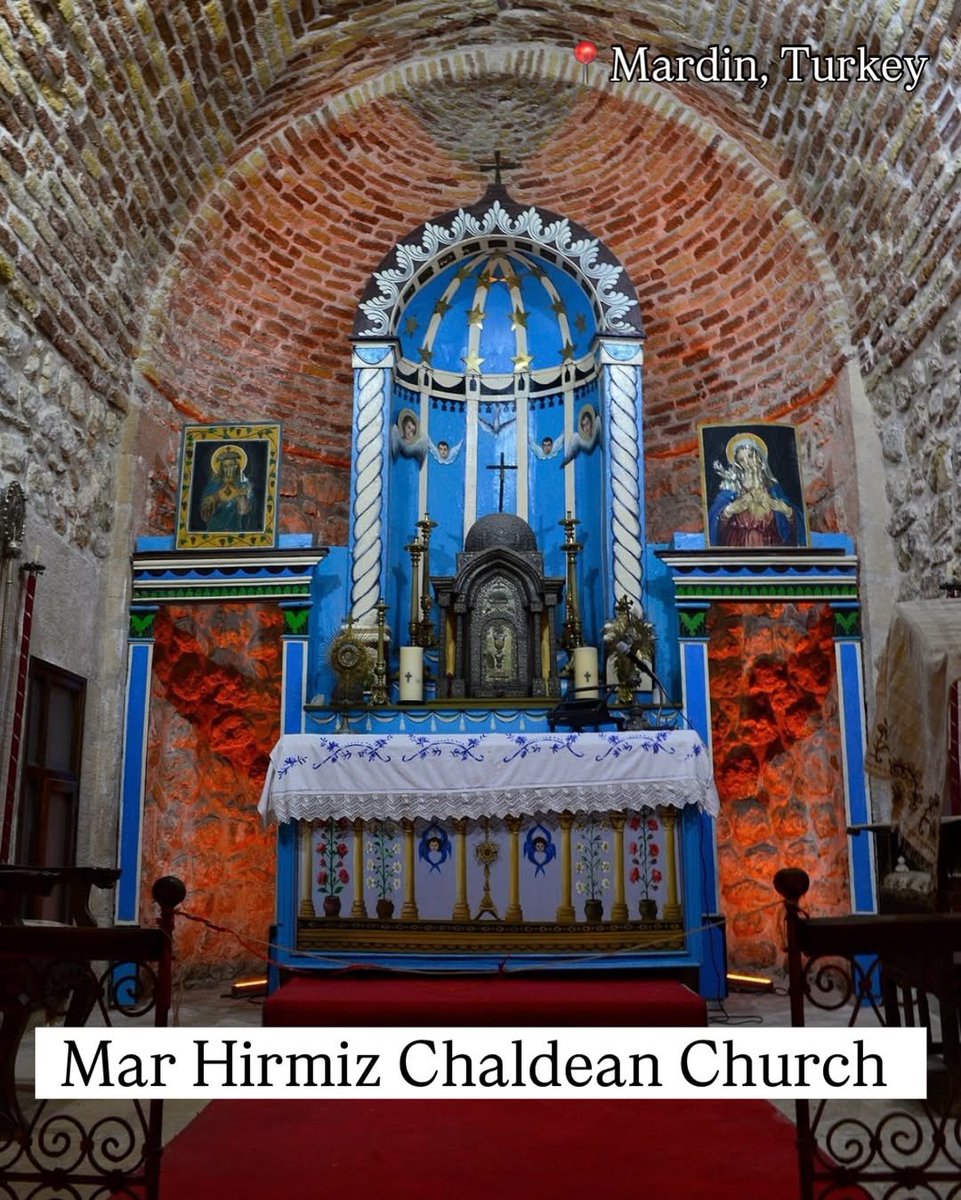
Mar Hirmiz Chaldean Church in Mardin and Mar Petyun Chaldean Church in Diyarbakir are two surviving ancient Chaldean Churches in Turkey.
For centuries, Chaldean communities lived, prayed, and preserved their faith across Mesopotamian Turkey, especially in historic cities like Mardin and Diyarbakir.
These churches remind us that the Chaldean story is not only rooted in Iraq, but across all of Mesopotamia.
Before the Chaldean persecution these communities were deeply connected to their ancestral land.
#chaldean #chaldeans
This is Hertevin - one of the rarest Chaldean Aramaic dialects.
Recorded in 1970, it preserves the sound of a community from Turkey that has almost disappeared. Today, only a tiny number of people are believed to still speak it.
Do you understand this dialect?
#Chaldean #Chaldeans
Rare photos of Chaldean men before the genocide.
Before our villages were emptied and our churches were destroyed, Chaldeans lived across ancient communities in modern-day Turkey (Northern Mesopotamia) since ancient times.
#chaldean#chaldeans
Many Chaldeans of Iraq have become disconnected from the historic Chaldean communities of Turkey. Villages such as Meer, Baznaye, Geznakh, Herbole, and Ischy were home to ancient Chaldean communities that had existed for centuries.
These communities were devastated during the Chaldean Genocide, along with many other villages and historic Chaldean settlements that were permanently destroyed.
Over the next few days, we will be showcasing the Chaldeans of Turkey to bring awareness to a once-vibrant community whose ancient presence has been nearly erased.
#chaldean #chaldean