This is impressive but NOT surprising. And certainly not insane.
Stacking Adaptive Apps with Ai does what has affordably never truly been able to do...
TRUE “differentiation” (Pace & Repetition of practice & teaching) for each student.
INDIVIDUALIZED learning paths.
This is what allows for expedited growth.
In my Reading Academy I stack a few adaptive applications and my results are similar.
There’s no “magic bullet” or one perfect system…but with close “coaching / teacher” observation and support. This system is easily replicated.
this school used AI to teach kids and outperformed the top 0.1% of schools globally, the stats are insane:
- average student is the equivalent of a valedictorian at a top 15% elite U.S. private school
- in mathematics “students perform at a level that breaks the standard calibration of the test with averages projecting to near-PERFECT SAT scores” 😂
- students learning rate didn’t plateau it got FASTER. meaning they weren’t just smarter - they got smarter FASTER
- kids only used AI for 2 hours PER DAY. that’s it. that’s all it took to outperform 99% of the nation.
- 5 year olds performed at the level of 9 year olds. teenagers performed at college level and beyond.
🚨🚨 Jordan Peterson revela una verdad que la mayoría de las familias modernas no quieren oír:
"La guardería para menores de tres años, especialmente durante el primer año, no es recomendable... No existe ningún tipo de cuidado que pueda reemplazar el cuidado de una madre en esos primeros años"...
"Es bastante sorprendente que hayamos creado un mundo donde quedarse en casa con niños pequeños se ha convertido en un lujo para la mayoría de las familias, como si hubiera sido intencional"...
Décadas de investigación (que aún se mantienen prácticamente sin cambios) demuestran que el período crítico de apego durante los primeros tres años de vida se ve favorecido de manera excepcional por un cuidado materno constante y receptivo. Las interrupciones en este período se correlacionan con aumentos medibles en la reactividad al estrés, problemas de comportamiento y dificultades emocionales posteriores...
What's best for the kids?
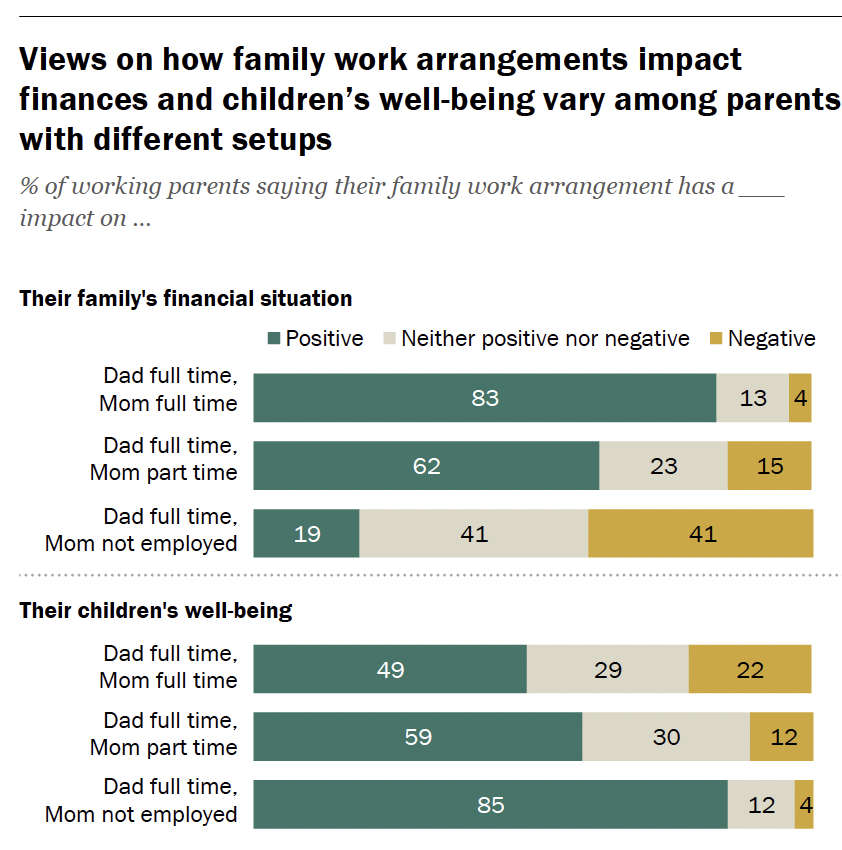
Striking new #s from Pew on work/family re: the kids:
✔️ Only half (49%) of parents who both work full-time say it's good for their children
vs
✔️ 85% of parents w/ mom at home who say their arrangement is good for their children
~@pewresearch
People have no idea what's coming with the next generation of kids who are AI native.
My youngest teen just started an internship.
On the first day he was given a "challenging" two weeks worth of work with very specific objectives, timelines, etc. By 10am the next morning he was done the entire list and asking for more work.
They didn't think he could possibly be done.
How?
He used AI to help (with their permission). And he KNOW how to use AI (he's not using it like a google search bar).
These AI native kids are gonna run laps around 25-40 year olds that are not using AI.
One of the best tools currently at our disposal to help kids learn is AI.
I know it’s a loaded statement…
If taught to use as a LEARNING TOOL.
My son has French verb test.
He asked AI to help him study.
It gave him a chart for examples. Explained what they are. How to use them.
Then gave him 5 different types of activities to practice.
This was just a free GPT account.
Next step is to set him up with his own Agent to create scripts and interactive games to help him learn whatever skills he needs.
Teach them to use it for learning rather than simply generating content or “answers”
AI summarizes them and then is able to apply them specific to YOUR personality.
Then, it can send a cron job daily to support and guide you through the changes you’d like to see.
Far more helpful and supportive than just the book.
It’s like having the author as your direct coach.
Seinfeld no era una serie “sobre nada”.
Era una serie sobre el futuro.
Jerry, Elaine, George y Kramer eran el prototipo del adulto moderno antes de que el adulto moderno se volviera mayoría.
Gente sola.
Sin hijos.
Sin matrimonio.
Sin religión.
Sin misión.
Sin raíces.
Sin legado.
Solo departamento, café, citas, consumo, neurosis y conversaciones infinitas sobre estupideces.
Y ahí está lo brillante: no te lo vendían como decadencia.
Te lo vendían como comedia inteligente.
Jerry hoy sería creador de contenido.
Vive de observar la realidad, convertirla en chiste y monetizar su personalidad. No tiene jefe visible, no tiene familia, no tiene hijos, no tiene misión superior. Su vida es comodidad, rutinas, cereal, tenis blancos, citas desechables y reputación.
Elaine es la mujer urbana moderna antes de Instagram.
Independiente, profesional, sexualmente libre, siempre rotando hombres, siempre encontrando defectos, siempre incapaz de cerrar con alguien. No es presentada como tragedia. Es presentada como una mujer divertida, lista y “libre”.
George es el hombre moderno promedio con ego alto y valor bajo.
Resentido, inseguro, cobarde, envidioso, poco masculino, con estándares absurdos y cero capacidad real de convertirse en el hombre que las mujeres que desea elegirían. No es exactamente un incel, porque a veces tiene suerte. Pero su mentalidad sí es la del hombre frustrado que quiere más de lo que merece.
Kramer es el adulto sin estructura.
No trabaja de forma clara, no produce de forma estable, vive entrando y saliendo de la vida de los demás, sobrevive con favores, trucos, ocurrencias y algún ingreso fantasma. Hoy podría vivir de ayudas, reventas, economía informal o cualquier sistema donde no tenga que construir nada serio.
Y lo más brutal:
Ninguno construye nada.
No hay familia.
No hay sacrificio.
No hay hijos.
No hay patrimonio emocional.
No hay comunidad real.
No hay proyecto trascendente.
Solo el yo.
Mi cita.
Mi incomodidad.
Mi departamento.
Mi café.
Mi marca favorita.
Mi problema ridículo.
Mi neurosis.
Eso no era “una serie sobre nada”.
Era una serie sobre el individuo convertido en centro absoluto de su propio universo vacío.
Y claro, estaba llena de marcas: Junior Mints, Twix, Snapple, PEZ, cereales, restaurantes, cafés, productos. Pero la propaganda real no era “compra esto”.
La propaganda real era más profunda:
consume, ríete, no te comprometas, no aprendas, no madures, no formes familia, no dejes legado.
La famosa regla de la serie era “no abrazos, no aprendizaje”.
Es decir: nadie cambia, nadie crece, nadie madura, nadie se redime.
Perfecto.
Porque ese es exactamente el adulto moderno.
Un niño de 40 años con renta, citas, opiniones, ansiedad, consumo y cero dirección.
Y aquí es donde hay que entender el contexto: Seinfeld nace desde una élite cultural urbana, neoyorquina, secular, irónica, neurótica, sofisticada. No necesitas inventarte una conspiración barata para ver el patrón.
No fue una reunión secreta para destruir la familia.
Fue algo más efectivo:
una élite cultural exportando su estilo de vida como entretenimiento masivo.
Y como nos hizo reír, bajamos la guardia.
Hollywood entendió algo antes que muchos:
si presentas la descomposición como tragedia, la gente la rechaza.
Pero si la presentas como humor inteligente, la gente la adopta.
Por eso Seinfeld sigue pareciendo actual.
Porque no predijo el futuro.
Lo ensayó.
Nos mostró al adulto urbano sin propósito antes de que ese adulto llenara las ciudades, las apps de citas, los departamentos pequeños, los antidepresivos, los podcasts, los cafés caros y las redes sociales.
Seinfeld fue el tráiler de una civilización cómoda, sola y estéril.
Y lo más cagado es que todos se reían porque pensaban que estaban viendo una comedia.
En realidad estaban viendo el manual de usuario del vacío moderno.
As a result of a US government directive, we are suspending access to Claude Fable 5 for all users. You can continue to use all other Claude models.
Here’s what this means for you:
Across Claude products, new sessions will run on your selected default model or Opus 4.8, and existing Fable 5 sessions will end with an error.
On the Claude Platform, requests to Fable 5 will also return an error. Please update your integrations to other Claude models.
We know this is a disruption to your workflows; we appreciate your patience and support.
Jeff Bezos just bet $12 billion that you'll be able to support your whole family on a single paycheck again.
his reasoning: AI will let companies make more stuff with fewer people and less money.
and when something gets cheaper and easier to produce, and lots of companies can do it, they compete and the price drops.
it's why a flatscreen TV that cost $2,000 a decade ago is $300 today.
bezos thinks AI will do that to almost everything you buy.
in his words, it raises "the basket of goods people can afford."
your paycheck buys more without anyone handing you a raise.
the problem: look at which prices have actually dropped.
so far, AI has only made *digital* things cheap, like code and content.
but the stuff that really eats your paycheck is *physical*.
rent, cars, medicine. cheaper code doesn't lower your rent.
that's exactly what bezos just spent $12B on.
Prometheus, his new company, is building AI tools that help engineers design and manufacture physical products faster
things like cars, machines, and medicine.
the goal is to make building physical things as fast and cheap as writing software.
if it works, 1 income starts covering what used to take 2.
which is when his prediction kicks in:
"perhaps one of those earners will choose not to be in the job market, so they'll become a one-earner household." or "some people who are working overtime will stop working overtime, because they don't want to."
one paycheck covering a whole family again, like the 1950s.
I can’t believe this is an ACTUAL headline.
Share IPO info, share info about the company. Why should people “properly” hate one man for it?
What the heck does that even mean?
@MmeLockhartLDS@FixingEducation Wobble stools
Spooner board
Professional development that does a lot of talking, but zero teaching.
Stacks and stacks of resources and teacher guided materials that explore theory, but clearly have no practical application nor grounded in the science of anything.
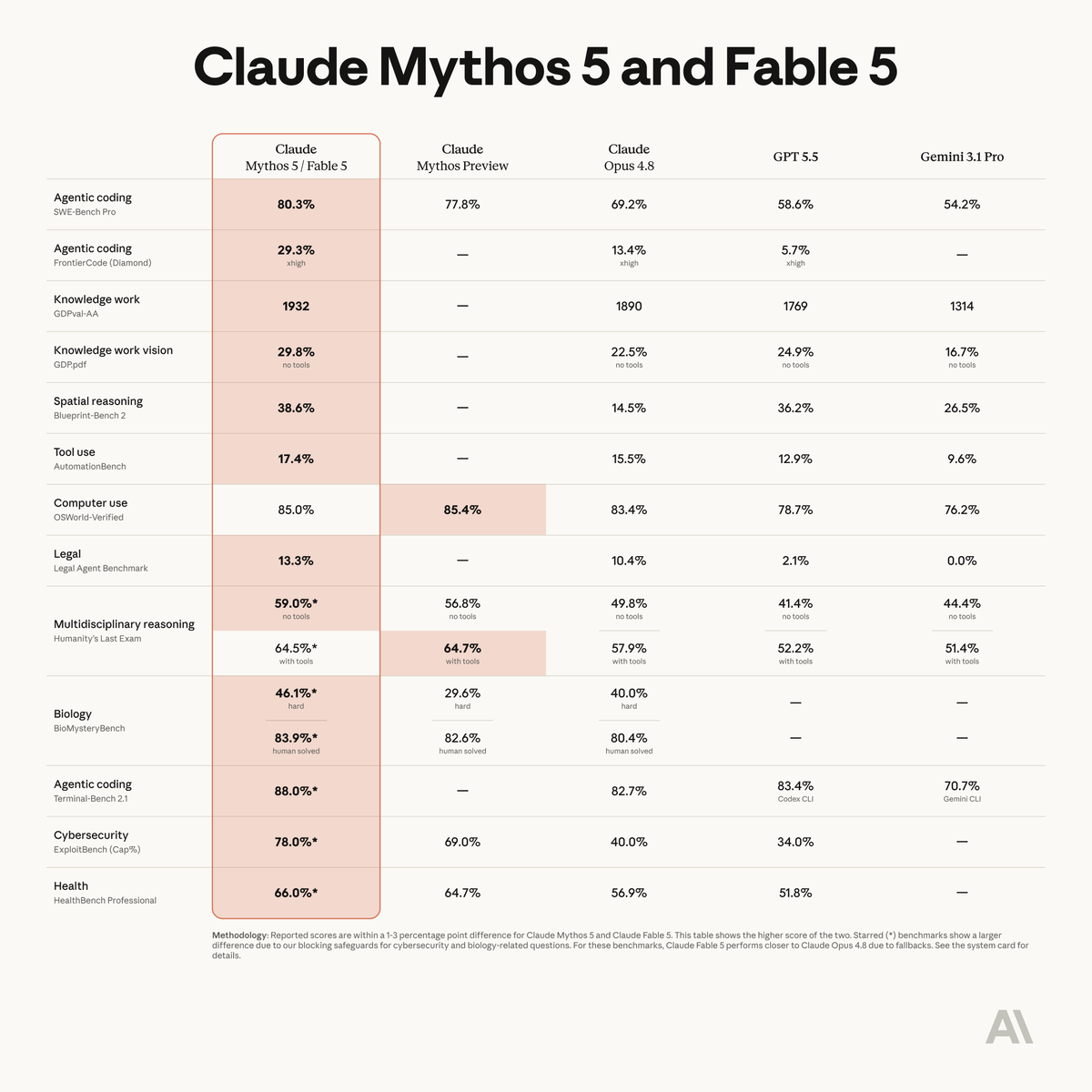
Fable 5 is state-of-the-art on nearly all tested benchmarks, with exceptional performance in software engineering, knowledge work, scientific research, and vision.
The longer and more complex the task, the larger Fable 5’s lead over our other models.
@teach0r Yes. You may no “need it” for a job. But there is certain fundamental societal knowledge that as a population MUST know. Constitution, what Democracy is, what Socialism is, what communism is etc etc.
Cultural values and norms that a country has is and should not be “negotiable”
Agreed!
This notion that EVERYONE needs to learn EVERYTHING is silly.
Learn as you go…pick up what you need.
Life long learners as we progress through this journey called life.
My daughter’s best friend is starting nursing school this coming year. She’s a sweetheart and I love her.
Her parents homeschooled her using a hybrid school. They really pushed her through math. She’s been thru calculus.
My daughter has been feeling behind because of the compassion. But frankly, her friend didn’t need all that math. I know because I’m in the field she’s entering.
My trajectory-> algebra 1 in 8th, geometry in 9th which I barely passed -> one semester of remedial math in community college ten years after almost failing geometry -> college algebra -> dosage calculation (aka one equation set up for the total of my career).
Her friend has been stressed out over higher level math for no reason. None. And that’s without the use of devices and AI, which I use continually.
In a broader context, homeschooling parents are freaked out about getting their kids “prepared” so they’re not “behind.”
In reality, they’re stressing the kids out and over preparing for absolutely no good reason, while neglecting things like how to navigate relationships and recognize low value people.
My suggestion-
-Figure out what your kids are interested in and focus appropriately.
-If they don’t know, wait until they do. This isn’t a race. Be available well after they’re adults, because not all people know when they’re teens. And that’s ok!
- Focus on relationships and teaching them how to find good people and who those good people are and how to be a good friend and how to navigate relationships. That is arguably more important than math.
One guy racked up over 20,000 Tinder matches.
Rob Henderson shared the story on Jordan Peterson’s podcast: his friend, a good-looking, active user, got so many matches that Tinder gave him free perks, boosted his reach, and basically begged him to stay on the app. Meanwhile, Peterson noted women swipe right on roughly 4% of men.
The rest? Mostly radio silence and rejection. A couple matches a week at best for the average guy.
Hearing the raw numbers laid out like that is wild. Dating apps didn’t create human nature, but they supercharged the inequality in a way that feels pretty brutal for most men.
These platforms are running one of the largest social experiments ever — reshaping how generations meet, mate, and build confidence (or lose it).
What’s your experience been like with dating apps, or what have you noticed in your friends’ stories?