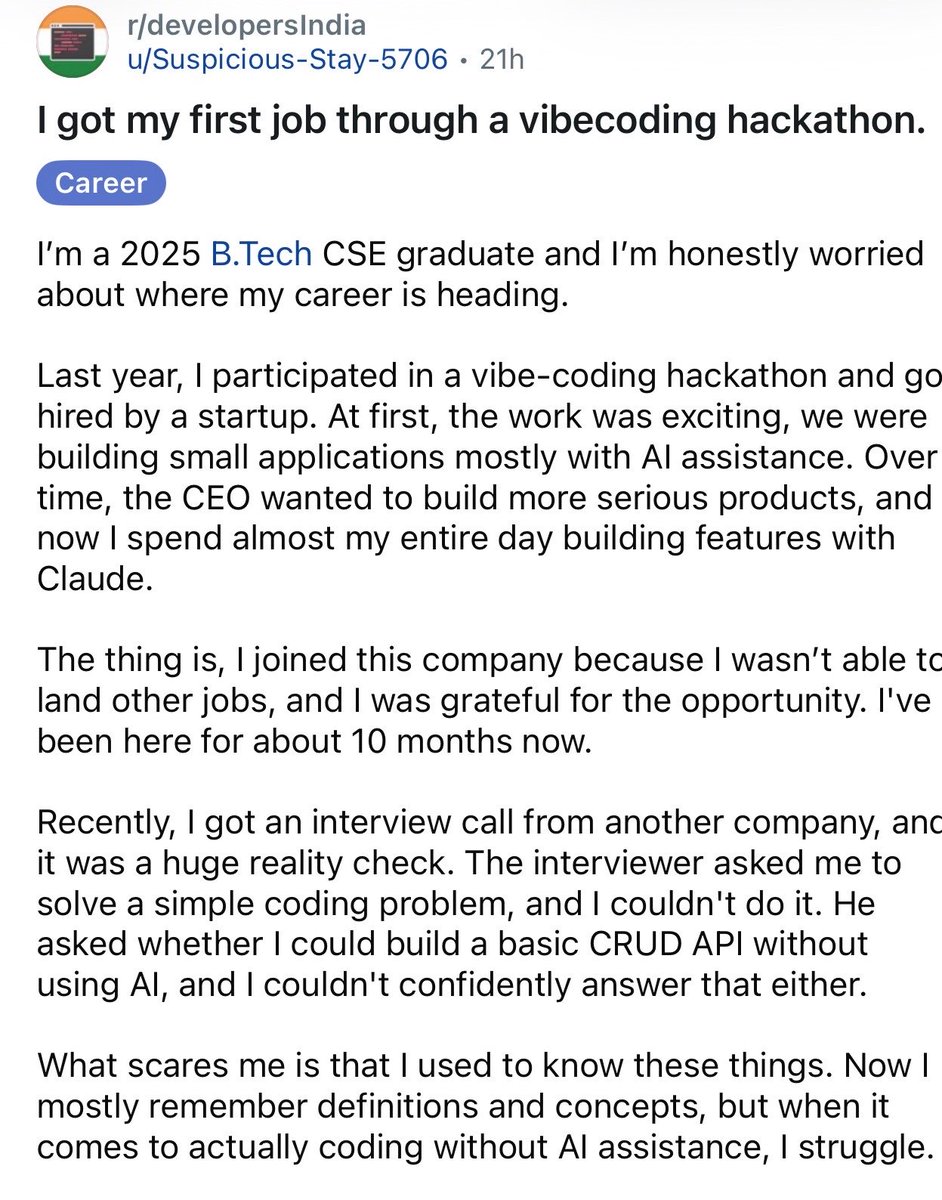
This is really scary.
A 2025 graduate got hired after winning a vibe-coding hackathon.
For 10 months, he shipped features daily with Claude.
Then he interviewed elsewhere.
He couldn’t solve a basic coding problem.
The scary part?
He said he used to know these things before.
Is this the future of software engineering?
An engineer earning ₹80 LPA in Bengaluru
can afford:
- A cook
- A maid
- Food delivery
- Frequent cabs
- A spacious apartment
An engineer earning €100k in Germany
can afford:
- Great public infrastructure
- Strong social security
- Better work-life balance
- More vacation time
The interesting part?
Many people in India assume the second person is richer.
I’m not so sure.
Money buys very different things in different countries.
What’s your take?
My monthly spending living in Bangalore
Rent - 36k
Groceries - 20k
House EMI - 96k
Insurance - 10k
Kid play school fees - 13k
Petrol - 5k
Utilities - 5k
Investments - 30 to 35k
Eating out & lifestyle - 10k
Am I doing alright or am I overspending?
Car in Bengaluru : 15L
Avg salary : 15 LPA
Multiplier : 1x
Car in Germany : €30K
Avg salary : €60K
Multiplier : 0.5x
In India, a car = 1 year of income
In Germany, it’s half
Why are cars still “luxury” here?
Interviewer:
You send a short prompt:
“Summarize this document.”
Input = 20 tokens
Output = 80 tokens
Bill = 900 tokens.
What just happened behind the scenes?
2 devs started as freshers.
Dev A:
- Picked hard problems
- Did beyond sprint stories
- Late nights, steep learning
- Today: Tech Lead 45 LPA
Dev B:
- Chose comfort & easy tasks
- Finished assigned sprint stories
- Avoided risk
- Today: 30 LPA
Was the struggle worth it?
The guy who made your APIs fast… without you noticing.
He did it with a reverse proxy written in C.
> Meet Igor Sysoev
> Russian engineer. Working at Rambler (a major Russian search engine)
> Faced one brutal problem:
Too many users, servers couldn’t keep up
> Early 2000s:
Apache HTTP Server dominated
But it used a process/thread per connection
> Problem:
More traffic = more memory + CPU
Servers crashed under high concurrency
> He needed to handle 10,000+ simultaneous users
Without scaling hardware endlessly
> So he wrote NGINX
> Event-driven, non-blocking architecture
> One worker → thousands of connections
Instead of one thread per request
> Result:
Massive performance boost
Tiny memory footprint
> Also introduced powerful features:
- Reverse proxying
- Load balancing
- Caching
- Static file serving
> Became the “front door” of modern web apps
> Handles traffic before it hits your backend
Protects + accelerates APIs
> Netflix, Airbnb, Cloudflare using this
> Powers a huge chunk of the internet (~40%)
> In 2019, F5 Inc. acquired NGINX
For $670 million
- Still lightweight
- Still insanely fast
- Still everywhere
Every time your API feels fast…
you’re probably going through his code.
Absolute GOAT 🐐
My cousin graduated in 2025 from a Tier-2 college
> Computer Science degree
> 9.1 GPA
> Smart & Hardworking
> Applied to 70 companies
> Still no job
He blames AI
Do you agree?
You see these endpoints:
GET /api/v1/products/active
GET /api/v1/products/inactive
Why is this approach problematic as the system grows?
What’s a better pattern?
engineers grinding leetcode 24x7 should really read this reddit post.
Building projects, GitHub profile & sending cold emails will get you a job in 2026.