Universe doesn't know which is (Right || Wrong), (Good || Bad).
It only responds to your actions, efforts & energies.Good Deeds, Good Thoughts always. Be Strong
@IndianTechGuide If software jobs and MBA degrees are coming to an end.
It's DOMINO EFFECT.
Urban developments falters, real estate falters.
No buying homes no need of PLUMBING and CARPENTRY. No buying cars no need of WELDING and ELECTRICAL works.
From URBANISATION to COUNTER-URBANISATION
@ikamalhaasan@satyanadella An American official spoke this on Indian soil.
"We’re not going to make the same mistakes that we made with China 20 years ago. We will not allow India's market to grow so large that India can compete with us in the future."
Indian golden IT period is over.Just One button Away
@NishitShawHere Telugu Films - Highest Footfalls In India
(minimum of 1.5 crore)
https://t.co/YiphCQAjGo
Devara in at 16 from top 20. Its purely fans pull
@vagabondd69 All of them were the bureaucrats from every govt department including ministers. Everyone involved in this drug mafia trafficking. In reality too. That's the teaser
Here is the Claude.md to drop into your project as it is
# Workflow Orchestration
## 1. Plan Node Default
- Enter plan mode for ANY non-trivial task (3+ steps or architectural decisions)
- If something goes sideways, STOP and re-plan immediately – don’t keep pushing
- Use plan mode for verification steps, not just building
- Write detailed specs upfront to reduce ambiguity
## 2. Subagent Strategy
- Use subagents liberally to keep main context window clean
- Offload research, exploration, and parallel analysis to subagents
- For complex problems, throw more compute at it via subagents
- One tack per subagent for focused execution
## 3. Self-Improvement Loop
- After ANY correction from the user: update `tasks/lessons.md` with the pattern
- Write rules for yourself that prevent the same mistake
- Ruthlessly iterate on these lessons until mistake rate drops
- Review lessons at session start for relevant project
## 4. Verification Before Done
- Never mark a task complete without proving it works
- Diff behavior between main and your changes when relevant
- Ask yourself: “Would a staff engineer approve this?”
- Run tests, check logs, demonstrate correctness
## 5. Demand Elegance (Balanced)
- For non-trivial changes: pause and ask “is there a more elegant way?”
- If a fix feels hacky: “Knowing everything I know now, implement the elegant solution”
- Skip this for simple, obvious fixes – don’t over-engineer
- Challenge your own work before presenting it
## 6. Autonomous Bug Fixing
- When given a bug report: just fix it. Don’t ask for hand-holding
- Point at logs, errors, failing tests – then resolve them
- Zero context switching required from the user
- Go fix failing CI tests without being told how
-----
# Task Management
1. **Plan First**: Write plan to `tasks/todo.md` with checkable items
1. **Verify Plan**: Check in before starting implementation
1. **Track Progress**: Mark items complete as you go
1. **Explain Changes**: High-level summary at each step
1. **Document Results**: Add review section to `tasks/todo.md`
1. **Capture Lessons**: Update `tasks/lessons.md` after corrections
-----
# Core Principles
- **Simplicity First**: Make every change as simple as possible. Impact minimal code.
- **No Laziness**: Find root causes. No temporary fixes. Senior developer standards.
- **Minimal Impact**: Changes should only touch what’s necessary. Avoid introducing bugs.
Jensen Huang, the CEO of Nvidia broke down all of AI in 2 minutes
the 5 layers:
energy → chips → infrastructure → models → applications.
nvidia sits at layer 2. openAI sits at layer 5. every AI company you know maps to one of these.
every product you use runs through all of them.
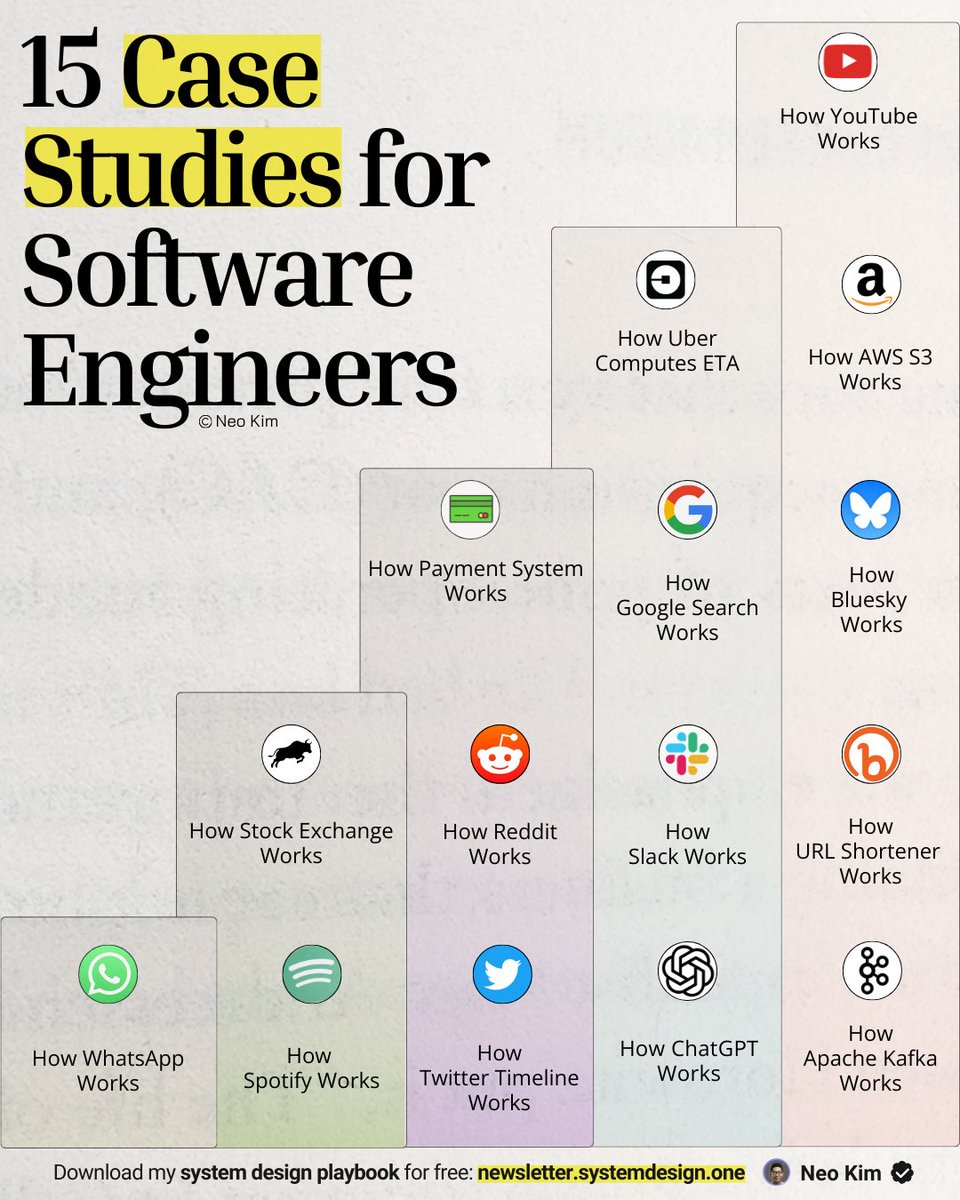
If you want to become good at system design, learn these 15 case studies (save this now):
1 How ChatGPT Works:
↳ https://t.co/TZYZ3iddYH
2 How Google Search Works:
↳ https://t.co/jwOaC4bhnv
3 How Uber Computes ETA:
↳ https://t.co/hw1hYJqQmj
4 How Amazon S3 Works:
↳ https://t.co/iReWAEHwmj
5 How YouTube Works:
↳ https://t.co/kHk3g6jz6t
6 How Kafka Works:
↳ https://t.co/8rOy9KgCMo
7 How WhatsApp Works:
↳ https://t.co/VScq8QwHMr
8 How Spotify Works:
↳ https://t.co/BxrH3oHIFS
9 How Slack Works:
↳ https://t.co/eIo29uOQOJ
10 How Reddit Works:
↳ https://t.co/o6Pw2hhj3T
11 How Bluesky Works:
↳ https://t.co/2rLYlRlky0
12 How Twitter Timeline Works:
↳ https://t.co/pF2RYmPaIG
13 How URL Shortener Works:
↳ https://t.co/tGndgdhH0V
14 How Payment System Works:
↳ https://t.co/ARiLxGR43G
15 How Stock Exchange Works:
↳ https://t.co/iFNSX9TM9O
What else should make this list?
——
👋 PS - Want my System Design Playbook for FREE?
Click the link below to join my newsletter right now:
→ https://t.co/ByOFTtOihX
(200K+ software engineers have already signed up.)
———
💾 Save this for later & RT to help other software engineers ace system design.
👤 Follow @systemdesignone + turn on notifications.
full md file if anyone is interested (fixed the typeo in #6)
vvvvvvvvvvvvvvvvvvvvvvvvvvvvv
## Workflow Orchestration
### 1. Plan Node Default
- Enter plan mode for ANY non-trivial task (3+ steps or architectural decisions)
- If something goes sideways, STOP and re-plan immediately - don't keep pushing
- Use plan mode for verification steps, not just building
- Write detailed specs upfront to reduce ambiguity
### 2. Subagent Strategy
- Use subagents liberally to keep main context window clean
- Offload research, exploration, and parallel analysis to subagents
- For complex problems, throw more compute at it via subagents
- One tack per subagent for focused execution
### 3. Self-Improvement Loop
- After ANY correction from the user: update `tasks/lessons.md` with the pattern
- Write rules for yourself that prevent the same mistake
- Ruthlessly iterate on these lessons until mistake rate drops
- Review lessons at session start for relevant project
### 4. Verification Before Done
- Never mark a task complete without proving it works
- Diff behavior between main and your changes when relevant
- Ask yourself: "Would a staff engineer approve this?"
- Run tests, check logs, demonstrate correctness
### 5. Demand Elegance (Balanced)
- For non-trivial changes: pause and ask "is there a more elegant way?"
- If a fix feels hacky: "Knowing everything I know now, implement the elegant solution"
- Skip this for simple, obvious fixes - don't over-engineer
- Challenge your own work before presenting it
### 6. Autonomous Bug Fixing
- When given a bug report: just fix it. Don't ask for hand-holding
- Point at logs, errors, failing tests - then resolve them
- Zero context switching required from the user
- Go fix failing CI tests without being told how
## Task Management
1. **Plan First**: Write plan to `tasks/todo.md` with checkable items
2. **Verify Plan**: Check in before starting implementation
3. **Track Progress**: Mark items complete as you go
4. **Explain Changes**: High-level summary at each step
5. **Document Results**: Add review section to `tasks/todo.md`
6. **Capture Lessons**: Update `tasks/lessons.md` after corrections
## Core Principles
- **Simplicity First**: Make every change as simple as possible. Impact minimal code.
- **No Laziness**: Find root causes. No temporary fixes. Senior developer standards.
- **Minimat Impact**: Changes should only touch what's necessary. Avoid introducing bugs.