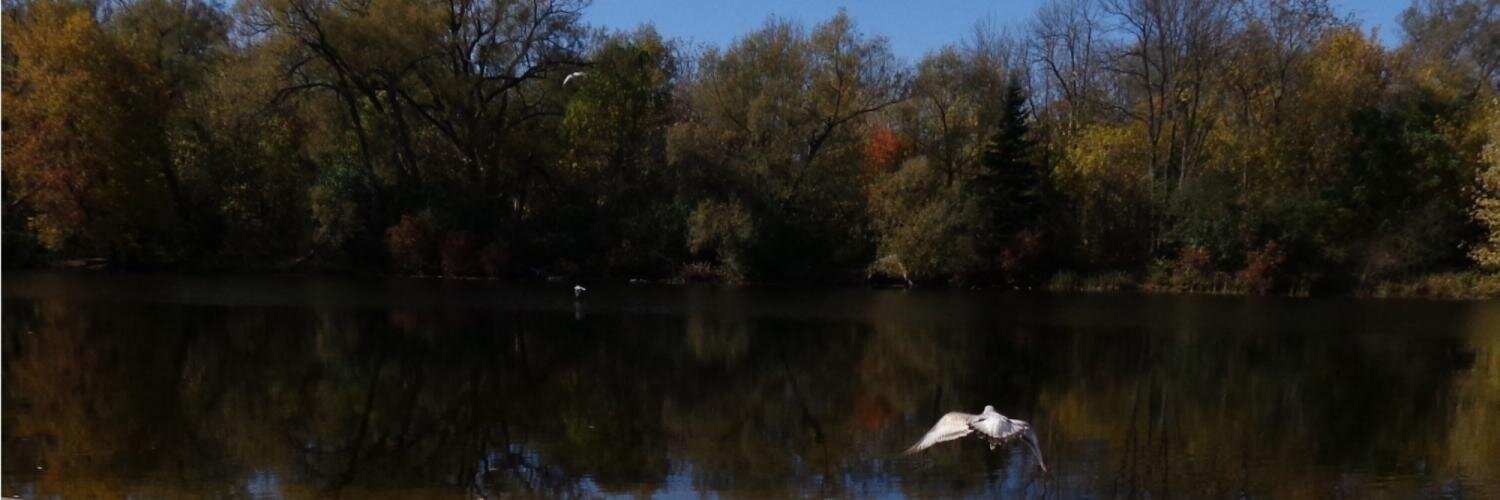
"Frogs" are not people ... that is our attitude about all fellow creatures, they are "fare" game. We do have favorites but usually that does them little good. Cats, dogs, goats, sheep, cows, pigs, chickens, horses, donkeys, camels, squirrels(?), mink, bees, ...
The most used weedkiller on American corn turns male frogs into egg-laying females at a tenth of the dose the law allows in drinking water, Europe banned it in 2004, and the company that makes it put the scientist who found out under surveillance.
Atrazine goes on half the corn in America, seventy million pounds a year, and every spring the rain washes it off the fields into the reservoirs of the corn belt in a pulse the water companies can set their calendar by. In 2002 Tyrone Hayes at Berkeley, who had been hired by the maker to test it, found that at a fraction of the legal limit it castrated male leopard frogs and turned some of them into functioning females with eggs. The company tried to keep the results. He published. The documents that came out in court a decade later were the company's plan for him, by name: discredit him, investigate him, have him followed, and buy the search results for his name so his work came up last.
The frogs were the warning. The water is the point. For most of the growing season the taps of Illinois, Iowa, Indiana, Ohio, Kansas and Nebraska run above the European limit, and the water utilities sued the maker to pay for the filters and settled for a hundred million dollars. The European Union looked at the data and banned it because it could not be kept out of the water. The United States looked at the same data and renewed it, twice.
The corn it protects is fed to pigs, burned in cars, and refined into the syrup in the drink.
A pasture has never needed atrazine, and the cows on it drink from the pond. The corn belt puts a chemical through its own taps every June that changes the sex of the thing in the pond, and the official position is that the frogs are not people.
1/2 This is a masterclass in carnivore pseudo-botany. Saying "plants don't want you to eat fruit" ignores middle-school biology. Fruit flesh is an evolutionary bribe designed for seed dispersal to keep the plant species alive. Plants want us to eat them.
I'm guessing that would be the latte's fault.
Regardless, we evolved from life in the jungle to life on grasslands. Our bodies became adapted so that yes we could outlast animals in pursuit. Sometimes we ran away from the lettuce. But we remained omnivore and scavenger.
Your body was built to chase an animal until it dropped, and the chimpanzee's was built to sit in a fig tree.
You:
- Sweat glands at ten times the chimp's density
- A long, springy Achilles tendon
- A nuchal ligament to steady your head at a run
- A backside built for running
- An arched foot
The chimp:
- A tenth of your sweat glands
- An Achilles tendon barely worth the name
- No nuchal ligament
- Barely a backside
- Flat feet
The animals that share that neck ligament with you include the dog and the horse. The chimp and the pig go without.
The lettuce has never once tried to run away.
Atheists demand evidence for God.
Let's deploy logic.
Nothing produces nothing.
If there was ever truly nothing, there would still be nothing today.
But there is something. You.
Therefore, something eternal had to exist to produce you.
That eternal something is what we call God.
Prove me wrong.
Goats are good vegetarians and they should be an inspiration to us all. We need their services and we should install warning systems to alert them about approaching carnivore absolutists.
From 1935 to 1942 the United States government paid farmers eight dollars an acre to plant a Japanese vine across the South, raised eighty-five million seedlings in its own nurseries to give away, and the vine now covers seven million acres and is eating the state of Georgia at a foot a day.
Kudzu had arrived as a curiosity at the Philadelphia exhibition of 1876, with sweet-smelling purple flowers, and had spent fifty years as a porch ornament. Then the Dust Bowl blew and the Soil Conservation Service needed something that would hold a hillside together faster than anything native. Kudzu grows sixty feet in a season. So the service bred it, shipped it, paid for it to be planted along every cut and gully from Mississippi to the Carolinas, and sent out a radio evangelist from Atlanta called Channing Cope who founded the Kudzu Club of America and called it the miracle vine on air every morning. Farmers were told it would feed the cows and heal the land.
It did the second thing and did not stop. With no winter cold to kill it and none of the insects or diseases that keep it in check in Japan, it climbed the pines and the telegraph poles and the barns and the abandoned Fords, pulling down trees by the weight of its leaves and blacking out everything beneath. In 1953 the same department quietly struck it from its list of recommended cover plants. In 1997 it went on the federal noxious weed list. It is still spreading, by the government's own estimate, faster than it can be cleared.
The one thing that does control it is the thing the farmers were promised it would feed. Goats and cattle eat kudzu to the ground and keep eating it until the root gives up, and the only kudzu ever truly beaten in the South was beaten by a herd.
A department of soil conservation planted the vine that ate the South, and paid cash to do it. The animal it was meant to feed is the only thing that has ever got it off a hillside.
We are here, get over it.
Some people look for answers and ask questions.
Others claim to have answers but with no supporting evidence. They aren't even aware that their prayers are never answered.
Atheism claims to be the worldview of reason.
Yet it cannot account for the very tools it uses:
• Logic that is universal and binding
• Minds capable of discovering truth
• A universe ordered enough to be investigated
Global warming, or climate change, thrust upon us by the UN, and many other countries, including the Canadian government, continues to be scientifically dismissed. Again and again. Please send this to your elected representatives at each level.
A particular lesson was learned but our agricultural policies and methods still work against nature and there are consequences.
The cows always pay a price too.
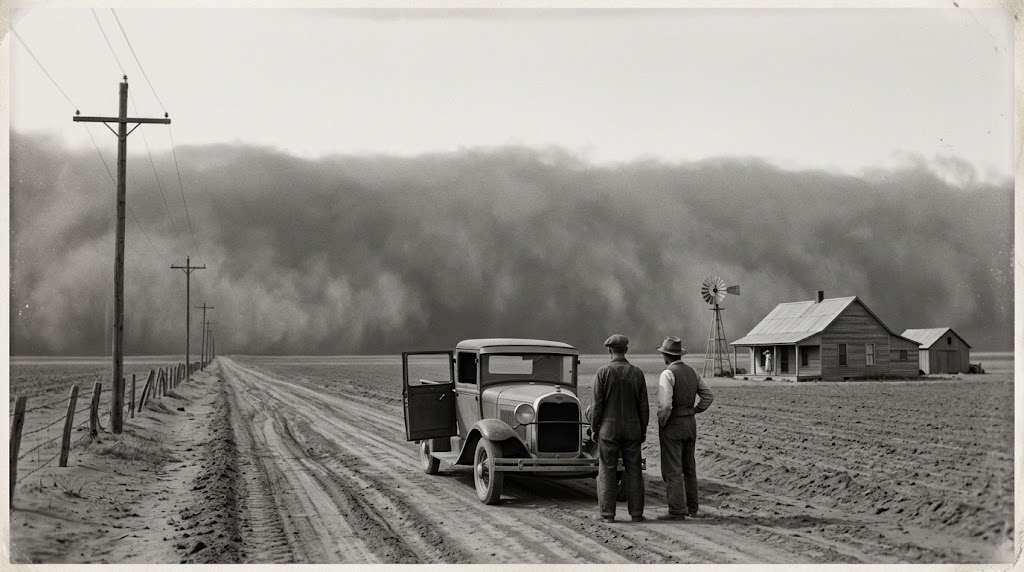
On the fourteenth of April 1935 a wall of dust two thousand feet high and two hundred miles wide came over Boise City, Oklahoma at sixty miles an hour, turned a clear Sunday afternoon into midnight in a minute, and the people in the churches thought the world had ended.
The cause was a decision, and it took ten years. The southern plains had never been farmland. They were buffalo grass, roots five feet down, a net that had held the ground through every drought since the ice, under thirty million bison and then under the Texas cattle. Then the Great War sent wheat to the sky, the government opened the land to anyone who would break it, and the tractor could turn two hundred acres a week. Forty million acres of sod went under between 1920 and 1930. Suitcase farmers came out on the train, cut the roots, took a crop at the top of the market and went home, and nothing was left in the ground but a seed that needed rain.
In 1931 the rain stopped, for most of eight years. A wheat field in a drought is bare dirt, and bare dirt on the plains, in the wind the plains have always had, is a cloud waiting for a reason.
Dust came through the walls of the houses. Families slept with wet sheets over their faces and woke with the shape of their bodies left on the mattress in dirt. Children died of dust pneumonia with the fields packed into their lungs, and the Red Cross handed out gauze masks at the school door. Cattle were found dead with their stomachs full of mud. The static in a storm knocked a man flat when he touched a car, so they dragged chains behind the trucks to earth them. Two and a half million people walked off the plains, and the soil they left came down on the decks of ships off New York.
And the government shot the animals. In 1934, with no grass left on the ploughed country, Washington bought more than eight million cattle at a few dollars a head, shipped the ones that could stand, and had the rest shot in the fields and bulldozed into trenches while the families watched. Those cattle had not blown away an acre in sixty years. They died because the wheat next door had taken the grass they stood on.
Hugh Bennett, the government's soil man, had been telling Congress the plains were being skinned and nobody had listened. On the day of his Senate hearing that April he knew the dust was crossing the country, so he talked slowly until it arrived, and when the windows went dark at midday he told the senators that this was what he had been saying. The Soil Conservation Act was signed within the month, and what it paid for was putting the ground back the way it had been: grass, and cattle on it, and it has held since.
The plough failed in a decade. The pasture had never failed. The cows were shot in between.
Customer: "No veal, thanks. I know what happens to the calves."
Butcher: "So do I. Which bit do you know?"
Customer: "Crates. Taken off the mother, kept in the dark, can't turn round."
Butcher: "Banned here in 1990. This one had straw, a shed, and other calves to annoy for eight months. Rose veal, we call it. Pink, not white."
Customer: "It's still a baby cow."
Butcher: "It's a dairy bull calf. Where do you think they went before people bought veal?"
Customer: "Reared for beef?"
Butcher: "A Holstein bull doesn't make beef worth the feed. For years the answer was a bolt in the head at a day old. Tens of thousands a year, in this country, shot in the pen because nobody would eat them. The industry only promised to stop that a couple of years ago."
Customer: "That's horrific."
Butcher: "That's the price of a latte. Every pint of milk needs a cow in calf every year, and half the calves are boys."
Customer: "So eating the veal..."
Butcher: "Gives him eight months in a shed instead of eight minutes. The customer who won't touch veal and buys a flat white has made a choice. She just didn't get told what it was."
Customer: "I'll take a kilo."
Butcher: "Good. And the next person who tells you veal is cruel, ask them what they take in their coffee."
Cuy is just meat. The rest is cultural conditioning.
In the Andes, guinea pigs (cuy) have been raised as livestock for over 5,000 years—domesticated long before the Inca and long before Europeans arrived. They weren’t pets. They were an efficient, high-protein animal that could thrive at altitude on alfalfa and scraps where larger livestock struggled. Peru still raises tens of millions of them for food and even has a National Cuy Day.
The nutrition is straightforward and excellent:
• ~19–20% protein
• Very low fat (often cited around 1.6%)
• Solid mineral content (iron, zinc, phosphorus)
• Easy to digest, high biological value protein
That’s why it’s still valued for food security in highland communities and why Peruvian health authorities have promoted it for anemia and general nutrition. It’s leaner than a lot of the meat most people eat without a second thought.
How it’s prepared is also straightforward: roasted, grilled, or fried whole (cuy chactado—flattened and crispy). Served with potatoes, corn, onions, and chili sauces. Taste is usually described as similar to rabbit or dark poultry. Nothing exotic once you get past the shape.
The only reason this registers as shocking to most Westerners is that we’ve spent decades turning the same animal into a children’s pet. That cultural overlay doesn’t change the animal’s history, its biology, or its nutritional profile. Plenty of animals are food in one place and companions in another. The distinction is cultural, not nutritional.
If the standard is “nutrient-dense animal protein that humans have successfully raised and eaten for thousands of years,” cuy clears it easily. The discomfort is almost entirely about modern expectations of which animals are allowed to be dinner.
Meat is meat.
I want to believe that all churches are true churches, but the fact is they aren’t.
Jehovahs Witnesses preach a false gospel.
Seventh Day Adventists preach a false gospel.
Mormons preach a false gospel.
And if you preach a false gospel, you are not a true church.
It means absolutely nothing that one person survives by ignoring selective advice. Besides, you could be 12 years old as far as we would know. Or not a person at all. And maybe you are paid to make such claims. File under pointless and misleading.
I am unvaccinated
I drink ½ a gallon of raw milk daily
I eat mostly red meat
I use fluoride-free toothpaste
I never wore a mask
I don’t use sunscreen
I fast 16h a day
I cook with animal fat
Weird how disobedience made me healthier. Almost like the whole system is a fucking scam.
My most controversial nutritional opinions, in no particular order, so the replies can pick a fight efficiently.
- Chicken tastes of nothing because it is nothing.
- Salt is a farming invention and I haven't added it in years.
- You do not need to eat liver. The animal was using it as a filter.
- Vegetables are very healthy, once a cow has eaten them.
- Fruit is bait with a stone in it.
- Fibre is a word for the part you cannot digest, sold as the point.
- Seed oils caused the diabetes. Sugar just turned up to help.
- Carbs are not poison. They are a hobby.
- Grass-fed is a label for the default. Every British cow is standing on the label.
- 30% fat mince was the normal mince. The lean stuff is the deviation.
- Butter lives on the counter. The fridge is for people who ration it.
- Raw milk is the only food on earth designed to be food.
- Olive oil is a seasoning the Mediterranean cooked in lard beside.
- Mutton beats lamb. The lamb was two years short of flavour.
- A bacon cheeseburger without the bun is as healthy as it gets.
- Sunburn is a seed oil problem wearing a sun costume.
- The only animal we cannot do without is the one that eats grass.
Every one of those is checkable, which is the part the replies find hardest.
Cows drink water; rain is the originating source. Wales in this case. Got it. How is that a problem?
Of course waste water may be a problem. But methane and slaughterhouses are the issues. Not all cows are on mountains in Wales. And our cruelty is simply dismissed.
Standing at a gate in Wales watching five cattle steal our water, and not one of them has the decency to look guilty.
They are drinking rain. Out of a trough. It is still drizzling.
I had seen the graphics. The cartoon cow beside the fifteen thousand litres, the bath taps running, the little blue drops stacked up like a crime scene. I thought I understood. Then a bullock lifts his head out of the tank, water running off his chin, looks straight at me, and goes back in for more. It fell on him an hour ago. He is now drinking it. He does not seem to think this is a problem.
A red one has her whole face in. The three behind have lost interest and are pulling at the grass, which is soaked, growing out of ground that is soaked, and they are eating that as well.
Nobody pumped any of it. The water in that trough and the water in that grass came out of a cloud, free, the way it has arrived on this field since before anybody had a word for Wales. About 94% of the famous fifteen thousand litres is exactly what I am watching: rain landing on a field, soaking into grass, and being eaten by a cow who would have let it fall there anyway. What he actually drinks comes to about 1%.
So the biggest item on beef's water bill is weather.
The trough is overflowing. He is dribbling some of it back in.
I have rung nobody. All five remain at large.