🚨My friend spend $20,000 for a Claude course.
A week later, he was still struggling to learn how to Build & Automate Anything.
Meanwhile, a free tutorial covering Claude Masterclass FULL COURSE 4 HOUR (Build & Automate Anything)
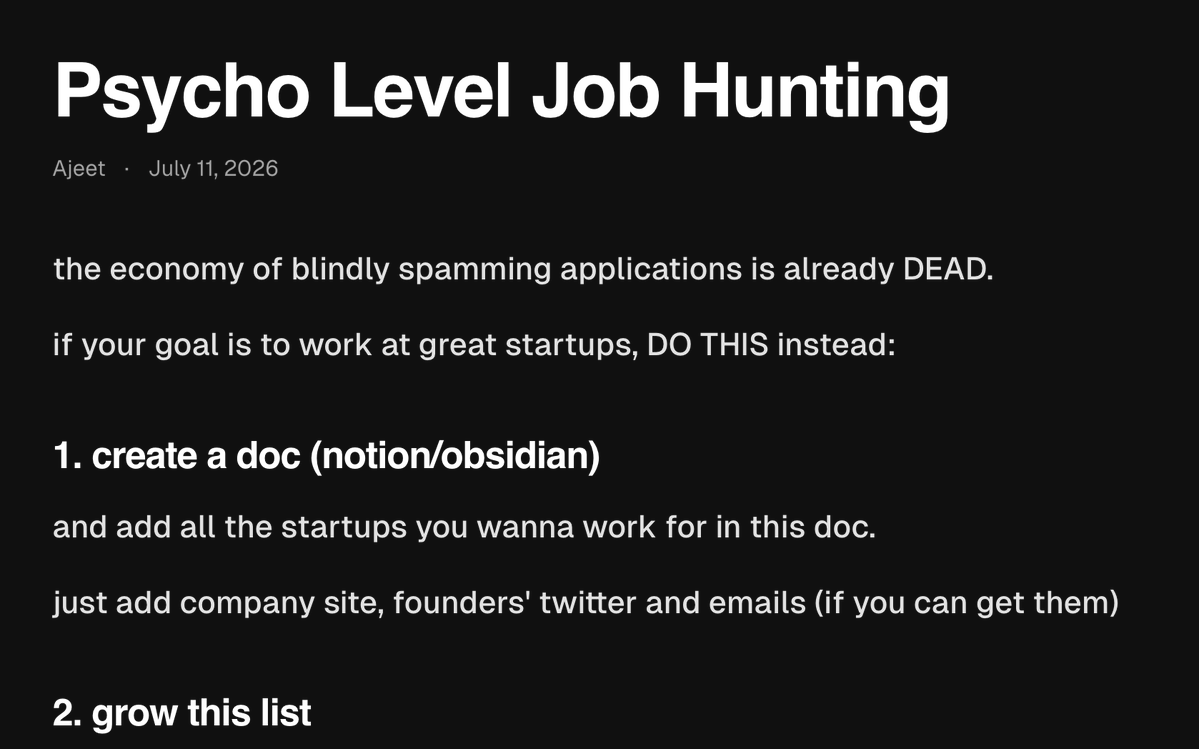
How to actually land a remote job in 30 days.
I've made 320+ hires.
Most candidates apply on job boards and wait.
Here's what actually moves the needle.
Step 1.
Pull companies hiring across these boards
- Wellfound
- Remote OK
- We Work Remotely
- FlexJobs
- Jobgether
- Remotive
- Working Nomads
- Jobspresso
- JustRemote
- Underdog
- Built In
- Remote co
- Skip The Drive
- Virtual Vocations
Step 2.
Verify the posting is genuine before you spend time on it. Check multiple signals.
Same role posted on the company's own careers page
Same role posted on LinkedIn
Same role also live on Wellfound
Company page on LinkedIn shows recent hiring activity, not just one stray post
Job description matches across platforms, not copy pasted from 6 months ago
More signals lining up, more real the role is.
Step 3.
Find the email of the CTO, engineering manager, or founder using Apollo.
Step 4.
Email 2 people directly. Keep it short, mention the specific role, attach your resume.
Step 5.
Follow up once after 4-5 days. Low key, just a bump, not a chase.
Step 6.
Do this for 10 companies a day, every day, for 30 days.
That's 300 companies you've reached out to directly. Not 300 applications sitting in some ATS queue.
I've seen people land offers doing exactly this while everyone else was still refreshing job boards and waiting for a response.
Happy to answer questions if you're stuck on any of this. Happy Job Hunting :)
Recently got a lot of DMs asking how I got a remote job. So here's what worked for me.
→ Pick one niche and go deep. Something you actually like, that you can talk about without running out of things to say.
→ Be consistent. Do what you're doing everyday, even if it's just for an hour. It builds muscle memory.
→ A few places to find these companies: YC jobs, Wellfound, Remote OK, We Work Remotely. Look for the ones that recently raised funding, they're hiring fast.
→ Find the founder or their employees. Get their contact, X, or email, and message them directly.
→ Keep it simple. Who you are, what you do, one line on why this company. Know about the company first, don't message blindly.
→ If you only want remote, say it upfront in the first message. Don't let it come up later.
→ Send proof of work, not just a resume. Make a Notion doc, write a bit about yourself, and drop the links to your best projects. Add a 2-3 minute Loom video walking through them, it shows the actual effort. If you have open source work, add that too.
→ Don't wait to feel qualified. Just start. But have a few good projects ready before you do.
→ Even if someone rejects you, keep the connection. Say thank you, end it well. I actually got referred to another company by a founder who rejected me.
→ Post your work on X. Doesn't matter how much reach you get, it still increases visibility. I was getting clients even without much reach.
→ It's a numbers game. Do cold DMs every day, make it a habit, not something you try when you're desperate.
→ Keep the consistency and the hard work. You don't know when the opportunity will come.
I conducted many ML interviews as a lead MLE in a remote startup and attended some calls as a candidate.
If you want to become an ML Engineer, follow these resources by @chipro.
Overall interview prep:
https://t.co/nivUSR1ZTY
You must read the two books by the same author for fundamentals in classic ML and Gen AI.
From my experience:
- Prepare ML system design in depth
- Arrays, strings, two pointers, sliding window, basics of trees and linked lists
- Explain project lifecycle and trade-offs
- Research the company's ML team and product
For mid-senior level:
- MLOps intermediate questions
- Distributed systems for ML
- User-centric scenarios for ML system behavior
You have to explain what you know and how you can solve problems in ML interviews. Clarity matters more than textbook answers.
My friend makes $1.2 million a year as an Anthropic engineer.
I asked him how he learned prompting so well.
He sent me a video that was never supposed to get out. Their core team's prompting playbook.
You won’t find anything better about prompting than this video.
I watched it last night.
Halfway through, I realized I've been using Claude completely wrong for two years.
Watch it, then read the article below.
Real Roadmap to first AI Intern
- Learn python
- Learn Langchain
- Build Rag based and automation Projects (2-3 Good projects with demo or live url)
That's it. You dont need to know what is harness,loop engineering and all that bullshit you see on X
Just do this, Send 20-30 cold dms daily and you are good for your first intern paying anywhere around 35-50k in-office blr or 15-30k remote
Everything I Used to Prepare for Coding, System Design, and Machine Coding Interviews
Someone on reddit posted all the coding strategies and resources he used to get interview at Google
1. Coding Patterns & Strategy
Before jumping into problems, understand the patterns:
All LeetCode Articles on Coding Patterns Summarized (https://t.co/NXa4N9wQf3)
Solved All Two Pointers Problems in 100 Days (https://t.co/qgcrNoBIHG)
Tree Question Pattern 2023 — Tree Study Guide (https://t.co/w0oMd97Kv5)
Important and Useful Links from All Over LeetCode (https://t.co/3DUhT6AjkW)
Coding Interview Preparation Problems for Beginners (https://t.co/zSacSvb2Kn)
2. Company-Specific Prep
Google, Meta, Apple, Amazon Senior SDE Preparation (https://t.co/bpa1OLESZs)
A Study Guide for Passing the Google Interview (https://t.co/gdWNR4e3zh)
I was solving problems randomly but had no way to track progress by company. So I built a small tool where you can filter problems by company, mark status (todo/solved/revision), and it auto-schedules what to review next. Also added an AI coach that gives hints (not full solutions) — helps me stay honest when I'm stuck. Have added company-wise questions (https://t.co/KpV9SzxHpo)
3. System Design (HLD)
The general LeetCode docs are great for breadth, but what actually moved the needle for me was working through structured, progressive sheets instead of random docs. The Design Round has curated HLD sheets that go from crash-prep to full coverage — start narrow, expand when ready:
Arch 25 — crash sheet of the highest-frequency systems and reusable patterns to cover first
Arch 50 — Arch 25 plus deeper infra, data, reliability, and advanced product systems for SDE2/Senior prep
Arch 75 — Arch 50 plus high-signal variants, niche domains, and company-style specialization
Arch All — the complete 103-question HLD bank for full coverage and long-term mastery
Core Concepts — 33 distributed-systems deep dives to build the underlying intuition
4. Machine Coding (LLD)
The machine coding / LLD round caught me off guard the first time — it's a different muscle from DSA, and most prep ignores it. The Design Round has LLD sheets and design-pattern references that map directly to what gets asked:
MaCo 30 — the core 30 machine-coding problems, highest ROI for interviews
MaCo 60 — MaCo 30 plus extended coverage across all categories
MaCo All — the complete list of all 103 machine-coding problems
Design Patterns — 31 OOP & structural patterns you'll lean on during the round
Most tech content is noise. But one YouTube channel is quietly archiving the deepest engineering knowledge on the internet.
I’ve been watching Ryan Peterman’s (@ryanlpeterman) podcasts over the last few months, and the signal-to-noise ratio is absolutely insane. He is sitting down with:
▪️ Turing Award winners (like Leslie Lamport & Mike Stonebraker)
▪️ Bjarne Stroustrup (Creator of C++)
▪️ Elite Big Tech ICs & VPs of Engineering
This isn't just about writing code.
They dive deep into the reality of high-level tech careers : foundational architecture, system design from first principles, and complex trade-offs like Paxos vs. Raft.
If you are serious about computer science, bookmark his channel.
It's the masterclass you won't get in a classroom.
the engineer who built Claude Code just dropped a 28-minute video on how to write prompts that actually work
I've seen $300 courses that don't cover what he shows in the first 10 minutes
CLAUDE.md files, memory shortcuts, parallel sessions, prompting patterns
all in one video and completely free
works whether you're a developer, a beginner, or someone who's been using Claude for months
based on this, I put together 18 things you can copy and use in Claude today
full guide in the article below
in 15 minutes, 2 Senior Staff Engineers at Airbnb gave a Live Lecture on Agentic Coding
Airbnb already shipped one of the most ambitious LLM-agent migrations in production.
Tonight two of their senior engineers shows how they actually build with agents in 2026.
Most builders are guessing. These guys ship.
bookmark & watch this.then read the complete article below.
There are lots of backend resources out there.
But I don't want you getting stuck in tutorial hell doing nothing.
If you are just starting out:
> watch the Backend From First Principles playlist by @sriniously
Then, if you choose Node.js / Bun:
> watch the backend playlist by @Hiteshdotcom
I have personally learned from multiple resources, but these two are undisputed champions.
Backend From First Principles gives you a complete overview of how systems actually work.
It starts with the most important question:
"Why does backend even exist?"
And then slowly takes you through the entire journey.
After completing it, you will understand how backend systems think.
Then comes the second part:
actually building something with those concepts.
That’s where Hitesh sir’s playlist shines.
He teaches from the absolute basics.
I still remember there was nearly an hour-long video focused only on schema design.
Not just:
"make tables and move on"
But:
"how should you think before designing a schema?"
And that changes everything.
He has also built complex systems like YouTube step-by-step with code.
So this is my advice:
Focus on building concepts.
Treat these playlists like 1 lecture per day.
Never binge watch.
Give your brain time to absorb things by experimenting, building, breaking stuff, and ChatGPT-ing your doubts.
Best of luck.
Software engineering in 2026 explained in 60 seconds…
I broke into big tech by doing everything in this roadmap and more for 223 days (all while documenting it).
Since then I got the return offer at Amazon, then turned it down to build my own VC backed startup. So safe to say it works.
Here’s everything I would if I had to restart so you can copy me.