Tweet about all things organizational #change / organizational development / learning / talent / culture / communications and possibly a #Podcast in the future.
@LinkedInHelp This glitch in your platform is just really frustrating ... especially for those of us with new businesses who are just trying to get the word out. I hope LI can be better one day.
@LinkedInHelp@LinkedIn I am trying to reach and hear back from support, but am getting crickets. Please help. I'm having trouble boosting my articles + would like to know why and how to fix it. You're leaving money on the table...
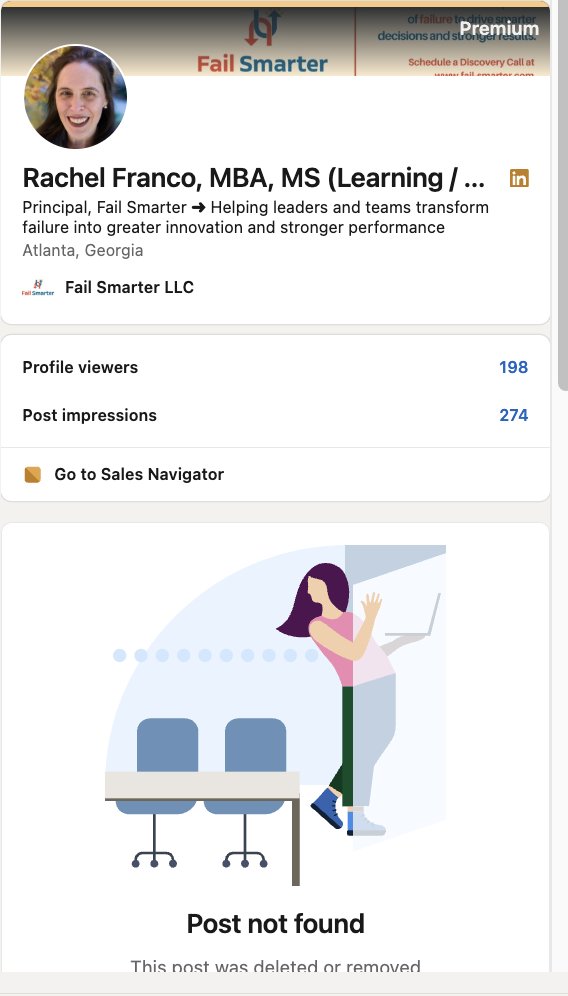
@LinkedInHelp I know how to boost the article; the problem is with LI. When I go to boost the article, I see this in the preview ad. No one will click on it if they just see my profile + a post not found message. Help? I have $ to spend, but can't until this is fixed.
Want to know the easiest way to keep people calm during a #change initiative? It's so simple, yet often neglected and ignored until it's too late. Ready?
#Communicate. Honestly + frequently. As a planner of the change, you've lived w/ it a while - other stakeholders haven't.
Those who can't think or see outside of the box will always get 'inside the box' results. In fact, it's the quickest way to kill #innovation. Because one can only see one way of doing something. Ditch the box.
When Bob Iger stepped down as CEO of Disney, he thought he was done, but #COVID19 had other plans. As he stepped back in to save Disney, how could he best communicate his vision and plan to employees feeling angst and dampened spirits? Here's my take: https://t.co/Yy9kzKAQIr
When developing your #communications strategy + messaging for #change or other initiatives, be sure to include inspirational + tactical messages. The tactical messages give people the "how", but the inspirational messages give them the "why". And the "why" drives them to act.
Are you a manager or above who has personally caused a professional failure that's impacted your company, your function, your team or even a project you worked on?
Come on, you know you want to talk about it ... how about with me?
Learn more here: https://t.co/k3IHZNf8eS
I agree with Brian Grazer ... eye contact is so important, either one on one with someone or as part of a group, in building connections with others.
And if you're speaking to a group of colleagues (or friends), make sure you're m…https://t.co/Azlxfqtd0i https://t.co/dlBk0aRyT9
Resist the urge to pigeonhole people into one area or the other. People have multiple talents and are capable of learning new things. Give them the credit they deserve.
Happy Friday, everyone. In case you missed it, here's my latest post offering three critical lessons tennis teaches us about life and work...
If you're involved in the hiring process in any way, play in the diversity & inclusion s…https://t.co/cZ6WDLqbaq https://t.co/685lgkG9SF
Remember, more often than not, people rest in fear rather than in possibility. So, when leading a #change effort, you've got to show people that the possibilities outnumber and are greater than their fears.
Change may be hard for many people, but don’t assume #change is hard for all people. Give people more credit for being able to adapt to new situations and environments.
So, speaking of #change, recruiters/hiring managers must modernize their mindset for the #FutureOfWork. If you're still asking candidates who've freelanced or worked from home whether they can work in an office or work for someone else again, you're asking outdated questions.
The biggest obstacle one faces is the closed mind of someone else.
So, if you’re that “someone else”, work on keeping an open mind. Check your biases at the door. Question your assumptions.
You owe that to others, but mostly you owe that to yourself.
There is a little worse than a person who says they will help and then doesn’t follow through. When you give your word, keep your word. Each time you don’t, you chip away at your reputation until you have the kind of reputation where people don’t want to help you in return.