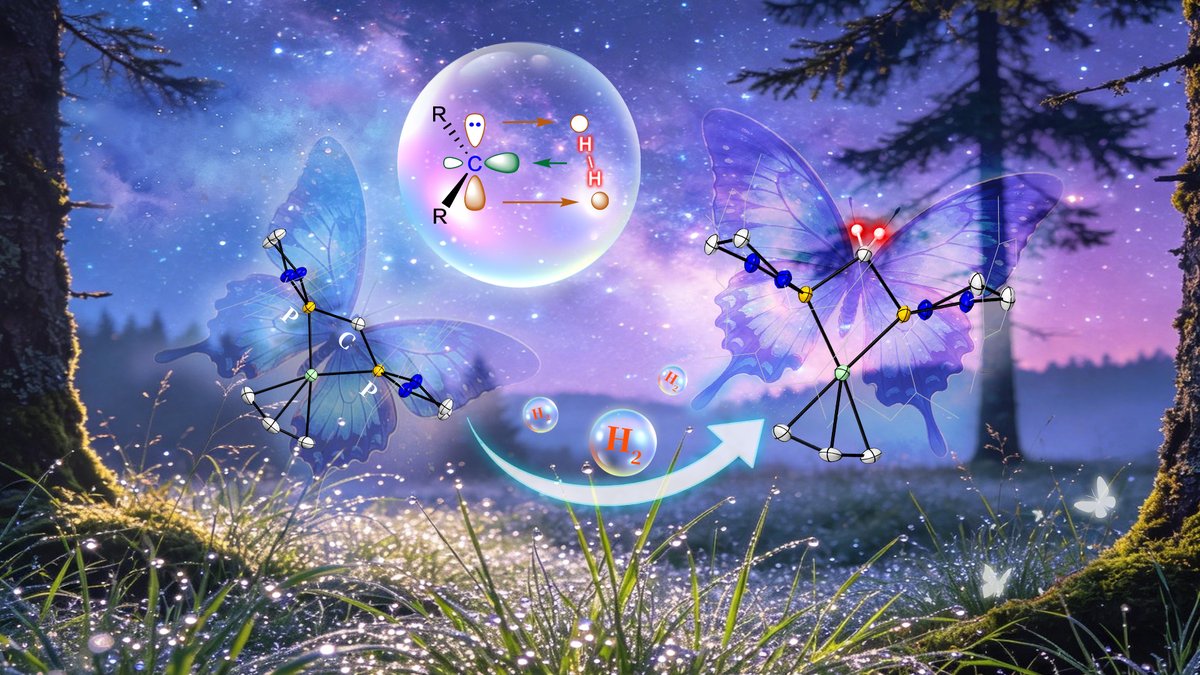
We've successfully stabilized σ0π2 carbene for the first time. Grateful for the @SUSTechSZ updates. Big thanks to Prof. Liu @LLL_lab_SUSTech for the strong support, and appreciation to Xinfeng, Jiancheng and Xiaoyong for the assistance. #carbene
https://t.co/C13QohalKW
Excited to share our new work published in @angew_chem!
We report the first isolable donor–acceptor-stabilized Si–E–Si trimetallylenes (E = Ge, Sn, Pb), exhibiting NIR absorption and enabling access to Ge(I) and Sn(I) radical anions.
https://t.co/NiDREDiBjl
Many thanks to Matthias (@DriessLab) and all co-authors. @AvHStiftung@TUBerlin
#InorganicChemistry #MainGroupChemistry #Silylene
Hot off the press @NatureChemistry: we extend σ⁰π² carbenes to a neutral system, showing H₂ activation via a σ-face pathway near the least-motion limit. Congrats Fei, Haoxiang, Miaomiao & thanks to editors and reviewers! https://t.co/h5zAWXvnNU
Aluminum: lightest p-block metal with very low electronegativity. Converting Al(III) to Al(I) in stoichiometric reactions is rare. But now, we've made Al redox catalysis a reality! Check it out @nature
https://t.co/T5SP88l7dg
Second one online @ Acc. Chem. Res. in 2025. We summarize our journey with carbyne anion and related low-valent carbon chemistry. https://t.co/VxdW4OZn4Q
Walther Nernst
👶 #onthisday 1864 in Briesen, West Prussia, now Poland
⚗️work on Nernst heat theorem
➡️3rd law of thermodynamics
➡️1920 Nobel Prize in Chemistry🔆
🤔How did he and other influential chemists fit into the broader historical context?
🖱️https://t.co/CYYdWezGAH
Thrilled to share our latest publication in @J_A_C_S! Explore the findings from our experimental and theoretical study on a groundbreaking library of persistent (yet reactive) carbenes here:
https://t.co/Z2iThZnuRg
Popular this week: Boost Reactivity of Distibene & Dibismuthene With Light
work by @AlexBismuto University of Bonn, Germany, Antonio Frontera, University of the Balearic Islands, Palma, Spain, and colleagues
published in @angew_chem
https://t.co/YCaPUfz2J8