ethereum:0xfaba6f8e4a5e8ab82f62fe7c39859fa577269be3 is trading at $0.3755 right now, sitting mid-range after a volatile year.
Here's the structure that matters.
Early trading was rough, a sharp spike shortly after listing, followed by a long grinding decline through the back half of last year.
By February, price had based out in the $0.25 to $0.30 range for months.
On May 8, ONDO spiked hard to roughly $0.50 in a single move, with RSI hitting 91.93 that day, deeply overbought.
That kind of spike rarely holds. It didn't. Price faded from there into a $0.30 to $0.45 range that's held since.
Within that range, ONDO dipped toward the $0.30 area in August before climbing back to current levels near $0.3755.
Momentum is mildly constructive, not extreme.
RSI(14) sits at 59.24, above the neutral 50 line, with its moving average at 42.30. Elevated but nowhere near May's overbought reading.
MACD's line is sitting above its signal line, a mild positive tilt.
In plain terms: ONDO is recovering inside an established range, not breaking out of one.
The range's ceiling near $0.45 to $0.50 and its floor near $0.30 are the levels worth watching for an actual break either direction.
Not a signal to act on, just what the chart is showing. I'm not a financial advisor, and this isn't trading advice.
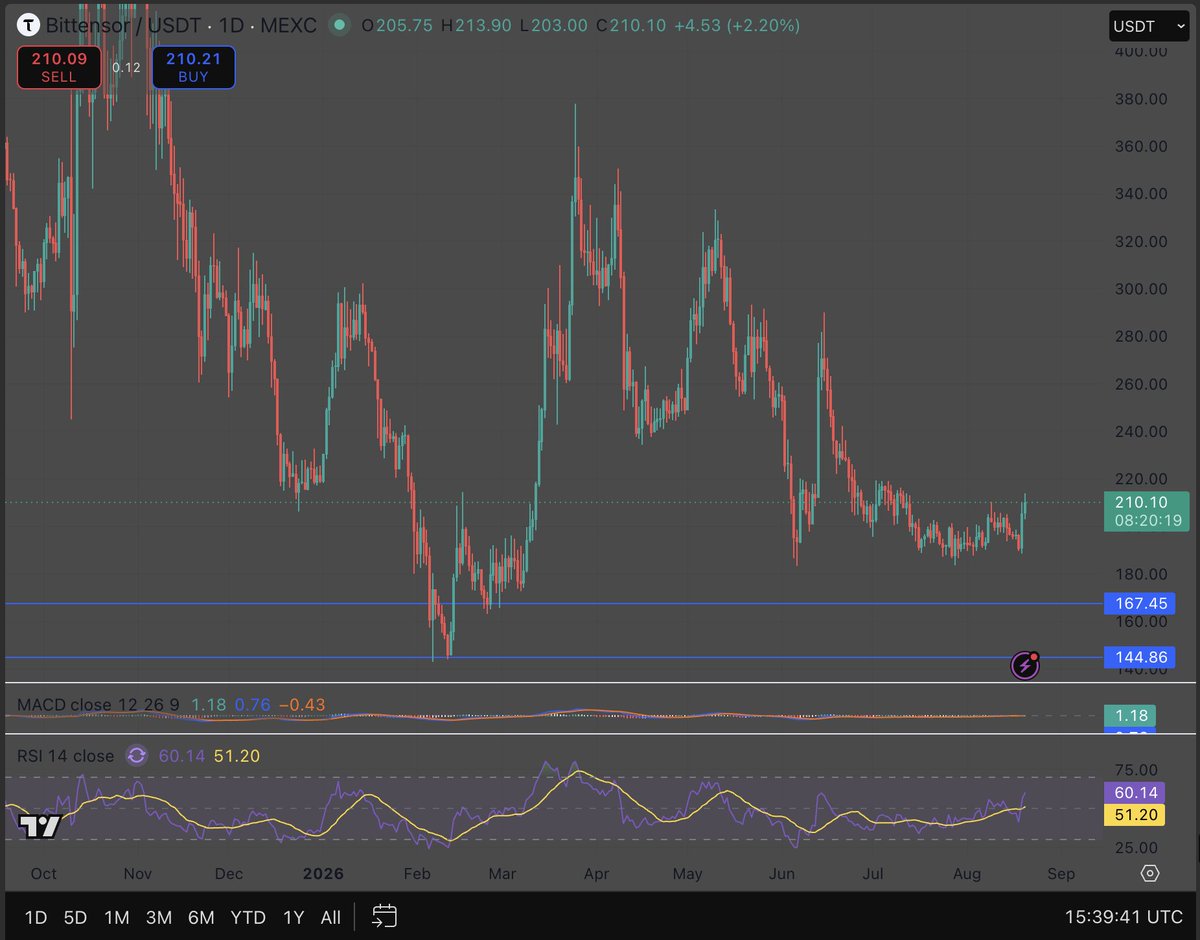
Six months of lower highs, and the chart just did the one thing it has refused to do since November.
It stopped making new lows.
$190 held.
$167 never got tested.
$144 never came into play.
Everyone is staring at the majors while this quietly builds a floor under itself.
The staircase down has one step left to break, and that step sits at $230.
Above $240, the entire pattern the shorts have been leaning on is gone.
Below $190, the range failed, and the patient bears were right to wait.
A base nobody is watching is the only kind that ever pays.
Who else sees this?
The $0.02 token and the $2.50 token both say "Apple" on the label.
Only one of them will ever let you redeem it for an actual share.
Read the framework before you read the price.
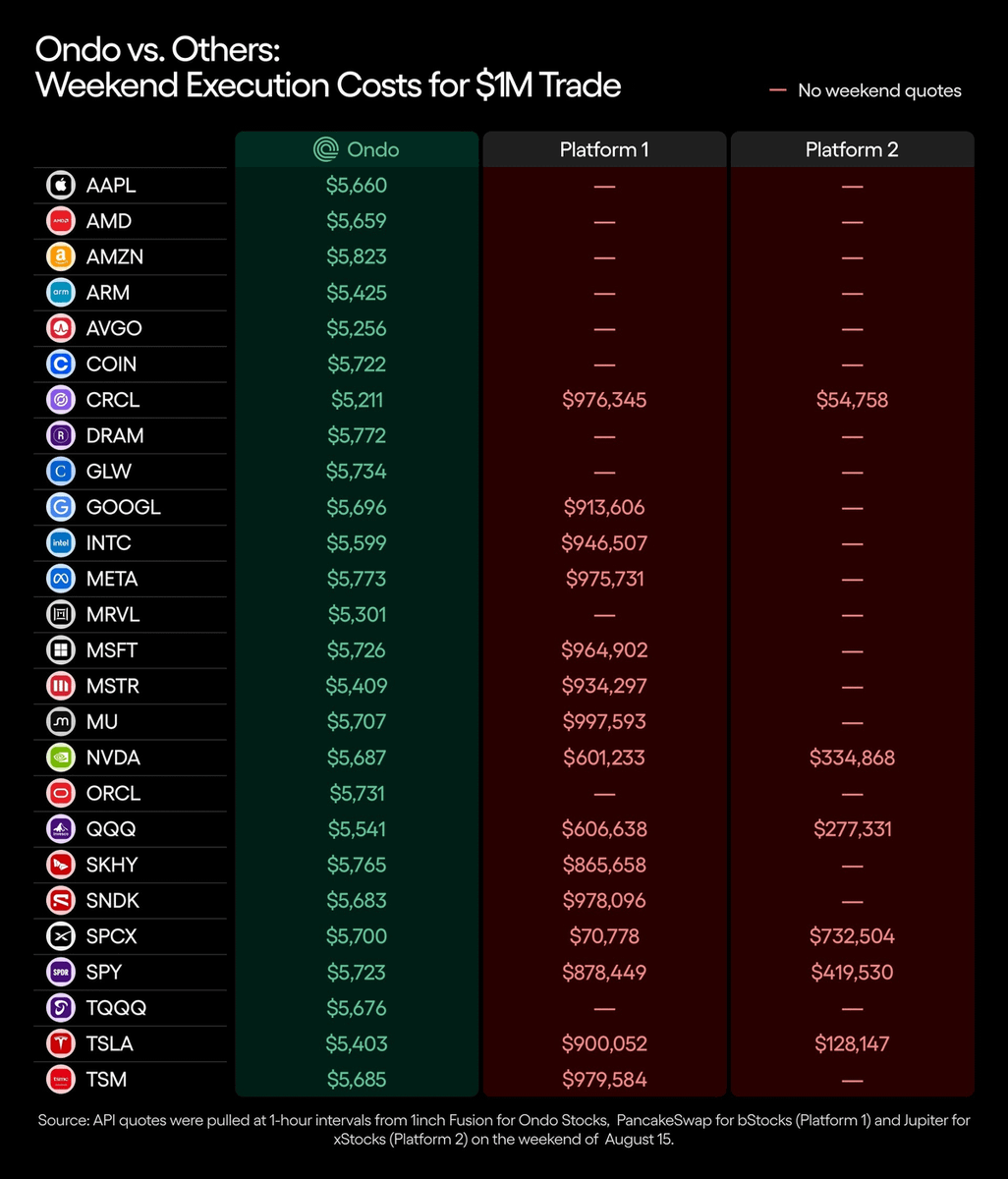
While Wall Street was closed this weekend, someone still paid $997,593 in costs to trade $1 million of Micron stock.
On Ondo, the exact same trade cost $5,707.
That's not a typo.
That's what happens when a market has to fake liquidity it doesn't actually have.
Traditional exchanges shut down on weekends.
So anyone trading tokenised versions of those stocks elsewhere is trading against thin, stale order books.
The spreads blow out because there's no real depth behind the price.
Ondo tested this directly on the same $1M trade:
META: $5,773 on Ondo vs $975,731 elsewhere.
GOOGL: $5,696 vs $913,606.
Same asset. Same moment. Roughly 170x cheaper.
This is the actual test of "24/7 markets."
Not whether a platform is technically open on Saturday.
Whether it can execute size without falling apart when the rest of the world's liquidity goes home.
Real liquidity doesn't clock out.
Most of the market just hasn't been built to prove it yet.
Price tells you who left, it never tells you what got built while they were leaving.
$TAO is emitting less every halving cycle into a subnet layer that keeps shipping.
$RENDER is selling the one thing the AI buildout cannot get enough of.
The chart records the panic.
It does not record the accumulation happening in the same candle.
Fear is loud. Conviction is quiet.
I know which one I would rather be holding at the next print.
SEPTEMBER 15: THE BIGGEST CRYPTO REGULATORY VOTE OF 2026 IS LOCKED IN
The U.S. Senate has scheduled a key procedural vote on the CLARITY Act for Tuesday, September 15 at 2:15 p.m. ET.
This is not final passage. It is cloture on the motion to proceed, the first real floor test that needs 60 votes just to open formal debate.
Quick facts:
House already passed it in July 2025, 294 to 134.
Senate Banking advanced it in May 2026, 15 to 9.
Thune filed the cloture motion in early August.
Key fights left: ethics rules, money laundering provisions, and stablecoin rewards.
Prediction markets price the chance of the full bill becoming law in 2026 at around 20%.
This is the clearest timeline crypto has had all year.
Mark the date.
Imagine every person on Earth getting their thoughts, facts, and worldview filtered through one company's AI.
No way to check it.
No way to audit it.
No alternative.
That's the exact scenario the founders behind Bittensor say keeps them building.
"Everybody in the world will be sipping from the mental biases of a single company that controls artificial intelligence."
Not a hypothetical to them.
The default outcome, if decentralised AI doesn't win.
Here's the thesis in one line:
Bitcoin organises money without a central authority.
Bittensor is trying to do the same thing for intelligence itself.
Transparent. Co-owned. Auditable.
Instead of being controlled by whoever owns the biggest data center.
Here's the part almost nobody knows.
At one point, a single subnet on Bittensor was serving more open source AI tokens than any other provider on Earth.
People were already using it.
They just didn't know Bittensor was underneath it.
Even Jensen Huang, CEO of Nvidia, has publicly namechecked Bittensor.
Not because it competes with Nvidia's chips.
Because he says he believes in access, competition, and freedom.
The bet isn't just that decentralised AI can compete on performance.
It's that the world won't fully notice why it mattered until the alternative is gone.
"If decentralised AI doesn't win, that's when people notice."
Nvidia just landed one of the largest financing deals in AI history. Apollo, BlackRock, Blackstone, Brookfield, Goldman Sachs, and KKR all signed on.
The stock dropped 2.6% that same day. $130 billion gone.
The market didn't treat the biggest funding win in the sector's history like good news. Because it wasn't really about growth.
It was about credit, and credit cycles never stay contained to one sector.
Here's what's actually happening underneath the headlines.
Amazon spent $54.2B on AI infrastructure last quarter and posted negative $8.8B free cash flow.
Alphabet spent $44.9B and posted its first negative free cash flow quarter as a public company, ever.
Capex is now eating 94% of hyperscaler operating cash flow, up from under half two years ago.
So if profits aren't covering the buildout, what is? Debt. Hyperscaler bond issuance went from $16.7B in 2024 to $193B by mid this year.
Morgan Stanley and JPMorgan both project $1.5 trillion more in tech and data center debt needed through 2028.
Oracle is carrying $156B in debt against negative cash flow and just got downgraded to one notch above junk.
Nearly half its remaining obligations trace back to a single customer.
The Bank for International Settlements, the central bank for central banks, just named this exact structure, companies financing their own customers' purchases of their own product, as one of the top three risks to global financial stability. Right next to sovereign debt fragility.
We've seen this movie before. Lucent and Nortel financed their own customers in the late 90s, booked the revenue, then ate the defaults when those customers disappeared.
Lucent went from a $258 billion peak to rubble.
Over 90% of telecom high yield debt from that era defaulted or got restructured.
Here's the part that should actually stop you. You don't need to own a single AI stock for this to be your problem.
The Magnificent 7 are now 34% of the S&P 500, ten points above the dot com peak.
If you hold an index fund, a pension, or a target date fund, you already own this trade at roughly a third of your equity exposure.
Whether you wanted AI exposure or not.
The chips might be the future.
The bet right now is whether the payments get made before the world finds out.
30+ countries have now banned the same app.
Nobody's talking about why that number keeps growing.
South Korea just blocked Polymarket.
On its own, that's a headline.
But it joins France, Germany, Australia, and dozens more.
All landing on the exact same conclusion. Independently.
The reasoning never changes:
Winner takes all payouts. Money staked on outcomes you can't control. A platform that sets the rules and takes a cut.
Regulators keep landing on one word for that.
Gambling.
Doesn't matter what you call it. Doesn't matter how it's built.
Polymarket's usual defence doesn't work anymore either.
No local currency. No local language. Fully decentralised settlement.
All of it, rejected.
Korea's regulator said it outright: the technology doesn't exempt you from the law where your users live.
Here's the part most people miss.
This isn't Polymarket choosing to leave a country.
It's an ISP-level block. Enforced at the network, not the app.
A VPN gets around it. The legal risk doesn't disappear; it just moves to the user.
In Korea, that's fines up to roughly $7,000.
Prediction markets sold themselves as information, not betting.
Regulators stopped buying that story.
And once one country's playbook works, the next one copies it word for word.
This isn't one ban.
It's a method. And it's spreading fast.
Six weeks later, still the cleanest frame on $TAO.
Everyone is still staring at the emission board and the loudest subnet of the week.
The load bearing questions sit almost untouched.
When does real on chain governance land on mainnet? Collectives, not sudo plus a curated Triumvirate.
How hard do we push stake concentration and performance weighted rewards before the incentive geometry quietly flips from pay for quality to pay for capital?
Yuma does not care whether the work is inference, protein folds, compliance artifacts, or forecasts.
It only prices fuzzy quality consensus.
That meta layer is the product. AI is just the first and loudest commodity market written in it.
Root Reborn and the conviction tightening are steps.
They are not the destination.
The accounts treating governance maturity and collusion resistance as second order noise will keep chasing weekly APRs.
The ones who price the foundations will own the expansion when the story moves past decentralised AI into coordination layer for any hard to verify work.
Watch the scoreboard that actually matters.
Everything else is noise.
Jensen just published an FAQ answering “is this circular financing” inside his own launch post.
That is the tell.
When the largest company on earth has to deny circularity before anyone asks, the market is about to ask.
Read what he actually secured:
$600B of NVIDIA compute committed through 2030
4.25 GW at one Ohio site, scaling toward 16 GW
~1.5M GPUs per generation, refreshed across 20 years
NVIDIA now backstops portions of the lease and a residual value on the building itself.
The chipmaker is underwriting its own customer’s demand.
Here is the part nobody is naming.
He calls GPUs “a productive asset, rentable and financeable.” CUDA makes them fungible. Fungibility makes them collateral.
That is not a hardware story.
That is compute becoming a real world asset class, financed instead of bought, underwritten by the vendor selling it.
The AI infrastructure trade and the RWA trade just became the same trade.
Bullish until the residual value clause gets tested. That single line is where the whole structure holds or breaks.
Who read the FAQ before the headline?