Tracking the spread of assets and quantitative strategies. Generating income + gains of real purchasing power. Storage of value. amateur of PPP + diamonds
To help, here is a summary index based on the previous post regarding AI-related stocks.
The index is equally weighted, with no market-cap weighting or rebalancing.
New entrants are added, and the equal-weighting is adjusted accordingly.
The 200-day moving average (MM200) for the index is shown.
Below that, the drawdown chart reveals that this is the third 50% correction since the launch of ChatGPT.
Further down, the spread against the Nasdaq is displayed.
One can observe the massive value creation that took place over the 12-month period from mid-2025 to mid-2026.
By the summer of 2026, key observers began sounding the alarm about the sheer madness of it all—which, in hindsight, marked the actual market peak.
I am not sure if another wave of speculative frenzy will emerge from this point forward. A rebound and an attempt at a rally are all but guaranteed—but a repeat of that same buying frenzy, now that we all know the underlying financials are rotten, seems unlikely.
We shall see whether the "narrative machine" is capable of reigniting a spark within human belief systems.
Wouldn't it be better to listen to the CDS (Credit Default Swap) pricing set by the bond market, rather than the human delusions driving expectations for stocks?
This summer, when I analyzed the AI bubble, I suggested exiting all AI-related stocks entirely.
The projected profitability is accounting-wise fallacious, and there simply isn't enough electricity available to support the scale of these expectations—disappointment is therefore guaranteed.
CDS spreads on the debt of these market players have skyrocketed, signaling a high probability of bankruptcy by 2030.
Meanwhile, the stocks themselves have quietly crashed—from "neo-cloud" firms and their ilk to memory chip manufacturers in Korea.
All of this has been masked by the heavy weighting of mega-cap stocks, keeping stock indices at all-time highs.
Is it over?
No.
Debt has been issued, yet there is no money available for repayment.
Aside from the hyperscalers, no free cash flow (net of capital expenditures) is being generated—only more debt, already baked into the plan.
The gamblers keep saying we just need to wait for tomorrow. We’re told to believe... just keep believing...
Over time, I’ve become a true non-believer.
For a year now, MAG 7 has been spending, or will spend, $2 trillion with around twenty providers.
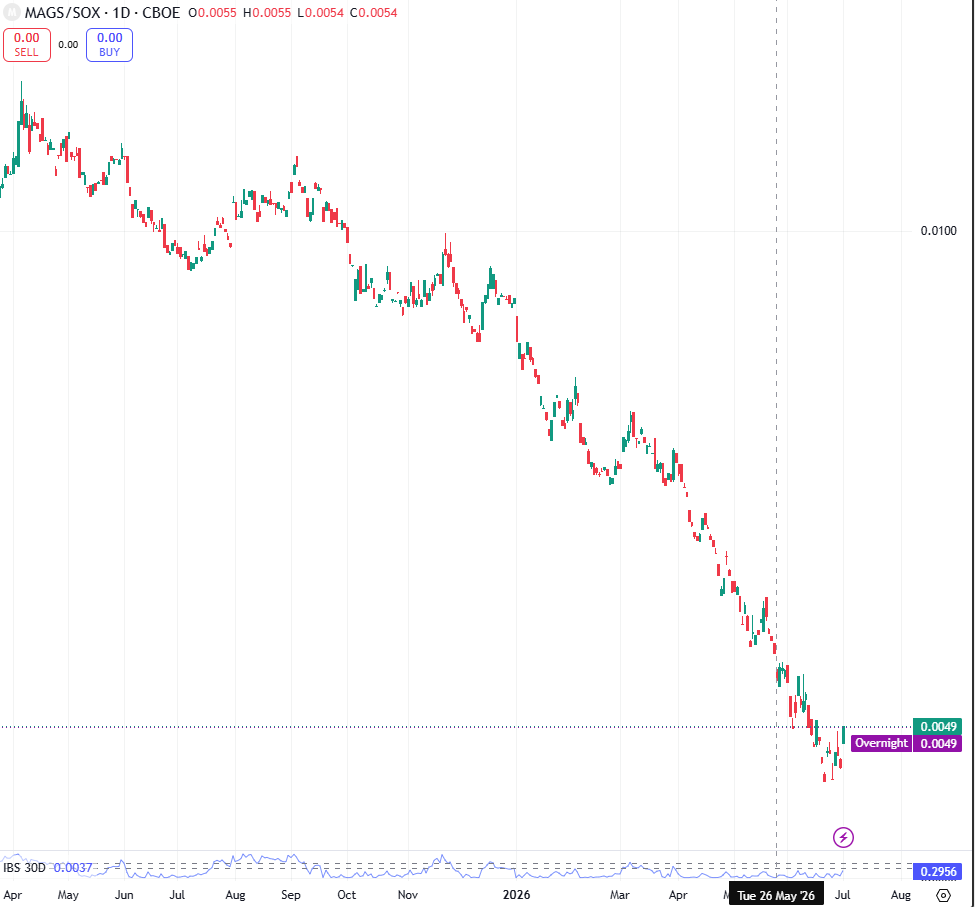
MAGS ETF vs. SOX
The turning point of the AI bubble will be visible in this spread.
It will be MAG 7 shareholders and their cronies at ORACLE and company who will say enough is enough to burning through 100% of their free cash flow plus off-balance-sheet debt in dubious SPVs.
The SOX will take a spectacular tumble, and MAG 7 will rebound, reversing the spread (see attached image).
All of this is unlikely as long as the ChatGPT and Claude IPOs haven't materialized.
And right now, the prospect of SPC X being added to the Nasdaq in a few sessions guarantees around $15 billion in automatic purchases and rebalancing with the ETFs.
It will be the same with the other two.
And then the great money-counting machine will start up again... and it will tell us that MAG 7 members are taking too many risks, blah blah Blah, cancellation of investment projects, blah blah blah, the same old song about the end of the bubble.
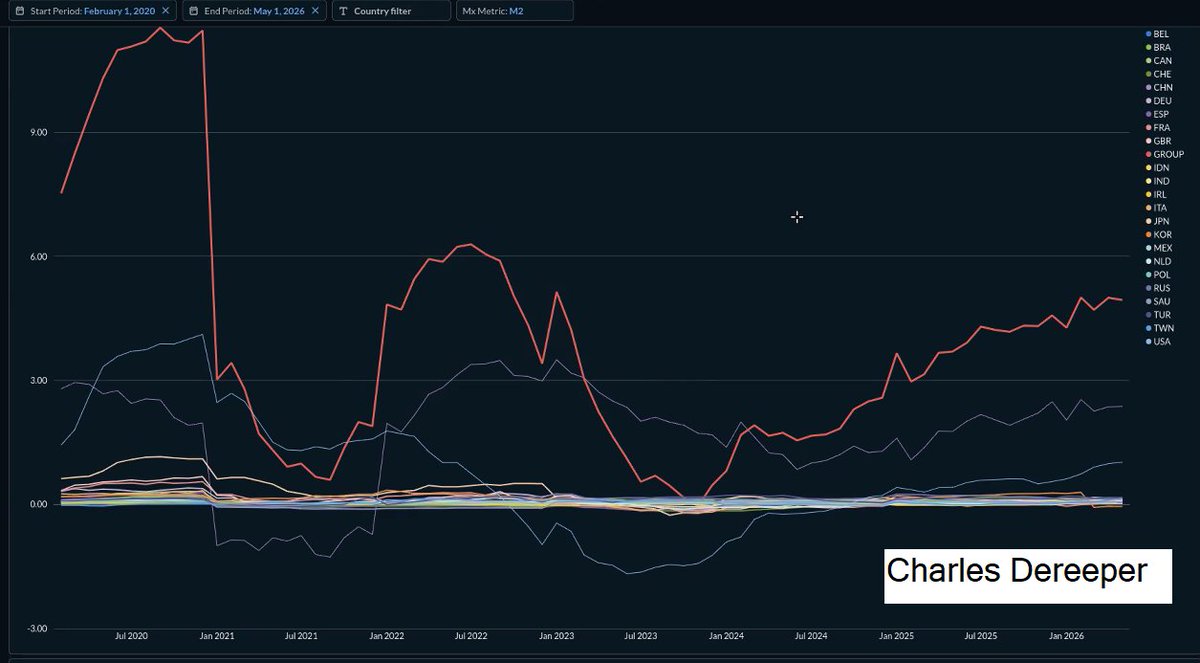
Excess liquidity is at +$5 trillion over one year
Two countries have been messing up global finances since COVID
China in the lead
Its M2 represents 250% of GDP. A complete mismatch. No serious investor will ever trust this type of monetary management.
The USA is behind China
Excess liquidity is calculated by subtracting GDP and inflation over one year from M2 to determine the excess money injected into the economy.
The red curve on my graph takes into account the G25, representing 85% of the global economy.
Exchange rate fluctuations are neutralized through local GDP in local currency, not dollar GDP.
An excess liquidity of $5 trillion represents such a high surcharge that it guarantees global inflation of 3% or more.
China is struggling with deflation and dreaming of inflation.
The USA is struggling with debt and dreaming of inflation.
There are only 3 countries that offer a decent 10-year bond yield.
I modeled, as part of an Investors University project, the minimum 10-year yield needed to cover inflationary episodes in the United States, using 150 years of historical data.
And I looked at spreads and their impact on exchange rates, because there's no point in earning interest if the exchange rate subsequently devalues and negates the gain.
Conclusion for those living off investments?
Brazil
Russia
Mexico
Forget the rest. Investing in passive income guarantees a loss of purchasing power.
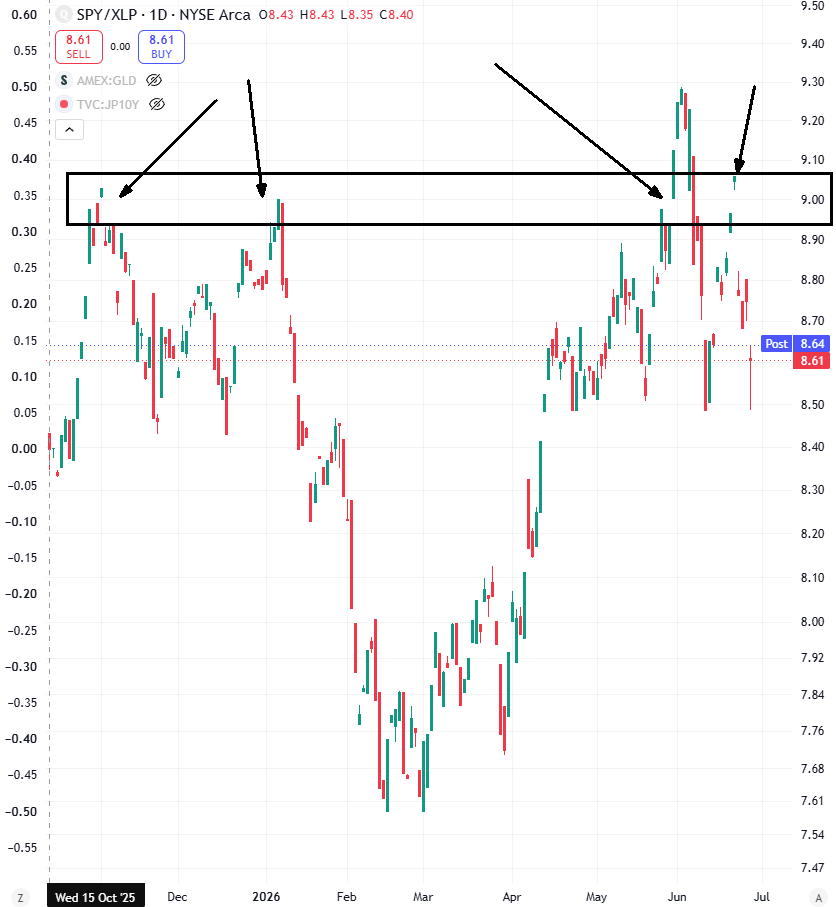
For the past nine months, I've been accumulating Staples whenever it hits a significant dip relative to the S&P 500.
In the attached image, I've drawn my purchase level.
My account is up 3.4% today, while the Nasdaq is down 1.5%.
I don't share the overly optimistic outlook for gold, silver, or oil as a way to diversify my tech portfolio.
Buying on tech corrections by diversifying with Staples dips allows me to see gains every week, without having to worry about what Machiavellian China will come up with next or the mood swings of Trump, who hates war but has waged it more often than any other president before him.
In short: I sleep well at night thanks to the techno staples duo that blends harmoniously.
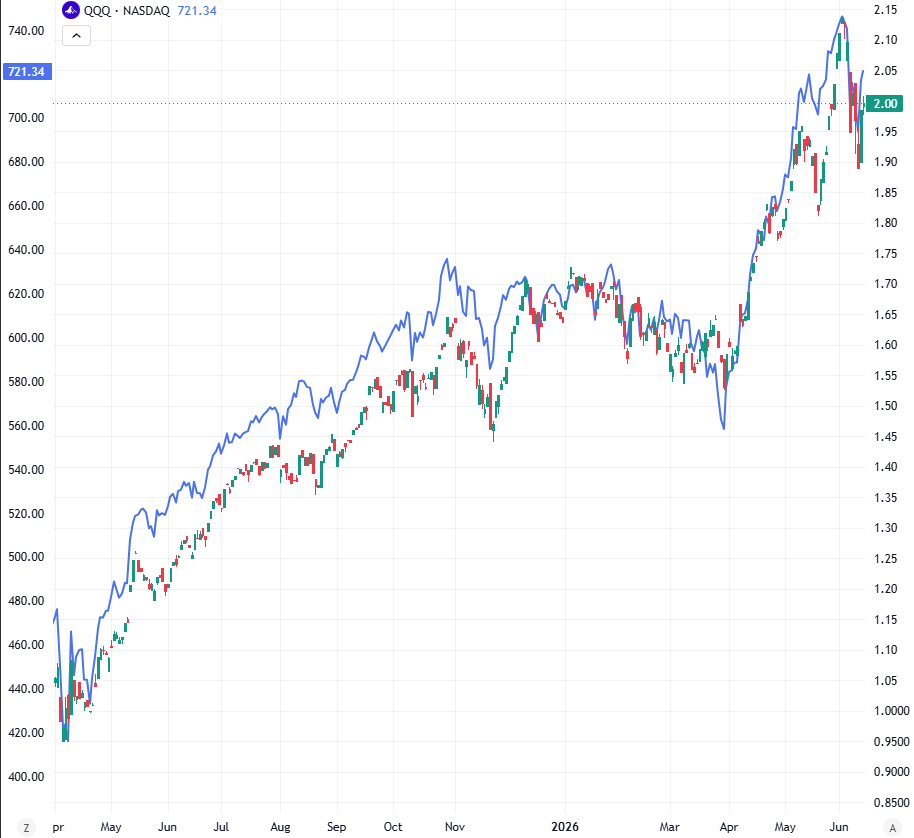
Another perfect trade
april 2025 - june 2026
Nasdaq = +77%
Long HIGH BETA / Short LOW VOLATILITY = +126%
Same timing, same waves, 0 leverage used
The riskiest stocks hit turbo bull trend
The safest stocks hit all time lows
Investors aren't interested in the accounting profits under Trump. The beautiful promises of a bright future have become the new main investment strategy.
I find this very suspicious in light of the known history of the last 150 years.