“The Captive Mind” is as relevant today, and maybe more so, than it was when first published in 1953. It’s deeply insightful, revealing the psychology driving intellectual conformity—how intelligent, educated people gradually subordinate independent judgment to prevailing orthodoxy in education/academia, media, Hollywood, corporate groupthink and culture more broadly. If you agree with the elite consensus, you’re not part of the “Resistance.” Conformity, moral self image and social reinforcement don’t jibe with independent thought.
Czesław Miłosz – How Brilliant People Surrender to a Lie.
The most precise book ever written about how intelligent people surrender to a lie was written by a man who had served one himself – and then stopped.
Czesław Miłosz. Poet. Nobel Prize, 1980. After the war he served communist Poland as a diplomat in Washington and Paris. In 1951 he defected. Two years later he published The Captive Mind.
1. His question was not why ordinary people submitted. Fear explains that. His question was why the brilliant ones did – the writers, the professors, the poets. Often before anyone forced them. Often with enthusiasm.
2. The first answer was a pill. Miłosz took the image from a Polish novel written before the war. An army from the East is about to conquer Europe, and people start taking a little pill. It makes them stop resisting. The fear goes away because the judgment goes away: they no longer see the conquerors as conquerors, and when the army arrives, they welcome it. Miłosz watched his friends take the same pill – the communist doctrine. It explained everything, so they no longer had to look. It promised that history was on its side, so surrender felt like wisdom. It filled the emptiness modern man felt when the old faith died – with a lie. That is what the pill does: it lets you live inside the lie without feeling it.
3. The second answer was the double life. Miłosz called it Ketman, after an old Persian practice: keep your true beliefs hidden, show only obedience. Outside, you say what is required. Inside, you think what you like. Done long enough, it stops feeling like lying. It becomes a way of life – even a private pride: I play their game, but I know better. The professional who serves the regime so he can keep working. The patriot who collaborates "to save what can be saved." The skeptic who believes nothing and recites everything. Everybody knew. Everybody performed. That is how a lie survives with almost no believers.
4. He drew four portraits of writer friends – the moralist, the disappointed lover, the slave of history, the troubadour – and showed each of them surrendering for a different reason. The lesson is uncomfortable: there is no single type of collaborator. The system has a door for every temperament.
5. The West didn’t want to hear it. Miłosz saw that people who had never lived through war, occupation and terror could not imagine how quickly their own convictions might collapse. In Paris, the intellectuals treated him as the problem, not the regime. Pablo Neruda attacked him as a deserter.
6. Then came 1980. The Nobel Prize. And the same year, in Gdańsk, the workers of Solidarity carved his verses into the monument to their fallen comrades. The nation he had left put his words in stone.
7. The pill is still on sale. Only now it is swallowed for status rather than out of fear – and nobody needs a secret police, at least officially. Ketman is everywhere: the employee nodding through the diversity training, the academic signing the letter he doesn’t believe, the journalist who knows and doesn’t write. Read Miłosz today and you will recognize your office.
He showed that a mind is not captured by force. It is captured by fear, ambition and the hunger to belong. And it is freed the same way it was captured: one person at a time – the moment he stops pretending.
By squeezing the Strait of Hormuz, both the U.S. and Iran expected to outlast their foe, making time work in their favor. Now, it looks like the trend is moving against Tehran. “The Iranian blockade is more leaky than the U.S. blockade" https://t.co/3yuHgGmgBv via @WSJ
Thank you to @JoeSquawk and the @CNBC Squawk Box team for having me on this morning.
Nobody consumes crude oil - refineries do. Everyone else consumes gasoline, diesel and jet fuel. Crude is the noise, but products are the signal.
Crude fell 9% this week on an Iran-Oman "proposed framework" for a transit corridor; diesel is still $174 a barrel against $80 crude.
The framework is a joint statement between Iran and Oman, not a deal with the United States. The IRGC says the Strait stays shut until Washington accepts Tehran's conditions, and the US blockade remains in force. Five ships transited yesterday against 130 a day before the war. This is the third reopening the market has priced since June. The tankers haven't followed yet.
Even if it holds, you can flush the crude out of the region but you cannot get the product out. Nobody is going to guide a full product tanker through what is still a hot conflict zone.
Solving one chokepoint does not solve the problem.
Hormuz is one squeeze among many that are both war-made and weather-made. Ukrainian strikes have taken out Russian refining capacity. The Black Sea grain corridor is shut with 97% of Azov–Black Sea export capacity offline, just as USDA cuts the corn crop. The Red Sea and Bab el-Mandeb remain constrained.
The Rhine is at a 146-year low and Panama is cutting drafts. Every other commodity is dirt plus diesel, so what happens in Hormuz shows up in the price of grain.
These bottlenecks do not exist independently of one another. Years of underinvestment in refining and logistics left no spare capacity to absorb any of it. That is why gasoline, diesel and jet are far tighter than the crude price suggests.
You can increase the availability of crude, but if the system cannot refine and move it into the products people actually consume, the economic pressure remains. The story around crude is immaterial when you consider what is happening at both the affordability and CPI levels.
Watch the full interview below.
https://t.co/Flsj7qCwV0
Incredilby interesting: From missile detection to battlefield surveillance, U.S. space capabilities are reshaping modern warfare. https://t.co/7AHzu0Md8W via @WSJ
Listen, Christopher Nolan.
I stand with Homer’s Odyssey, not with a modern version created to make Odysseus easier for us to forgive. You say you did not mean to Christianize the story. But when the Trojan Horse becomes a source of guilt, the journey home becomes penance, and a warrior hungry for glory becomes ashamed of who he is, I have to wonder: are we still watching Homer’s hero, or a modern man sent to therapy in ancient armour?
Yes, Xenia matters. But so do kleos, timē, metis and nostos: glory, honour, cunning and the unbearable desire to return home.
Homer’s Odysseus is proud, violent, brilliant, selfish, loyal, wounded and deeply human. He is not asking the audience to approve of him. He is trying to reclaim his wife, his son, his home and the name the world almost took from him.
I do not need Odysseus to be more likeable. I need him to be recognizable.
Perhaps great stories are not supposed to make us comfortable. Perhaps they survive because they force us to face people whose values are not our own.
You borrowed Homer’s seas, his gods and his hero, but gave Odysseus the conscience of another age.
And I couldn’t help but wonder: when we rewrite the past until it finally agrees with us, are we bringing Homer to life or simply putting him on trial?
It really bothers me that people that should know a lot better, continue to parrot this nonsensical idea that shutting in OPEC fields will cause real, structural reservoir damage.
Anyone with a single shred of curiosity can easily dispel these myths -- why, because there have literally been full-field shut-in tests conducted before that show there's no irreparable reservoir damage... lmao. The strongest evidence is in SPE 115976, where Kuwait shut-in their Burgan field for a month and observed bottom hole pressure.
There wasn't some sky is falling moment. They observed measurable increase in reservoir pressure across nearly all wells which confirms simple pressure rebuild rather than any degradation upon shut in. They said that even large-scale shut-ins ultimately led to predictable pressure recovery and preserved reservoir deliverability, NOT long-term damage.
There is some very minor truth to the statement that it will take some time to restore production after we get the "all clear" for Hormuz, but in general the risks are grossly overblown across the board, and it has mostly to do with surface constraints, I'll explain, but first about the fields.
With the exception of a few fields the super-giant oil fields in the Middle East are high porosity, and high permeability clean carbonates and sands [Wara/Burgan is a sand]. This is important because they generally don't have high clay contents. These fields act more or less like one massive sponge, and producing it is a massive, and carefully orchestrated act of managing the pressure exerted to "squeeze" that sponge.
Unlike shale rock, OPEC fields are very porous *and* permeable. In the US you may be familiar with "drilling locations" -- wells that behave independently of one-another despite being into the same formation, or even in direct proximity -- it's not like that in the Middle East. Fields are treated as one unit, and carefully managed.
To produce these fields, the countries very very methodically inject water, and manage producing wells to ensure steady, manageable drawdown, to maximize oil recovery. Drawdown is the difference between reservoir pressure, and the flowing pressure of the well. Because fluids flow from high to low pressure, the bigger difference between formation and bottom hole pressure, the harder the well flows. Waterfloods are there to maintain reservoir pressure...
Increasing drawdown means pulling harder on the reservoir by lowering wellbore pressure. There are many ways to do this but opening the choke of a well (unrestricting its flow apparatus at the surface) is most common.
What's important, is A SHUT IN IS JUST REDUCING DRAWDOWN TO ZERO. This allowing pressure to equalize back to reservoir conditions without changing the rock itself. Even at very large scale, removing production simply flattens pressure gradients and lets pressure rebuild; when you restart, flow resumes because the underlying reservoir properties were never altered.
BTW, that's what OPEC spare capacity is, more or less. They don't have a shut-in field that they just "turn on" when they need to produce more, instead they increase the drawdown on existing fields.
Now, what can really can cause water floods to shit the bed upon shut ins are;
1. Clays swelling that reduces effective permeability. In most of these fields that's low risk because of very low clay content.
2. Coning that happens when you draw down too hard initially changing the fluid contact. Not a huge risk because these fields are run below their critical coning point [which is KNOWN], and obviously not going to be drawn down too hard it's not monkeys running them.
3. Fines settling when flow stops, and small particles essentially move and block pore throats. This is a small risk but massive pore throats and low fines generally mean it's extremely small.
All this really means that the time to restore production, for the vast majority of crude being produced from large carbonate fields under waterflood, is <2 weeks. Operators can very consciously restart injection and production; and the MAIN risks which are; scaleing build up in tubing, wax/asphaltenes accumulating, and gas/fluid redistribution are both reversible (chem treatments) or completely manageable.
It will take longer to restore production for things like natural gas liquids associated with LNG production, or from fields where there was real surface infrastructure damage, but because there was existing spare capacity to begin with, it's not like you can't return to ~90-95% pre-war production levels when the all clear happens, fairly easily (i.e. within a month or so).
The REAL question, and note, is that you HAVE to have an "all clear" to resume full production. This "resume production" discussion is different from "is it OK to actually restart or is it too volatile in terms of tanker movement". There will definitely be a production recovery ramp, and it's definitely in the range of >150mmbbls, which isn't small, but I've seen some people say there will be production "scarring" that *isn't* related to damaged surface infrastructure; which is just... plainly and factually wrong.
In terms of damaged surface infrastructure, we're at ~300-600kbbls/d right now; once you get to ~50% of spare capacity damaged (>1mmbbls/d), that's when I think you will get real "production scarring", but for right now, I think the risks are WAY overblown. There are other parts of this war's lasting effects that are more important/impactful to focus on -- wide spread reservoir damage is NOT one of those things.
The Arab Word is Watching a Different War:
Three reasons why it has been difficult to understand the Arab position:
The first is the Arab relationship with Iran. From the vantage point of Brussels or London, Iran presents itself as a resistance movement with a grievance against American hegemony and Israeli occupation, and this presentation maps comfortably onto familiar Western anticolonial frameworks.
What it does not map onto is the lived experience of Arab populations in Lebanon, Iraq, Yemen, Bahrain, Syria, and across the Gulf. In those countries, Iran's presence meant Hezbollah holding the Lebanese state hostage to Tehran's decisions, thirty-five armed factions in Iraq drawing salaries from Iranian funds channeled through the Iraqi national treasury, and Houthi commanders answering to the Islamic Revolutionary Guard Corps while firing on Arab civilians from Yemeni soil. Freedom is not the word any serious Arab observer would use for what Iran brought.
Indeed, the Arab world's quarrel with Iran runs far deeper than American bases or Israeli airstrikes. What drives it is the systematic subversion of Arab sovereignty by a foreign power that uses the language of Islamic solidarity as cover for an imperial project conducted through proxies.
The second dimension is the proxy question itself, where Western analysis fails most comprehensively. Iran goes far beyond supporting armed groups. Parallel state structures get built inside Arab countries, financial systems get captured, and political figures get installed who owe their existence and survival entirely to Tehran.
The Iranians who have administered this project understand it as the export of a revolution, but what Arab populations have experienced is closer to a colonial occupation conducted through intermediaries, and as of now, they’re not mourning the Islamic Republic.
When Westerners treat these proxy networks as instruments of legitimate resistance rather than as mechanisms of subjugation, they endorse an imperial project while believing themselves to be opposing one, and as a matter of fact, make themselves the legitimizing force behind Iran’s war against the Arab world.
The third dimension is the most counterintuitive for a Western audience, and it is the one most consequential for how the current war is understood and misunderstood. For Arab nationalists, including secular nationalists and even those with deep reservations about Israeli policy, Iran represents a greater and more immediate threat than Israel does.
This is a position that Western media are structurally ill-equipped to render intelligible, because Western discourse on the Middle East has been organized for decades around the Israeli-Palestinian conflict as the primary axis of regional injustice.
The result is that when Western governments and Western publics take strong positions against Israel’s actions against Iran’s operations, they believe themselves to be standing with the Arab world. In reality, they are advancing a position that the Arab world does not share and has not asked for, while ignoring the threat that Arab governments and Arab populations actually live with.
The rhetorical use of Israel as a perpetual alibi for Iranian aggression has been one of the Islamic Republic’s most durable tools, and Western opinion has served as the unwitting amplifier of that tool across the entire duration of the Islamic Republic’s existence.
https://t.co/32dwric9G6
The Berlin Wall created the most brutal controlled experiment in human history: identical people, split by ideology, watched for 41 years to see which system would prevail.
West Germans embraced market economics while East Germans suffered under socialist central planning. The results? Devastating. By 1989, East German GDP per capita sat at roughly 30% of West Germany's level. East Germans consumed 40% fewer calories, owned cars at one-tenth the rate, and waited 12 years for a telephone connection. Meanwhile, their western cousins enjoyed rising living standards, technological innovation, and personal freedom that made West Germany an economic powerhouse.
But the socialists had excuses ready. "East Germany started from a worse position after the war," they claimed. Bullshit. Both regions faced identical devastation in 1945. The Soviets actually stripped more industrial equipment from their zone (roughly $10 billion worth), yet this affected rural areas less than urban centers. And East Germany possessed abundant natural resources like lignite coal and uranium that should have provided economic advantages.
The real difference? Property rights, price signals, and entrepreneurship versus state ownership, price controls, and bureaucratic allocation. West Germans could start businesses, invest capital, and respond to consumer demands. East Germans filled quotas set by party officials who had never run so much as a lemonade stand. You can't coordinate an economy through committee meetings and five-year plans when prices tell you nothing about real supply and demand.
East Germans voted with their feet—2.7 million fled west before the Communists built their wall in 1961. After reunification, investigators found Stasi files on one-third of the population. When you need secret police watching every third citizen, your economic system has already failed.
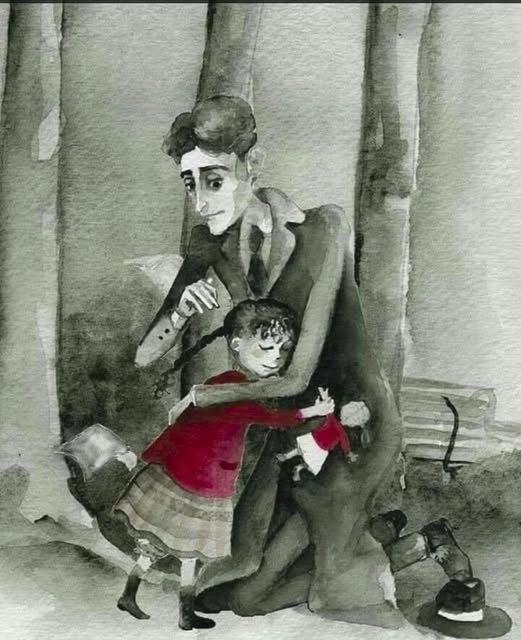
At 40, Franz Kafka (1883-1924), who never married and had no children, walked through the park in Berlin when he met a girl who was crying because she had lost her favourite doll. She and Kafka searched for the doll unsuccessfully. Kafka told her to meet him there the next day and they would come back to look for her.
The next day, when they had not yet found the doll, Kafka gave the girl a letter “written” by the doll saying “please don’t cry. I took a trip to see the world. I will write to you about my adventures.”
Thus began a story which continued until the end of Kafka’s life.
During their meetings, Kafka read the letters of the doll carefully written with adventures and conversations that the girl found adorable.
Finally, Kafka brought back the doll (he bought one) that had returned. “It doesn’t look like my doll at all,“ said the girl.
Kafka handed her another letter in which the doll wrote: "my travels have changed me.” the little girl hugged the new doll and brought her happy home.
A year later Kafka died. Many years later, the now-adult girl found a letter inside the doll. In the tiny letter signed by Kafka it was written:
“Everything you love will probably be lost, but in the end, love will return in another way.”
After more than a decade of uncertainty, this interpretation will provide market participants with a clear understanding of how the SEC treats crypto assets under federal securities laws.
This is what regulatory agencies are supposed to do: draw clear lines in clear terms.
What jumps put for me looking at this report of the Mullah's decamping to Mashad is the US-Israeli intelligence had to know as soon as it started.
I believe that the steaming of the USS Ford through the Suez Canal happened because of this.
Collapse 🧵
1/
My information consumption is now 1/4 X, 1/4 podcast interviews of the smartest practitioners, 1/4 talking to the leading AI models, and 1/4 reading old books. The opportunity cost of anything else is far too high, and rising daily.
"His tone couldn’t have been more friendly, but his instructions to me were not: 'Put on your white coat. Stay in your lane and just treat your patients. Leave health care policy to the professionals'.” https://t.co/nAR96c6HWC via @thenewmexican
.@senatorwirth Your trial lawyer donors have had a great run off the backs of doctors. Time to reform the medical malpractice system to center patient needs and safety, keeping doctors in New Mexico #nmleg#nmpol
.@senatorwirth Stop protecting your trial lawyer donors at the expense of health care access for New Mexicans. Reform the medical malpractice system to center patient needs and safety, keeping doctors in New Mexico! #nmleg#nmpol