Celsius has successfully emerged from bankruptcy on January 31, 2024, concluding the company’s restructuring process. You can read our official announcement here https://t.co/jqQfSzxPyg.
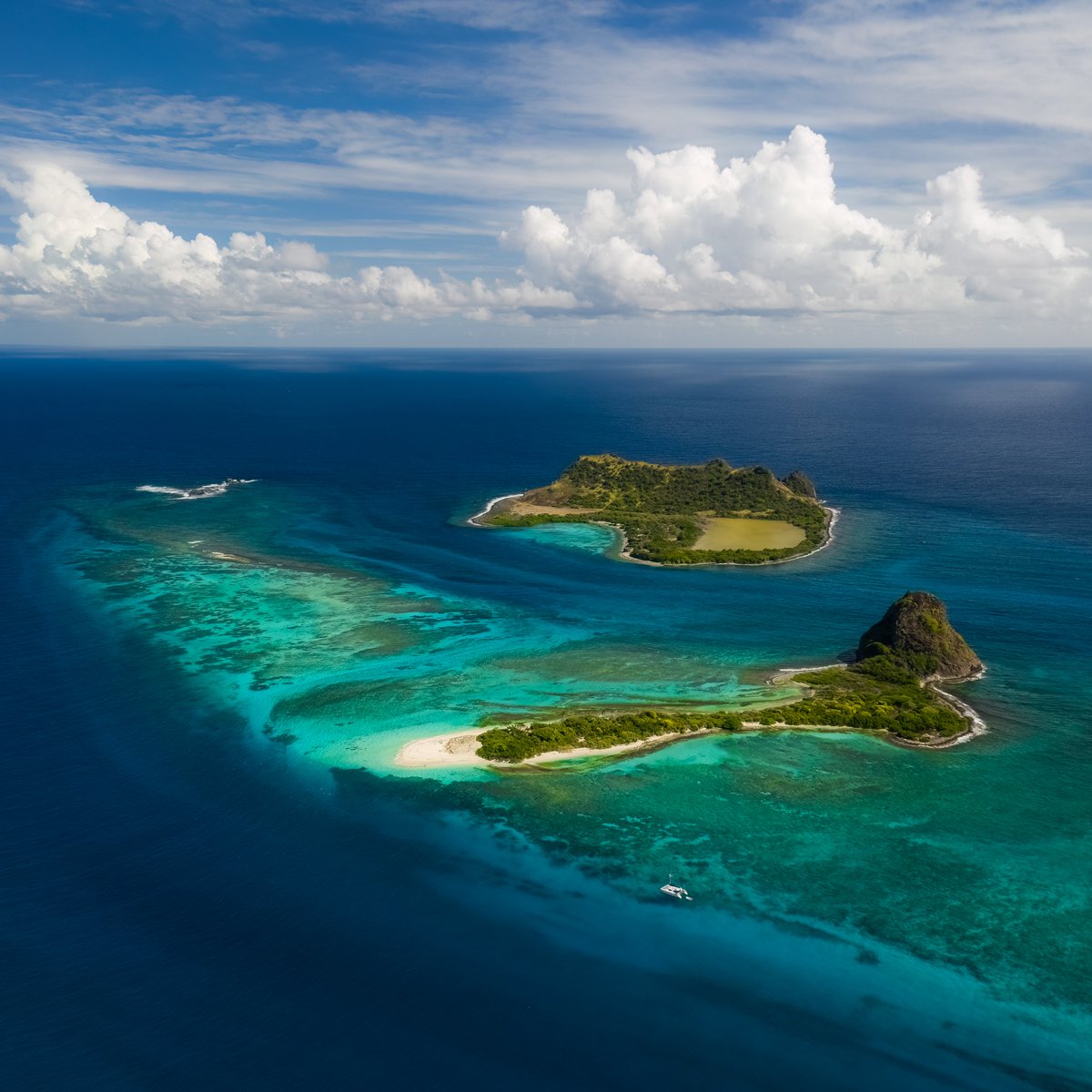
My small family spent two years of our lives essentially stateless, stranded at sea, 18,000km from home, floating on 40ft of fiberglass. 'Freedom to transact' literally became a matter of life or death. This is our story.
Australia locked its citizens out from returning during the pandemic. My family (wife and three kids 3, 5 and 6 months old) were sailing on a catamaran in the eastern Caribbean at the time. We ended up there for two years waiting out the pandemic.
When the pandemic hit, we essentially became stateless. For a time, all countries within sailing distance closed their borders to Australian-flagged vessels. No flights or cruise ships. My son couldn't renew his passport, and we had to get him temporary (refugee) papers.
Initially, we got locked down for 91 days on our boat in an overseas territory of France. The gendarme nautique (water police) prohibited us from leaving the boat. We technically weren't even allowed to swim off the boat at anchor.
Early on, desperate to get the kids some exercise, we took the dinghy to an isolated beach. The gendarme came with guns and megaphones to enforce our isolation. The next day, a mini aircraft carrier arrived, and military control was implemented on the island.
Hurricane season arrived while we were still in lockdown, ramping up the stress. We provisioned to head to sea if a hurricane approached; stateless, the last resort plan was to drift at sea, waiting out the season. I studied the weather manically.
Months passed, hurricanes became imminent, the outlook dire; then Grenada saved us. They let 1,200 stranded boats in, despite their borders being completely shut. A tiny poor country was saving us when my own affluent country was blocking its citizens. This hit home hard.
We sailed 3 days non-stop to Grenada. Too late in the season, we faced terrible weather, experiencing multiple frontal systems, winds of 30-40+ knots, and at one point, three tornadic waterspouts closed in around us while the gooseneck bolt on the boom vibrated loose.
Two more weeks of quarantine, then freedom after 4 months restricted to the boat. NOAA then issued a hurricane warning with a track map directly over us. We scrambled to prepare and tie to the mangroves. Thankfully, it fizzled out and passed just south of us.
As time went by, we became forgotten citizens. 'Freedom to Transact' issues began to arise. We had been living in Canada for the 3 years prior on global expert visas. Canada had also locked us out (it remained open to citizens & PR but not to work visa holders).
Our Canadian bank cards expired, and we needed to physically be in Canada to activate new ones. Subsequently, our online banking account was suspended for suspicious activity. Again, we were required to go into a branch to remedy, which was impossible.
Our Australian bank access also became restricted. After roaming overseas for too long, our Australian phone SIMs expired and we lost access to our 2FA numbers needed for access to our bank accounts there.
To obtain a new SIM, we needed to provide government-approved ID and activate from within Australia. Again, the familiar response was 'come into the bank and we can sort this out'. Loss of freedom of movement essentially led to a loss of freedom to transact.
Fortunately, we had access to family who could help us out, and the bank agreed, after much pleading over the phone, to accept a phone number of a family member for 2FA. But the lesson was clear: without Freedom to Transact, you have very limited options to sustain life.
The Australian government had also placed a Level 4 travel ban on the entire world for its citizens, previously reserved only for war zones. This immediately rendered both our travel and health insurance policies void due to exemption clauses for travel to Level 4 areas.
The Panama Canal then shut to vessels under 80ft. And so began two, often stressful, years at sea, 18,000km from home, reliant on the benevolence of small foreign countries to provide the very shelter that our own country refused to render.
In this crazy chapter of our lives, we faced numerous challenges, yet savoured incredible family experiences. Chiseled by the stress, we entered a heightened state of existence, ultimately transforming it into the most extraordinary time of our lives.
Navigating through immense technical and geopolitical intricacies, we journeyed using little more than wind across 15 countries & territories during the pandemic. With the absence of cruise ships/flights, the Caribbean's remote tranquility echoed the serenity of the 1950s.
Sailing into endless sunsets, dolphins playfully surfed our bow's wake, as the stars emerged in the evening sky. We saw numerous volcanic islands materialise on the horizon, and explored untouched jungles and secluded waterfalls.
We spent time with the kids wildlife spotting for monkeys, iguanas, bird colonies. Exploring volcanic landscapes, relaxing in hot springs. Swimming and diving over the reef with turtles and schools of fish. Just enjoying the sea and each other as we watch the kids grow up.
Endless hours at the beach meeting other stranded families from all over the world with vastly different backgrounds but ultimately a shared story. A common experience to bond us together.
We ran our own renewable power systems; solar and wind into a lithium bank. We made our own water via a small desalination unit, caught our own fish. Drank rum punch and watched the green flash from more remote beaches than one could expect to see in tens of lifetimes.
Not all roses obviously. The flip side was the challenges of raising a baby girl and two boys including doing home school in a confined space. Coming up to speed under duress as landlubbers with the realities of sailing, navigation, weather routing, and all boat systems.
Constantly working on the seemingly infinite list of boat maintenance jobs. Endless time spent provisioning and looking for parts. Fitting in the time to work remotely to keep us alive financially. Dragging anchor in midnight squalls, having other boats drag around you.
Enduring sleep deprivation from anchor alarms and a breastfeeding infant, we somehow persevered on multi-day sails without access to additional crew, testing our limits. We then faced extended lockdowns and quarantines everywhere upon arrival.
The mental angst of that initial 91 days of lockdown in the hurricane belt hoping that boarders would open somewhere for Australian flagged vessels before the hurricane season started will be with me for life. Certainly the hardest thing we have done as a family.
The 18 months that followed was a sublimely beautiful yet at times crushingly difficult; in hindsight the most meaningful time in our lives. When we finally made it home to Australia after two years floating on 40ft of fiberglass, it felt like an alternate reality.
People at home stressing about the smallest of issues and arguing over trivial things. The Australia I left, a nation of prolific travellers, was now scared of foreigners in a way I had never thought possible in my life. Something had been lost in the population here.
They had their own lockdown trauma. In a bizarre way being stranded at sea liberated us from it. Forged by circumstance, intermeshed into the physical world around us, our preconceived boundaries of what was possible in life physically and emotionally had been removed.
Yet in other ways it led to a kind of PTSD reintegrating into society. Everyone took for granted simple freedoms like freedom of movement, freedom to always be able to return to your home country, and freedom to transact. We knew first hand how fragile it all was.
I held back releasing ocean work or even this story as I needed time to process the experience. After two years of being back on land I created the Intrepid Ocean series to attempt to work though these thoughts and emotions.
The experience highlighted the fragility of the global norms and governance systems we take for granted. Now after three years back in Australia we are heading back to our boat in the Caribbean to finish what we started. The kids are now 4,8,10. So here we are again on the precipice about to jump off. To find out who we truly are, as individuals, as a family.
Hedy Lamarr was a Hollywood actress in the 1940s and 1950s, and she was considered "the most beautiful woman in the world" during her time. She began her acting career in Austria and became notorious for being the first woman to simulate an orgasm on screen in 1933. It was during this time that she also got married to Friedrich Mandl, a Vienna-based arms dealer with ties to Mussolini and later Hitler.
The marriage did not last long. In her own words, she wrote, "I knew very soon that I could never be an actress while I was his wife... He was the absolute monarch in his marriage... I was like a doll. I was like a thing, some object of art which had to be guarded and imprisoned, having no mind, no life of its own." According to her autobiography, she disguised herself as one of the maids and managed to flee to Paris. Others say she convinced her husband to wear all of her jewelry for a dinner party and then disappeared afterwards.
She eventually booked a liner to New York, where she met the head of MGM, who was impressed enough to offer her a $500-a-week contract to work as an actress. In 1938, she arrived in Hollywood and went on to star in several movies, working with the likes of Clark Gable and James Stewart.
Beyond her acting career, Lamarr was also a scientist and co-patented spread-spectrum technology during World War II to prevent the Nazis from jamming navy torpedoes. However, her invention was rejected and wouldn't be implemented until the Cold War in 1962. The technology would eventually be used in developing Wi-Fi and Bluetooth technology.
JUST IN:
The Bank of Spain has approved crypto exchange Coinbase to begin offering its range of services to retail and institutional investors within the country.
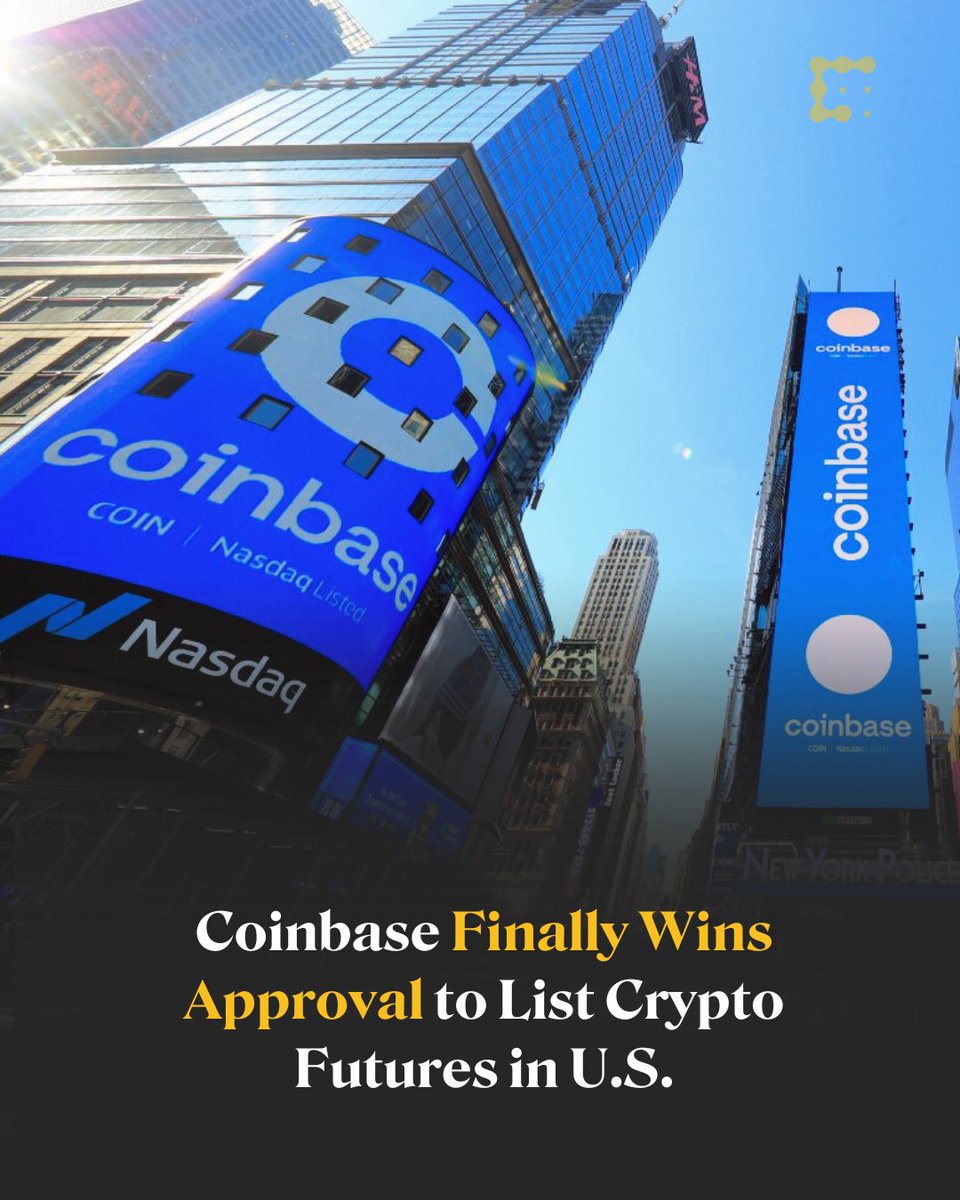
After two years of waiting, @coinbase said it has finally won approval to list crypto futures product in the U.S. By @JamieCrawleyCD.
https://t.co/Uh3vV6rOAQ
Coinbase has achieved a milestone by securing approval from the NFA to operate as a Futures Commission Merchant in the U.S.
@coinbase can now offer futures contracts in $BTC and $ETH to eligible customers.
https://t.co/PWcvDo7Htj
Like I said so many times, I am bullish on $ETH vs. $BTC. 🔥 With ETH Futures ETF, the flippening is not an "if", just a "when". Retweet if you are bullish on #ethereum !!
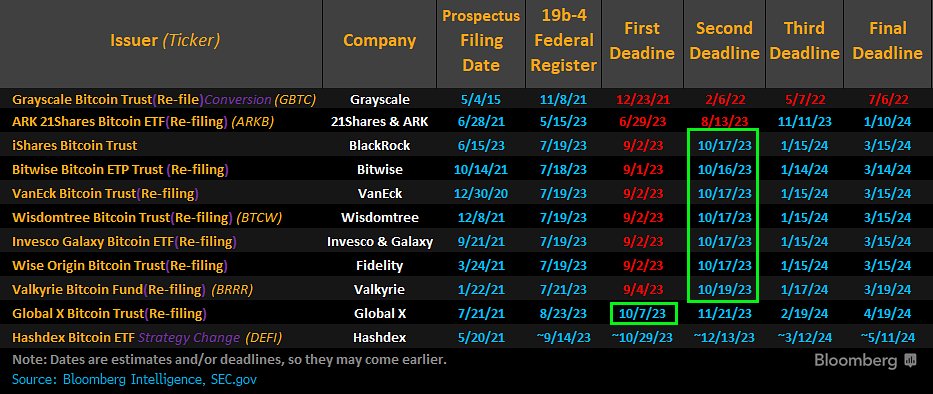
TOM LEE: “If the spot #Bitcoin ETF gets approved, the demand will be greater than the daily supply of #Bitcoin… the clearing price is over $150,000 up to $180,000” 👀🙌
A crypto dump and pump for the memory books. At 4pm EST minor Tesla bitcoin news reignited the sell-off, which ended in a monumental selling cascade. Then came SEC news ironically to the rescue
[DB] SEC SET TO GREENLIGHT ETHER-FUTURES ETFS IN CRYPTO INDUSTRY WIN: BLOOMBERG
Celsius Disclosure Statement Approved by Court
- Plan Focused on Distributing a Meaningful Liquid Cryptocurrency to Customers as well as Equity in NewCo
- Celsius Creditors Encouraged to Vote in Favor of Chapter 11 Plan by September 22, 2023
Read more👉https://t.co/4bF8IkhxYC
Major moment for crypto regulatory clarity in the U.S.
This has been a multi-year process toward approval, and we're excited to finally be launching federally regulated crypto derivatives with margin to our U.S. customers.
When there is a clear path to register, we do.



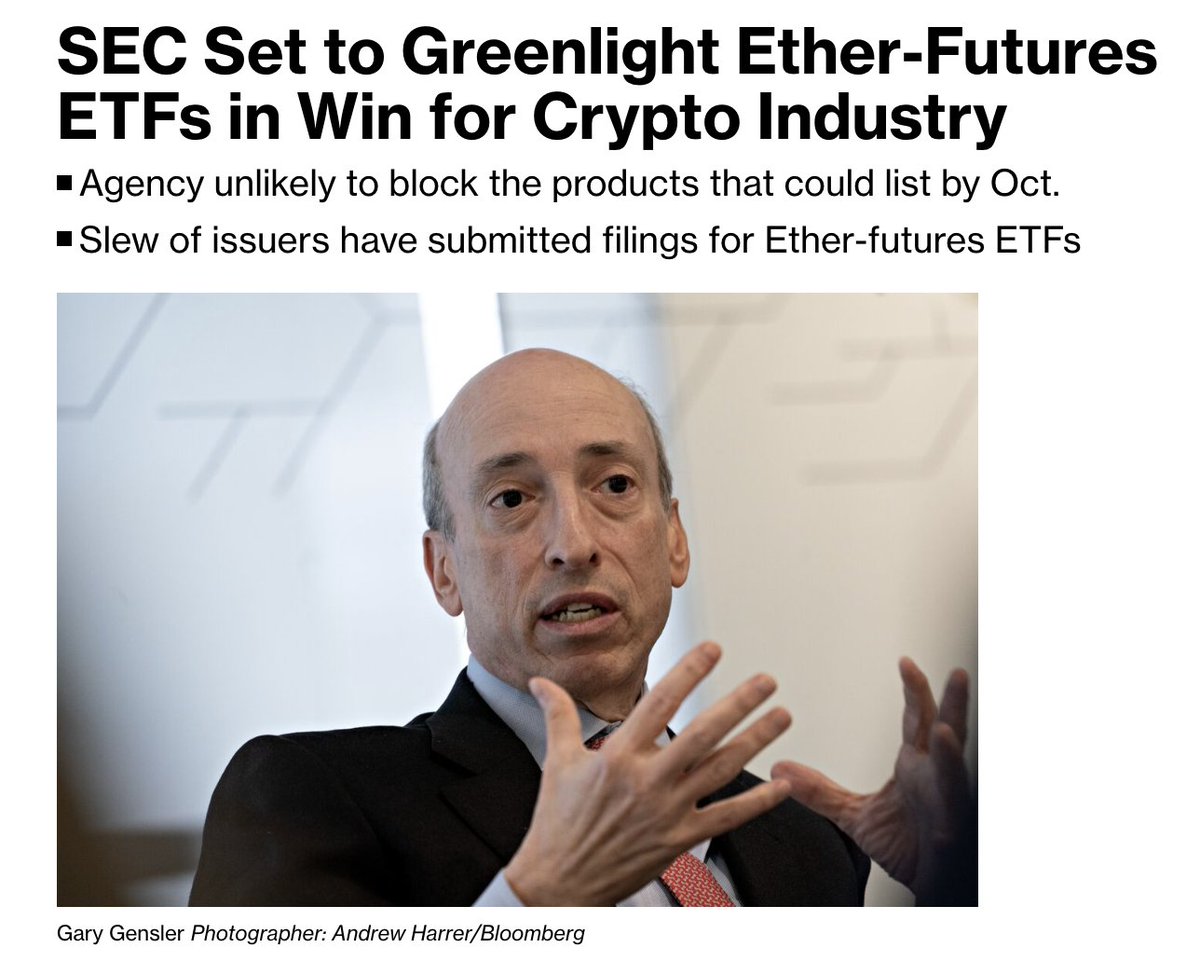
![krugermacro's tweet photo. A crypto dump and pump for the memory books. At 4pm EST minor Tesla bitcoin news reignited the sell-off, which ended in a monumental selling cascade. Then came SEC news ironically to the rescue
[DB] SEC SET TO GREENLIGHT ETHER-FUTURES ETFS IN CRYPTO INDUSTRY WIN: BLOOMBERG https://t.co/Xf7I1ooD86](https://pbs.twimg.com/media/F3xOCOGawAQqEbL.jpg)