I remember that time you told me
You said, "Love is touching souls"
Surely you touched mine
'Cause part of you pours out of me
In these lines from time to time. Joni Mitchell- A Case of You
So… people say maybe I’m not right… But I never got a certificate or anything for it… not even a testimonial! Anyway… not so much worried about that lately though. Plus it’s like basically the same thing…
7. Build something small.
A meal.
A sketch.
A clean drawer.
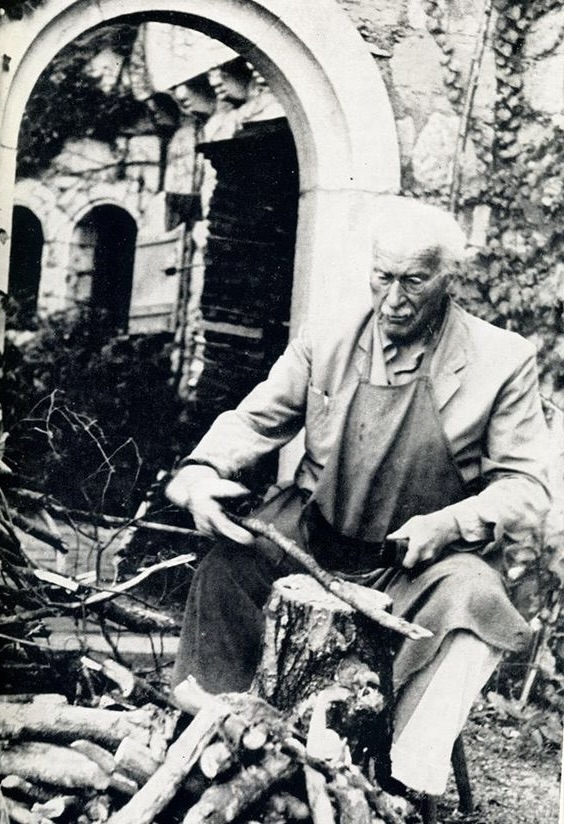
Churchill had bricks.
Jung had stones.
You need your version of bricks and stones.
Something concrete enough that your mind cannot turn it into another negative spiral.
6. Step into sunlight before you check your phone.
Do not let the algorithm become your first atmosphere.
Open a door.
Let your eyes receive the morning light.
Depression wants you in a mental cave.
Light reminds the body there is a world beyond your mood.
5. Do one visible task with your hands.
Wash a cup.
Fold a blanket.
Sweep the floor.
A small finished action gives the psyche proof:
“I influence my world.”
That matters.
4. Doodle what you cannot say.
Depression traps emotions beneath language.
So stop trying to explain what you feel.
Draw the heaviness.
Draw the pressure in your chest.
Draw the thing with no name.
The unconscious moves first through images, next through discovery.
3. Use a rebounder for 3–5 minutes.
You don’t need a workout.
You need a state change.
Gentle bouncing gives the nervous system rhythm, breath, circulation, and vestibular input.
Depression collapses the body inward.
Rhythm tells it:
“I am moving again.”
2. Walk outdoors without devices.
No music.
No podcast.
Just nature and you.
Walking brings back horizon, rhythm, weather, light, and ground.
Your mind opens because your body is no longer frozen in the same room with the same thoughts.
Churchill and Jung understood something modern psychology forgets:
Depression feeds on abstraction.
It weakens when your hands touch something real.
Here are 7 cheat codes to shift your nervous system from depression into momentum:
1. Use your hands to build something.
"Trees are sanctuaries. Whoever knows how to speak to them, whoever knows how to listen to them, can learn the truth.
They do not preach learning and precepts, they preach, undeterred by particulars, the ancient law of life."
- Hermann Hesse
🎨 Julia Tar
So… WiFi was down… but not now… still maybe going to a place where I believe in we… more than me 🤔… idk 🤷♀️
Someone could write a verse about it …if they weren’t stuck in a mood…
@Rexie44 You know, Rexie… sometimes I just follow the red bouncy ball, and I don’t usually even know where it is going… And occasionally I fall down the stairs! It’s okey-dokey though cause it’s a virtual kind and it really doesn’t hurt like IRL does…
Winston Churchill fought his depression with bricks. He'd lay them for hours at his country home in Kent. He joined the bricklayers' union. And in 1921 he wrote about why it worked. It took psychology another 75 years to catch up.
He called his depression the "Black Dog." It followed him for decades. His method for fighting it back was as basic as it sounds: laying brick after brick, hour after hour.
Churchill spelled out his theory in a long essay for The Strand Magazine. People who think for a living, he wrote, can't fix a tired brain just by resting it. They have to use a different part of themselves. The part that moves the eyes and the hands. Woodworking, chemistry, bookbinding, bricklaying, painting. Anything that drags the body into a problem the mind can't solve by itself.
Modern psychology now calls this behavioral activation. It's one of the most-studied depression treatments out there. Depression sets a behavior trap. You feel bad, so you stop doing things, and doing less means less to feel good about. Feeling worse makes you do even less. The loop tightens until you can't breathe inside it.
Behavioral activation breaks the loop from the action side. You schedule the activity first, even when every part of you doesn't want to. Doing it produces small rewards: a wall gets straighter, a painting fills in, a messy room gets clean. Those small rewards slowly rewire the brain. Action comes first, and the feeling follows.
Researchers at the University of Washington put this to the test in 2006. They studied 241 adults with major depression and compared three treatments: behavioral activation, regular talk therapy, and antidepressants. For the people who were most severely depressed, behavioral activation matched the drugs. It beat the talk therapy. A 2014 review of more than 1,500 patients across 26 trials backed up the result.
Physical work like bricklaying does something extra on top of this. It crowds out rumination, the looping bad thoughts that grind people down during the worst stretches of depression. Bricklaying needs both hands and gives feedback brick by brick: each one is straight or crooked. After an hour you can see exactly how much wall you built. No room left for the mental chewing.
The line George Mack used in his post, "depression hates a moving target," is good poetry. The science behind it is sharper. Depression hates a brain that has somewhere else to be.