Athens County, Ohio. The local food pantry runs on about $60,000 a year.
Roughly 1 in 5 people in the county do not always know where their next meal is coming from.
Then one December night, a quarterback who grew up there is standing on a stage in New York, holding the Heisman Trophy.
He uses part of his speech to talk about home.
His name is Joe Burrow.
Here is the whole thing.
Burrow grew up in Athens, where his dad, Jimmy, coached defense at Ohio University. He went on to LSU and had one of the greatest seasons in college football history.
When he won the Heisman, he did not just thank people.
"Coming from Southeast Ohio, it's a very impoverished area."
"The poverty rate is almost two times the national average, and there's so many people there that don't have a lot."
"I'm up here for all those kids in Athens and in Athens County that go home to not a lot of food on the table."
He never asked anyone for a dollar.
The next morning, an Athens man named Will Drabold started a fundraising page for the Athens County Food Pantry anyway.
Within 48 hours, more than 7,300 people had given more than $250,000. That was already more than the pantry usually brings in during an entire year.
The pantry's president, Karin Bright, could barely believe it.
"We're still trying to come to terms with the reality that this isn't a dream."
By the time the fundraiser closed at the end of January, it had raised more than $510,000.
That is about eight and a half years of the pantry's normal budget, from one speech.
Even Drabold did not see it coming.
"I did not think this was going to raise $510,000."
The Burrow family then set up the Joe Burrow Hunger Relief Fund to help other counties across Southeast Ohio.
His dad said it best. Powerful words from an influential person, he said, can make a big difference.
This morning, Burrow and the Cincinnati Bengals play the Atlanta Falcons at the Bernabeu in Madrid, the home of Real Madrid. It is his first trip to Spain.
He is coming in hot. Last week, he threw for 462 yards and five touchdowns and ran for the winning score in overtime of a 43-36 win over the Tennessee Titans.
Here is the honest part. One night of donations does not fix hunger in a place like Athens County. The need was there before the speech, and it is still there now.
But a lot more families got fed because a kid from Athens used the biggest night of his life to point back home.
He did not ask for anything. He just told the truth about where he came from.
For more stories like this, follow us on any platform @thesportsontap
An 11-year-old boy watched the movie Jaws. Then he helped clear the name of a dead man the US Navy had blamed for a terrible disaster.
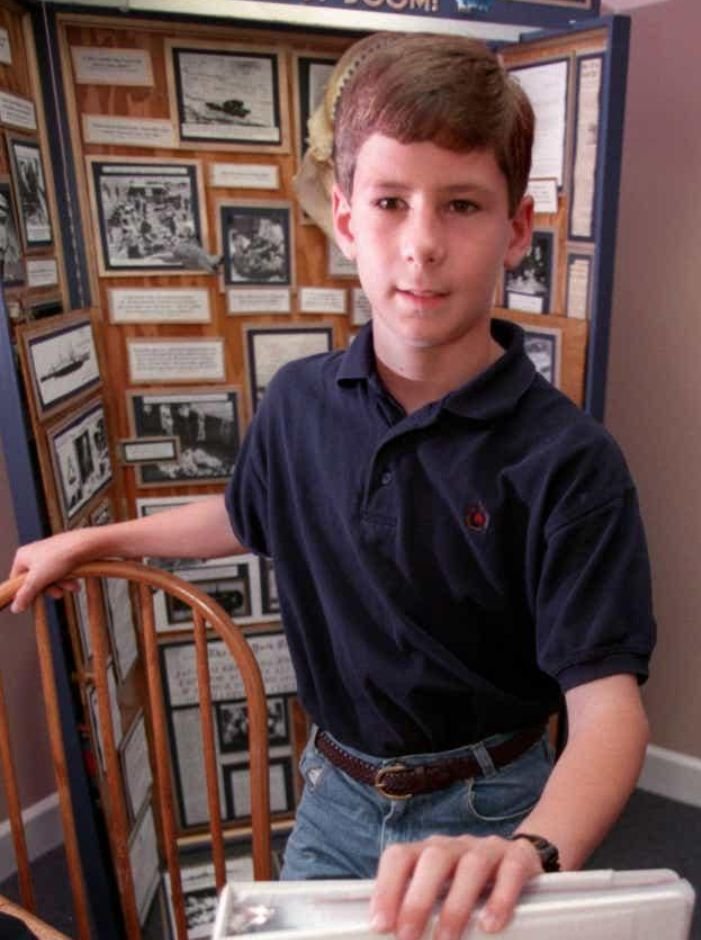
In 1996, a boy named Hunter Scott was watching the film Jaws at his home in Florida.
One scene particularly fascinated him.
The shark hunter Quint recalled the sinking of the USS Indianapolis during the Second World War.
Hunter had never heard of the ship.
He asked his father whether the story was true.
It was.
On July 30, 1945, a Japanese submarine torpedoed the USS Indianapolis in the Pacific Ocean.
The American warship had just completed a secret mission delivering components for the atomic bomb that would devastate Hiroshima.
Within approximately 12 minutes, the ship sank.
Of the 1,196 men aboard, only 316 survived.
Hundreds had escaped the sinking, only to spend days floating in the ocean, suffering from dehydration, exposure, injuries and shark attacks.
Nobody had raised the alarm when the ship failed to arrive at its destination.
The survivors were discovered almost by accident.
And then came another tragedy.
The US Navy court-martialled the ship's captain, Charles McVay, accusing him of negligence for failing to steer a zigzag course to avoid enemy torpedoes.
Yet McVay had not been informed of important intelligence concerning Japanese submarines in the area. His request for an escort had been denied.
Even the Japanese submarine commander testified that zigzagging would not have changed how he fired his torpedoes.
Many survivors considered McVay a scapegoat.
He carried the burden of the disaster for the rest of his life.
In 1968, he died by suicide.
Almost three decades later, an 11-year-old boy decided to investigate what had happened.
Hunter began what was supposed to be an ordinary school history project.
He read books and military documents. He contacted survivors, asking them to describe the disaster and what they thought of their captain.
Eventually, he reached out to all 154 survivors still alive in 1996.
More than 80 responded.
Many were elderly. Some had rarely spoken about their experiences.
They told Hunter about the men they had watched die. About their captain. About the injustice they believed had been done.
The boy kept investigating.
He wrote to President Bill Clinton. He assembled documents. He challenged the official version of events.
His research attracted national attention and helped persuade members of Congress to take up the case.
In 2000, Congress passed legislation calling for McVay's exoneration.
In July 2001, the Secretary of the Navy ordered that the congressional declaration of McVay's innocence be placed in his official military record.
More than half a century after the sinking, the captain's name had finally been officially vindicated, although the original court-martial conviction was not formally overturned.
And the boy?
Hunter Scott eventually became a US Navy officer himself.
There is something profoundly moving about this story.
Hundreds of sailors survived a nightmare. For decades, they struggled to get their captain's name cleared.
Then an ordinary schoolboy watched a film, became curious and refused to stop asking questions.
Sometimes history changes because someone powerful makes a decision.
And sometimes it changes because a child refuses to accept that the adults have already established the truth.
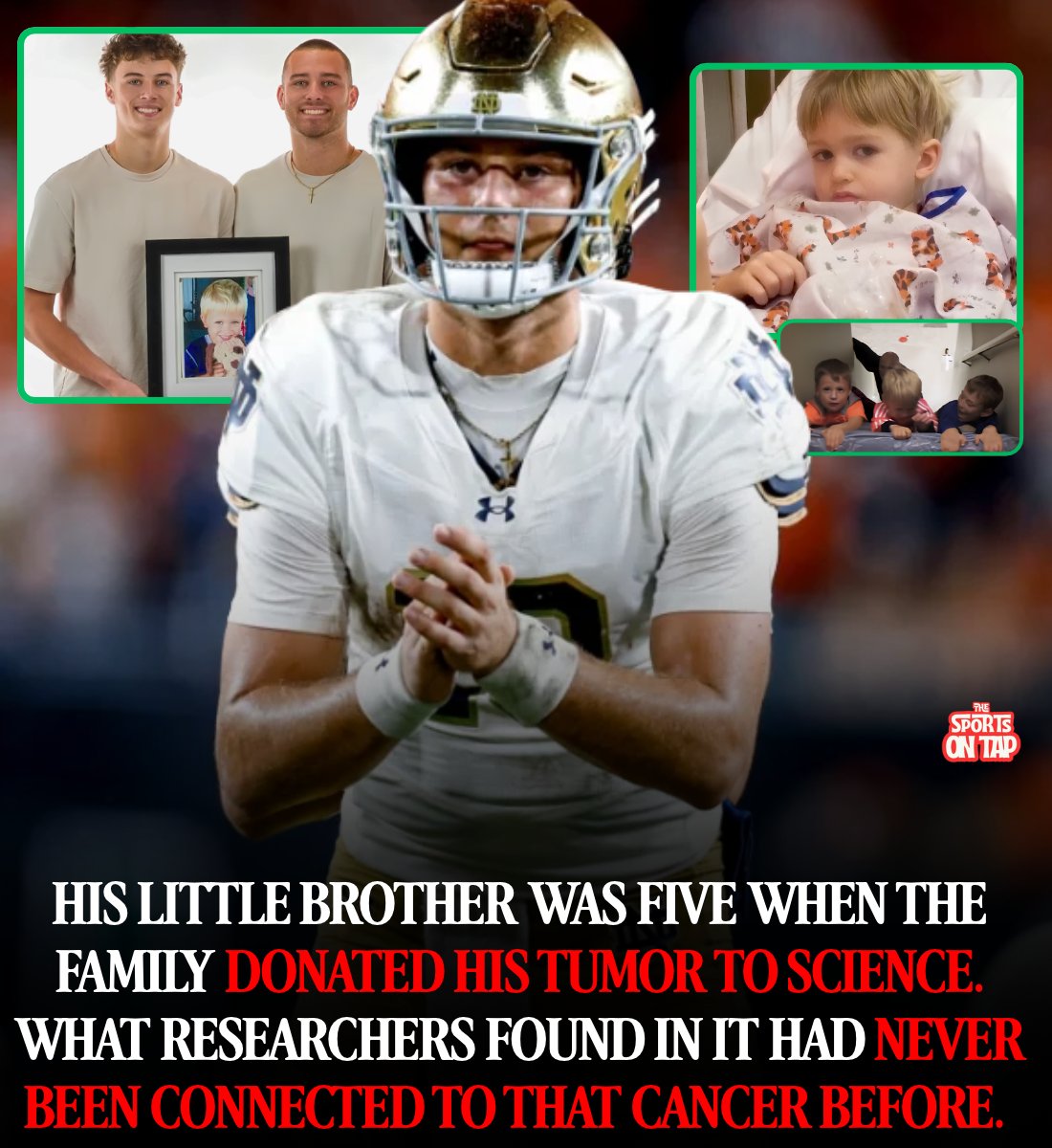
CJ Carr starts at quarterback for Notre Dame tonight, and his little brother Chad changed what doctors know about the cancer that took him.
Chad Carr was five years old.
He was diagnosed with diffuse intrinsic pontine glioma. DIPG. It grows in the brain stem, it cannot be cut out, and across hundreds of clinical trials the outlook for it has barely moved.
Fourteen months later he was gone.
His grandfather is Lloyd Carr, who coached Michigan to a national championship. His mother is Tammi Carr.
The family donated his tumor.
That has to happen within hours. Most families are never asked at all, because most doctors cannot bring themselves to raise it in that room on that night.
The Carrs said yes.
"This was Chad's final physical gift," Tammi said.
Because they had the whole tumor instead of a needle biopsy, researchers at Michigan were able to sequence six separate regions of it.
"Typically with a biopsy, we get a single snapshot of the genetic characteristics of the tumor," said Dr. Carl Koschmann, the pediatric oncologist who led the study.
Chad's tumor was 4.6 centimeters across.
"The current prognosis for DIPG remains bleak despite hundreds of previous clinical trials," Koschmann said.
What they found in Chad was a mutation in a gene called PTEN. Both copies of it. In every single region they looked at.
Koschmann called that unexpected. Nobody had PTEN down as a main driver of this thing.
So they went and checked a national database of pediatric tumors, and PTEN turned up in as many as 5% of DIPG cases.
PTEN is a gene doctors already go after in breast cancer and in prostate cancer.
"If we find it, it's something we can hopefully target with precision therapy," Koschmann said.
It is in the literature now. A five year old boy is a paper in a journal called npj Precision Oncology.
And since his story got around, the doctors there say more families have started asking about donating.
In 2018, thirty million dollars in gifts opened the Chad Carr Pediatric Brain Tumor Center at the University of Michigan. It pulls together pediatrics, neurosurgery, radiation oncology, genetics, pathology, engineering and public health.
It was announced at the family foundation's gala, and thousands of people around the country had chipped in to get it there.
"This is a monumental milestone in our mission to conquer pediatric brain cancer," said Dr. Valerie Opipari, who chairs pediatrics at Mott Children's Hospital.
"We want to see a day when no family will ever have to suffer this kind of heartbreak," Tammi said.
"This is Chad's legacy."
THIS MORNING, College GameDay ran a feature on his older brother.
CJ Carr wears 13. Tonight the number one team in the country comes to South Bend to play him.
Chad never saw any of it. His tumor is still being studied.
For generations, college sports have provided opportunities to learn, compete, grow, and lead.
Student-Athletes are calling for stability and asking Congress to protect opportunities for future generations.
Pass the Protect College Sports Act ➡️ https://t.co/NGYTknH3Fy
Bob Chesney Senior is 76 and he's in the UCLA football building early in the morning and he's still in there at night.
He's in the staff meetings. He works with the DL. He's got no title, he's not on the payroll and nobody ever asked him to come.
The players call him Coach Senior. He got there this summer and has been there since.
His son is the head coach. UCLA are 5th in the country this week (first time they've been in the top 10 since October 2001) and they're 8 and 0.
Now back up 26 years.
Bob Chesney grew up in Kulpmont, PA (population at last census 2,758). It was a coal town, with a corner store and a bar on pretty much every block and a social life that went through the clubs, the Knights of Columbus, the VFW and the American Legion and the Polish and Irish clubs.
His dad coached at the Catholic high school. So did his uncle. So did his grandfather. Chesney was the ball boy before he was old enough to play.
His parents couldn't afford his schooling so he went back home in the summer and worked. Some summers that was doing the landscaping. Some summers it was at the mine.
'The toughest one was mining coal.'
"Back in Kulpmont that's what you did."
Years later as a young assistant at Johns Hopkins (making around $28k) he was sharing a 4 bedroom house with his future wife and two roommates and was tending bar at a club in Baltimore at night (four or five hundred a shift).
"Got me through those years."
He started out as a graduate assistant at a DIII school in 2000. Then Delaware Valley. Then King's College. Then Johns Hopkins. Then head coaching jobs at Salve Regina, Assumption, Holy Cross and James Madison.
8 conference titles. A career record of 132 and 52.
Martin Jarmond (the AD who hired him) put it in seven words.
"Everywhere he's been he's turned it around."
Be absolutely clear about what his father actually watched, as it wasn't anything quick and it was by no means glamorous. Bob Senior saw all 26 years of it from the very start and that's how he describes it.
He did it one rung at a time. He didn't skip a single one.
A 76 year old man who coached high school football in a coal town is now standing on a practice field in LA with no title and no pay at all, just watching his son coach the 5th best team in the country.
I do get choked up about it. I'm an emotional guy.
Somebody asked Chesney what the best bit about having his dad there was.
"Well that he is my dad."
Josh Allen passed Tom Brady today.
But the number people in Buffalo will remember isn’t 102 wins. It’s $17.
That number is about his grandmother.
Here’s the full story.
Today, the Buffalo Bills beat the Baltimore Ravens 36-10. With that win, Allen reached 102 wins through his first nine seasons, including playoffs.
Brady had 101. Only Patrick Mahomes and Russell Wilson have more.
But let’s go back a few years, to a week Allen will never forget.
His grandmother, Patricia Allen, passed away unexpectedly. Less than a day later, he had a game against the Seattle Seahawks.
He played anyway. He threw for 415 yards in a 44-34 win, one of the best games of his career.
The news didn’t come out until after the game, when head coach Sean McDermott told reporters that Allen’s family had suffered a loss and word spread about his grandmother.
Then Bills fans, known as Bills Mafia, did something no one asked them to do.
They started donating to Oishei Children’s Hospital in Buffalo, giving in $17 increments for his jersey number.
By the end of the first night, hundreds of donations had come in. Within days, there were more than 20,000.
The hospital added a special button on its website that automatically selected $17. One of the hospital’s leaders explained why.
"Josh is a person who truly cares about our community and the health of the families and kids"
Allen replied on social media.
"At a loss for words. Buffalo, I love you."
Then he joined in, donating $17,000 of his own and pushing the total past $500,000.
That same week, he said this about Buffalo:
"I know my family is forever ingrained here, myself included."
He also said he wants to play in Buffalo for as long as possible.
The donations kept coming. By the end of December, the fund in her name had passed $1 million. The Bills later said it grew to over $1.4 million.
The hospital renamed part of its 10th floor the Patricia Allen Pediatric Recovery Wing. The money supports the pediatric critical care team.
Later, when the wing opened, Allen visited in person. He had already shared what it meant to him.
"The donations made to OCH in honor of my grandmother would make her so proud."
Here’s the honest part: Allen never asked for any of this. Fans started it themselves, and much of the money came from people who had never even been to Buffalo.
That’s exactly what makes it special.
He’s passed Brady now, and he’ll probably pass a few more names before he’s done.
But in Buffalo, a hospital wing now bears his grandmother’s name, built one $17 donation at a time.
Warren Moon was the MVP of the Rose Bowl, and not one NFL team drafted him.
So he went to Canada and won five straight championships.
Then he became the first undrafted quarterback ever voted into the Pro Football Hall of Fame.
Here is the whole thing.
Moon grew up in Los Angeles. He started at West Los Angeles College, a junior college, and then went to the University of Washington.
In his final season, he led Washington to the Rose Bowl and beat Michigan 27-20. He was named the game's MVP.
Then the draft came, and no one called his name.
Back then, many coaches and scouts believed Black players couldn't handle the quarterback position.
Moon was not interested in playing anything else. He explained it later.
"It was an opportunity to showcase my skills and to keep playing quarterback, I hadn't ever played any other position."
The Edmonton Eskimos of the Canadian Football League gave him that chance. Nobody there tried to turn him into a receiver or a defensive back.
Edmonton won the Grey Cup, Canada's version of the Super Bowl, in his first season.
Then they won it again. And again. And again. And again.
Five straight titles, a record in that league. Moon was named Grey Cup MVP twice.
He did not exactly feel like he was in exile, either.
"I was really happy playing in Edmonton, I signed a long-term contract there, I genuinely loved it."
Now the NFL wanted him. The Houston Oilers beat out other teams to sign him at 27, six years after every team in the league had passed.
He made nine Pro Bowls. He led the NFL in passing yards two seasons in a row, with 4,689 yards and then 4,690. He kept playing until he was 44.
He finished with nearly 50,000 passing yards in the NFL alone.
When he became eligible for the Pro Football Hall of Fame, it took one try. He was the first undrafted quarterback to be inducted, and the first Black quarterback, too.
Canada got there first. The Canadian Football Hall of Fame inducted him five years earlier. He is the only player in both.
Former NFL receiver Nate Burleson put it this way.
"Warren Moon paved the way, and it's not said enough."
Here is the honest part. For all of that, Moon never played in a Super Bowl. Not with the Houston Oilers, and not with any of the three teams after that.
And nobody can give him back the six years the NFL threw away.
But the league that skipped him on draft day eventually had to put his bust in Canton.
And the league that took a chance on him got five championships out of it.
Steve and Ginni Burton raised a phenomenal family steeped in a philosophy of faith, friends and family.
Seeing their children flourish as young adults is no surprise … but wow it is beautiful to watch.
Congratulations to @wbz’s Steve Burton @ginni_burton@Kay_Breezy22@Veronicaab22@austinburton_12@PaulWBZ