I am delighted to share the main work from my PhD with @ibianco3.
We used the saccadic eye movements of larval zebrafish to investigate fundamental mechanisms of motor control.
https://t.co/Z2eItUJeyj
🚨🚨🚨Calling aspiring group leaders! We've just opened a new round of applications for group leader fellowship sponsorship to start a lab in UCL NPP. Deadline 5 Jan #sciencejobs@uclnpp https://t.co/e55nPdtXo2
One of my favorite papers of the year is out today! The Ruta group very elegantly show how modular neural circuits can enable rapid evolution of mate recognition. Cool time for evolution of circuits and behavior!
https://t.co/hnO125Jotg
Personally, this work has shown me the beauty and complexity of neural circuits underpinning even the simplest movements, making our day-to-day feats of boiling the kettle or scrolling Twitter seem all the more remarkable - let alone what Simone Biles can do.
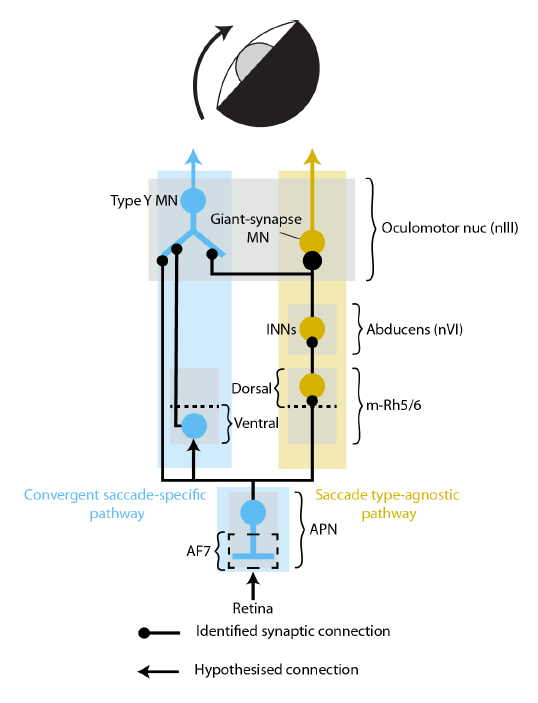
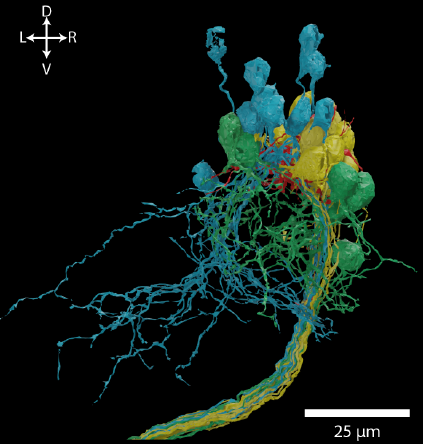
The type Y motoneurons by contrast overlapped topographically with motoneurons especially active for convergent saccades, receiving input from diverse sources on their Y shaped dendrites.
Combined we identify a mechanism by which kinematically and ethologically distinct movements are made by the recruitment of different motoneuron subpopulations, in turn differentially controlled by parallel action-specific and generalist premotor pathways.
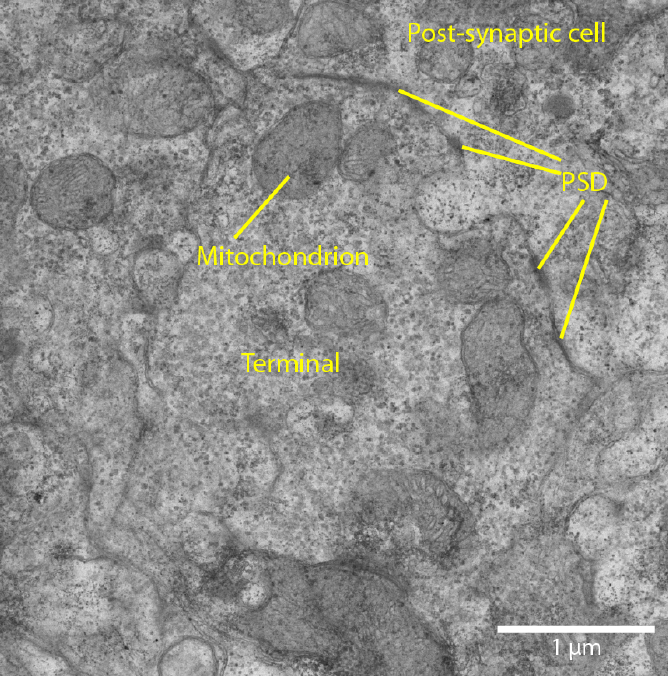
Sidebar: To our knowledge this giant synapse motif has not been described before. Further EM data we collected identified sites of multiple neurotransmitter release, making it somewhat equivalent to the calyx of Held.
I am delighted to share the main work from my PhD with @ibianco3.
We used the saccadic eye movements of larval zebrafish to investigate fundamental mechanisms of motor control.
https://t.co/Z2eItUJeyj
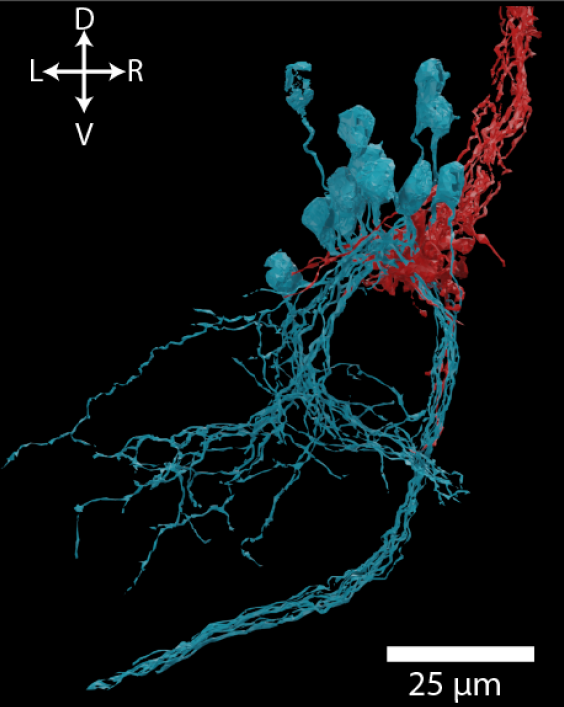
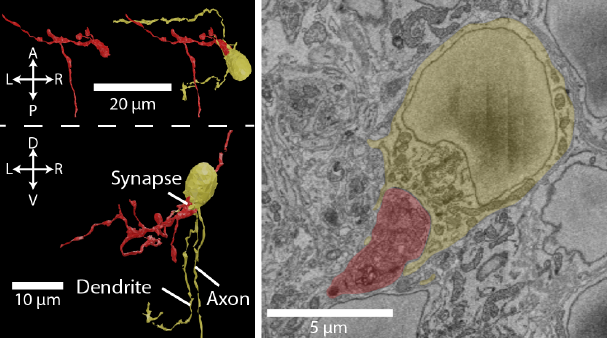
The giant synapse neurons were fascinating. Topographically they overlapped with motoneurons neurons agnostic to saccade type. Anatomically, they received almost all of their input via a single giant synapse from neurons that were also saccade-type agnostic (abducens INNs -red)
This functional topography was mirrored by the distribution of three anatomically distinct motoneuron types we call, type Y (blue), type X (green) and giant synapse (yellow).
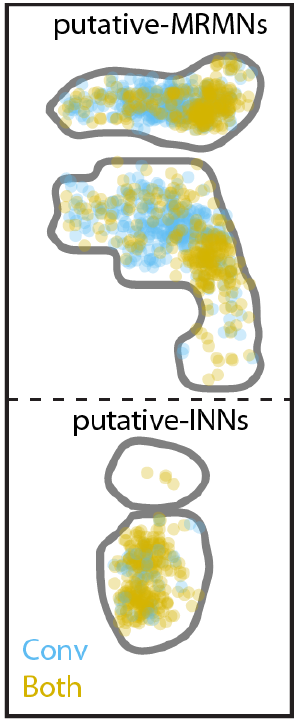
These neurons could be decomposed into populations with activity agnostic to saccade type (yellow) and especially active for convergent saccades (blue).
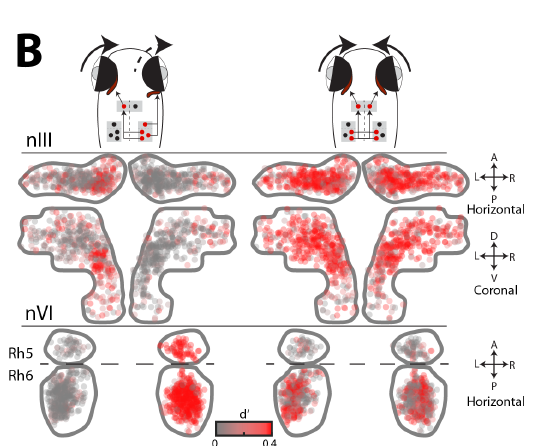
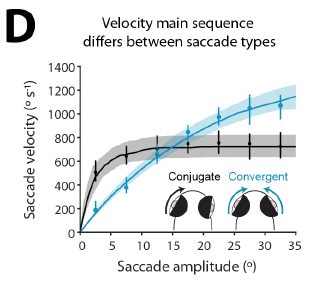
This observation was really cool, as it provided a simple test system to compare how two very similar and relatively simple movements are controlled - specifically the inwards (nasal) rotation of the eye during convergent and conjugate saccades.
In prior work we identified distinct kinematic differences between two types of saccadic eye movement in larval zebrafish made during hunting (convergent) and exploration (conjugate).
More details in this preprint here (soon to be published): https://t.co/AoaNfAXWOk
Underpinning all this is the contraction of muscles, which are in turn controlled by precise patterns of motoneuron activity. For even the simplest movements however, we have an incomplete understanding of how these motoneuron activity patterns are established.
In the course of our lives we move our body parts in extraordinary ways to interact with each other and the environment. Some more extraordinary than others.