The real risk in AI agentic commerce isn't the stolen $320M that made headlines last month. The blockchain money is traceable and probably coming back. But the 67,000 Trezor hardware wallet customers whose home addresses leaked through a shipping vendor stay public forever. “A stolen coin can be returned, a leaked identity cannot,” says our CEO Evin McMullen on @CoinDesk. A leak is worse than a hack. Now we're about to hand the same data-hoarding architecture to billions of AI agents. The fix already exists, we're just not using it. https://t.co/zJrR64oACn
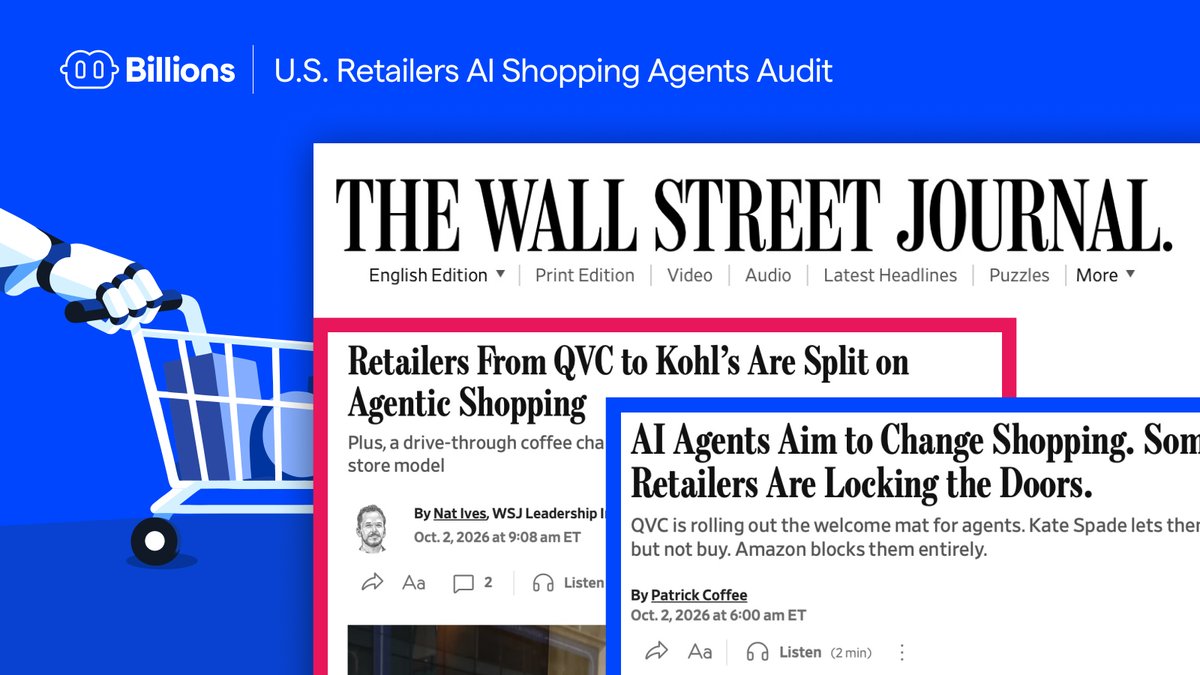
The Wall Street Journal @WSJ mentioned our research: "AI Agents Aim to Change Shopping. Some Retailers Are Locking the Doors." + "Retailers From QVC to Kohl's Are Split on Agentic Shopping."
Our audit of the 51 largest US online retailers found 37 block shopping agents by accident, and zero has a way for a verified agent to complete a purchase.
Before your AI agent spends your money, two things matter: are the facts real, and is the agent really yours? @Verona_dev verifies the facts. Billions links the agent to a verified human. Here’s how to set up your OpenClaw agent in under 3 minutes. https://t.co/SUA6ZgBjDr
Introducing our new partner @Verona_dev. An agent is only as good as the information it acts on. If it sees a fake price or a forged document, it makes a bad decision, and makes it fast.
Verona checks that the information is real. It uses a technique called zero-knowledge proofs, which lets you prove something is true without showing the details behind it. Think of proving you're over 18 without showing your birth date.
Verona has more than 5 million users and has verified more than 70 million interactions.
None of the 51 largest U.S. online retailers we audited has a way for a verified AI agent to complete a purchase. Why is no U.S. retailer agent-ready? https://t.co/Uiz4FomJqG