🇻🇳 Meanwhile in Vietnam
What real Environmentalism looks like.
India has over a Billion people living there - just imagine if 5% of their population started tidying the Country up….
JULIAN ASSANGE: "The goal is to have an endless war, not a successful war."
War is a taxation based money laundering racket for the transnational security elite - it matters very little to them whether it's in Ukraine or Afghanistan, the goal is theft of public money.
Declassified CIA MKULTRA document openly discusses drugging entire populations.
Substances placed in food, water, Coca-Cola, alcohol, cigarettes — even vaccinations to slowly induce anxiety, hopelessness, tension, and depression over time.
This isn’t theory.
This isn’t fiction.
This is real government paperwork.
This is only page one.
Read it again.
Esta camiseta hawaiana no es moda...
Es un ataque a la inteligencia artificial.
Un artista de Berlín diseñó un patrón que, a simple vista, parece solo una camisa colorida y llamativa.
Pero no está hecha para engañar a un humano.
Está hecha para confundir a los algoritmos.
Simon Weckert la probó una y otra vez contra YOLO (uno de los sistemas de detección de objetos más usados). El resultado: la cámara detecta perfectamente a todas las personas… excepto a quien lleva la camiseta. Bajo ciertas condiciones, el algoritmo simplemente no lo registra como “persona”.
La vende por unos 75 dólares.
No es magia. Es un ataque adversarial.
Y el mismo artista ya había engañado a Google Maps en 2020: caminó por una calle vacía con 99 teléfonos en un carrito y consiguió que el mapa mostrara un atasco inexistente.
Esta camiseta funciona solo contra determinados modelos. No te hace literalmente invisible.
Pero plantea una pregunta mucho más inquietante:
Podemos experimentar públicamente con sistemas abiertos como YOLO y ver dónde fallan.
Pero la mayoría de las cámaras de vigilancia reales usan algoritmos cerrados, propietarios… y nadie de fuera puede auditarlos.
La camiseta es solo el experimento.
El verdadero debate es qué pasa cuando el algoritmo que te observa no puede ser observado por nadie.
🚨 EDWARD SNOWDEN’S CHILLING WARNING IS NOW UNFOLDING IN REAL TIME
What China built… is exactly what Western governments are quietly preparing for.
Snowden is crystal clear:
Every photo, every purchase, every message, every movement — all of it is being fed into algorithms that decide your future.
In China, AI “city brains” now track:
Where you live
Who you visit
How you dispose of your rubbish
Every step you take in public
Whether you “follow rules” or not
Break a rule?
A camera catches you from three angles.
Your score drops.
Your life collapses.
Snowden’s warning:
“If any of your activities differ from what the government wants, you won’t get on a train.
You won’t board a plane.
You won’t get a job.
An algorithm will decide your fate.
And what they are selling… is us.”
This is not a future threat.
It is happening now — in Shanghai, in Beijing… and creeping into the West through digital ID, AI policing, and “misinformation scoring.”
China built the prototype.
Our governments are importing the blueprint.
Stay informed.
Stay alert.
Do not let this system take root.
Fortunately, the flood spared the library of the Sakya Monastery in Tibet, and the 84,000 texts remain intact—even though 95% of this ancient collection has yet to be translated (and there is no real will to make that happen).
✨🇨🇳China rolls out hydrogen‑powered shared bikes.
These zero‑emission vehicles use hydrogen fuel cells, emitting only water during operation, bringing green low‑carbon travel to urban streets.
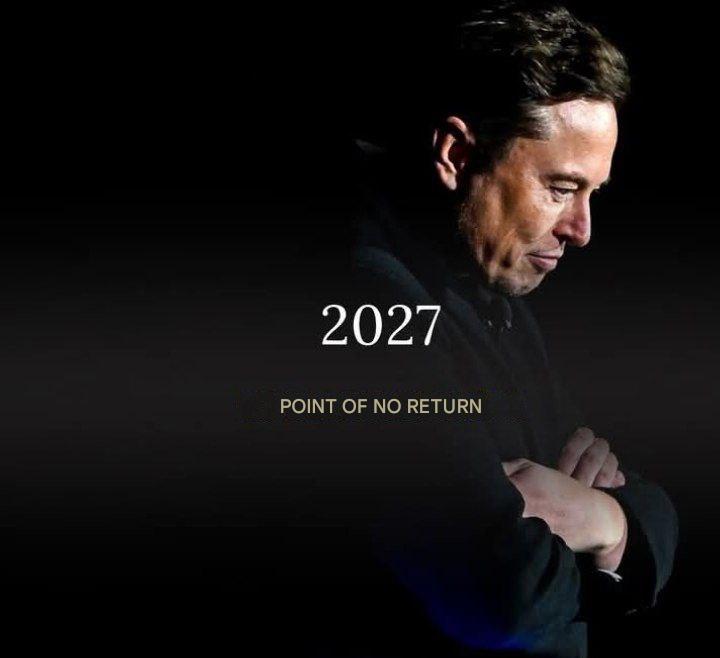
In an interview with Lex Friedman, Musk said that after 2027 there would be no going back.
When the reporter clarified what he meant, Musk paused for almost a minute, then added:
“It’s not a catastrophe, it’s a transition.” Analysts have identified three themes that he has been particularly vocal about: autonomous intelligence, loss of meaning, and energy dependency.
Everything he predicted is already happening.
The first sign is the collapse of attention.
Musk said that people will stop thinking long-term.
The planning horizon has shrunk from 30 years to three; people don’t build, they just innovate.
MIT research shows that the generation born after 2000 has an attention span of just eight seconds.
Musk called this cultural Alzheimer’s.
The second sign is artificial intelligence, which will no longer be subordinate.
Musk said: “When the system starts correcting the person, and not the other way around, linear logic will end.”
Algorithms already control our attention, choice of partners, food and thoughts. This will not be a revolt of machines, but a silent loss of freedom of choice.
The third sign is the energy dependence of civilization.
People are increasingly unable to survive without electricity for even a single day. When energy becomes currency, its control will become power.
Musk believes that by 2027, the relationship between people and energy will surpass everything, and everything that is not autonomous will disappear.
There is only one way out: a return to meaning. “Technology is stronger than us, but not smarter. As long as we have goals, we are not algorithms,” Musk repeated.
He added: “We must learn to be human before systems start doing everything for us and controlling us👌
downloaded👇🏻
@Endendini1
The process extends far beyond specialized manufacturing movements.
Workers might crumple paper, sort utensils, or simulate assembly-line tasks with cardboard mockups.
Smart glasses or motion sensors sometimes replace head cams, tracking subtle finger curls as someone pulls a zipper or threads a needle.
These aren't random acts; they're scripted to cover edge cases - left-handed vs. right-handed, varying speeds, or handling slippery fabrics.
Errors are costly: Objectways once scrapped 150-200 videos due to inconsistent folds, forcing retraining and delays.
The goal? Feed neural networks that analyze joint angles, torque applications, and tactile feedback, enabling robots to replicate actions without rigid programming.
3/