That's a really good question, but it's hard to answer in a single tweet because our mission is quite extensive, and it requires a lot of background knowledge to really understand what sets Kaspa apart.
Currently, a lot of people see Kaspa as “Bitcoin’s crazy little brother” that improves time-to-finality by leveraging the benefits of DAG-based consensus protocols without accepting their traditional drawbacks, such as decreased decentralization or a limited validator set.
This perception is somewhat accurate, but it falls short of conveying the full picture, because Kaspa’s vision extends far beyond just trying to be a better Bitcoin.
Anyone willing to study Kaspa and its broader vision will discover similarities to nearly all major existing DLT designs: from Bitcoin, to Ethereum, to Solana, Sui, Celestia, and beyond.
My personal view is that “research” in the DLT space is approaching a point of convergence. We increasingly understand how to push distributed systems close to the limits of what physics permits. The frontier is no longer only about raw throughput or faster finality. The attention is shifting toward game theory, incentives, sequencing, MEV, alignment, and how to build systems where the economic incentives of users, builders, miners, validators, applications, and infrastructure providers do not work against each other.
That is why debates like based rollups versus arbitrary sequencing, shared sequencing, MEV mitigation, proposer-builder separation, and execution-layer incentives matter so much. These are not niche technical details. They determine whether a network can remain neutral, decentralized, and aligned while scaling to global usage.
And this is where I think Kaspa is pushing the boundaries in a very important way.
Kaspa is not merely trying to be “fast.” The goal is to build an L1 where speed, decentralization, security, and incentives are aligned at the base layer. A system that does not scale by hiding complexity behind trusted committees, privileged sequencers, centralized validator sets, or opaque coordination mechanisms, but instead tries to preserve the spirit of proof-of-work while extending what an L1 can realistically do.
Because Kaspa arrived later than many other major projects, it does not carry the same degree of technological debt. It can absorb lessons from Bitcoin, Ethereum, rollups, modular blockchains, high-throughput monolithic chains, DAG research, MEV research, and the broader history of decentralized systems, and combine those lessons into something more optimal.
To me, that is what Kaspa is building: not just a faster blockchain, but a more incentive-aligned decentralized infrastructure layer.
But this also creates a different challenge.
Kaspa’s biggest problem today is not its technology. It is the lack of centralized coordination around communicating the vision. And because Kaspa is a grass-roots movement, that responsibility does not belong to a marketing department, or a single leadership team. It belongs to the community.
That also means the community has a different role to play.
There will always be holders who are mainly interested in price, and that is completely fine. But there also need to be people who are here because they want to use the technology to build a different future. People who care about the architecture, the incentives, the open questions, the trade-offs, and the long-term trajectory of decentralized infrastructure.
I am one of those people.
I am not interested in DLTs merely as a way to generate wealth. I am interested in them because I believe they can change the trajectory of humanity as a whole.
For that reason, I want to use this opportunity to announce a regular community hangout where we discuss the current state of development, the open questions, and where we can align our vision together.
The first session will be on Tuesday, June 9th, 2026.
We will talk about the vProgs framework, how the codebase works, what sets Kaspa apart, where we improve on existing solutions, and what still needs to be done. The goal is for this to become a regular, possibly bi-weekly, event where we as a community come together to discuss the future and understand the technology.
Eventually, we can invite people from other projects as well, but the main focus at the beginning will be explaining and communicating how things work under the hood.
There is still a lot of work to be done, and I do not want to waste precious time. So the first sessions may feel a little improvised, but we can improve as we go.
The important thing is that we start.
So mark the date: Tuesday, June 9th, 2026.
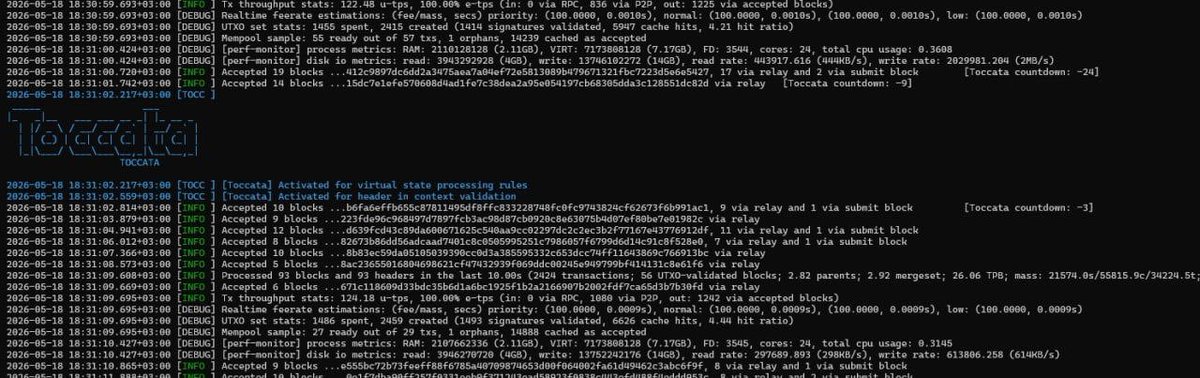
Update: Testnet 10 underwent the Toccata hardfork about 30mins ago and everything’s still running like clockwork. Transition was smooth and seamless.
This seamlessness is the standard that kaspa devs set. It’s easy to take it for granted so I want to take this moment to recognize the effort and due diligence that went into making this happen @michaelsuttonil@OriNewman@Max143672@IzioDev@FreshAir08@manyfest_@hus_qy (and sorry if I missed anyone)
Mainnet HF soon
Here we go again: rehearsing a major hardfork on testnet 10, this time crescendoing into Toccata
Activation is scheduled for tomorrow May 18, 16:00 UTC.
Existing TN10 miners/operators should upgrade now. In a few hours upgraded p2p nodes will stop connecting to non-upgraded nodes as we enter the 24h pre-activation window.
Let’s make the mainnet activation boring by making the TN10 rehearsal as mainnet-real-world as possible
- hard forks don’t mean app breakage. especially with programmability, backward compatibility is a core requirement. existing apps/contracts should keep working as-is unless there’s some truly exceptional reason otherwise.
- kaspa is still evolving, but not toward endless L1 forks. the zk-apps/vprogs vector should let the L1 converge into a versatile base surface while most future app innovation happens above it. the dk/100bps vector is also converging toward “perfect PoW properties”, so to speak, so it has a natural end horizon rather than an endless upgrade loop.
why I’m personally excited about Kaspa’s upcoming Toccata covenants
- for the first time, I can build creative, complex apps directly over infrastructure I helped design and build
- we designed under architectural constraints, but the result came out surprisingly expressive and powerful
- Silverscript is cool as hell
- I can literally open a *.sil file and write a complex contract that will be fully verified on Kaspa L1
- (nottoself: create a 10-minute video showing the building of such an app e2e)
- I can design my own vaults and safeguards, and manage funds securely without risking a heart attack each time I touch a wallet
- covenant ids, contract templates, and inter-covenant communication (ICC) feel like a new set of axioms, or a new algebra to work with and discover
- sig verify from stack / sighash anyone-can-pay + covenant ids can allow interesting shared-state covenants (requires a non-consensus miner policy; kudos to @maxibitcat for pushing this line of thinking)
- complex contract systems can be deployed in one spk hash. no storage rent, no deployment tax; users pay only the transient mass for tx data as they use it
- as I’ve mentioned in the past, this becomes especially interesting for AI/agentic environments, where bots could cheaply create one-time agreements between themselves
- I didn’t even mention based apps yet. That’s a whole vertical that isn’t ready for exploration yet, but will be very soon
https://t.co/n1qOT2qd7m has been refreshed.
Kaspa has a lot going on, but the main site does not need to put it all at the front door. Its first job is simple: help someone arrive, understand what Kaspa is, and know where to go next.
The previous site accumulated more over time. Pages, explanations, resources, and audiences were added. This version starts smaller, so it can grow with Kaspa from here.
The refresh is not just visual. The wording, structure, and narrative direction all needed attention IMO.
The content traces back to @hashdag’s writing, simplified for a first read. Kaspa is already deep enough. The first read should not make people work harder than necessary.
There are many true ways to talk about Kaspa, but https://t.co/n1qOT2qd7m cannot carry twenty narratives at once. For this version, the strongest one to unify around is real-time decentralisation.
Part of the refresh was also about making the builder path easier to follow. https://t.co/n1qOT2qd7m gives people the overview of what exists, why it matters, and where to go next. https://t.co/FrgQZdNMey gives builders the deeper material, with room for examples, detail, and ongoing improvement.
https://t.co/FrgQZdNMey starts with @IzioDev's work and has the broader goal of bringing important Kaspa L1 builder documentation into one place.
Both repos are public. Pages will be added, wording will change, gaps will be filled, and the work can happen in the open.
Big shoutout to @kasmediadotcom for their support in helping bring this refresh together.
Have a look around. If you see something that can be better, please open an issue or PR.
i am not sure how true this is, but i would't be surprised.
$KAS has the possibility of having a DEX built on it with instant confirmations after Toccata hard fork.
Tier 1 Exchanges are scared of $KAS success.
STUDY $KAS
Unfortunately I was part of the group laid off from @coinbase today.
My whole tenure was protecting U.S. retail from tokens with actual utility like $XMR, $KAS, and quai-network:native.
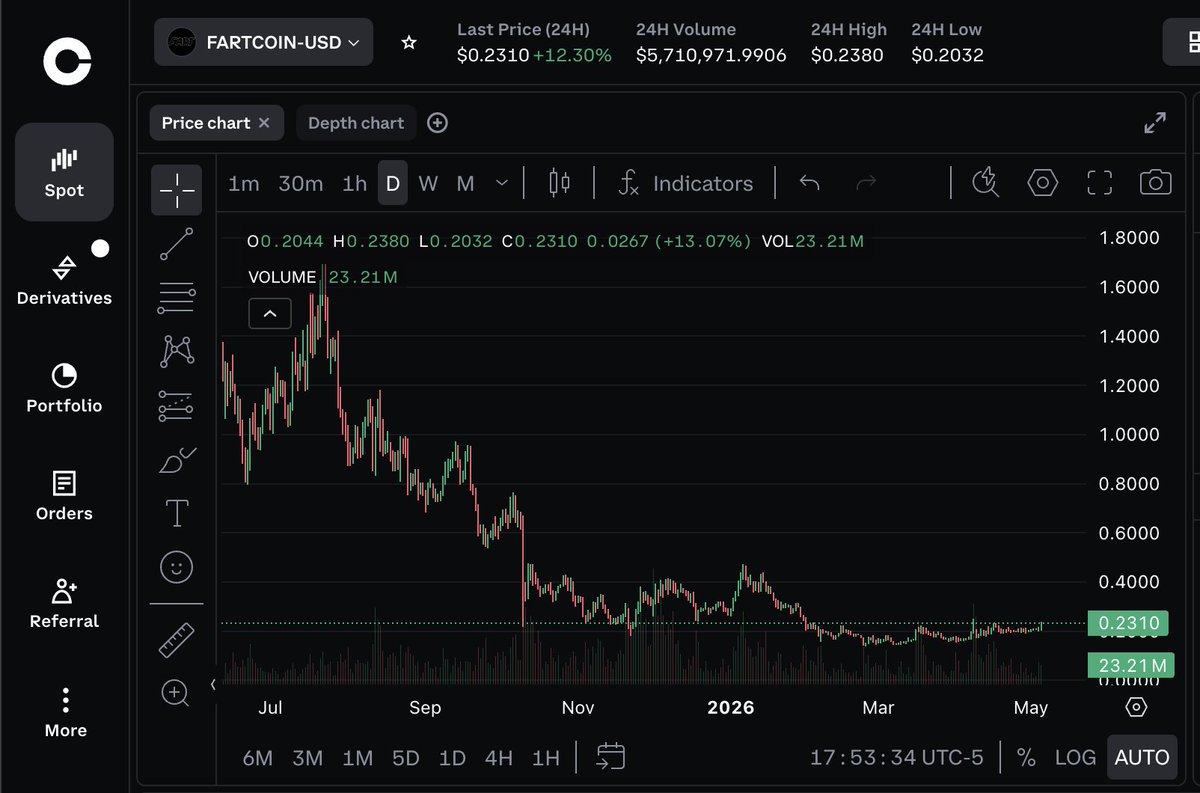
Instead we focused on listing pristine crypto assets like $RAVE, $USELESS, $FARTCOIN, and $TRUMP.
Pictures unrelated.
Today Kii have completed our main flagship projects which will all be running directly on the L1. Now just the final security hardening and migration to enterprise servers. June is going to be a blast!
And we have a few surprises in store!
Kaspa is an incredible platform to develop on and is only going to get even better.
#kaspa #thinkKaspa #KaspainEnterprise
@jerrybanfield "weak real world utility"
i think @KaspaKii would beg to differ.
gotta love $KAS FUD : P
please don't buy any $KAS. it will grow in adoption with or without you.
@KaspaSilver@hashdag (2/2) Is there a middle ground like "View Keys" or "Programmable Privacy"—that you think satisfies both cypherpunks and regulators?
@KaspaSilver@hashdag (1/2) Privacy coins are under intense regulatory scrutiny. Does adding ZK infrastructure to Kaspa risk the "Store of Value" and "Institutional" narrative (like the ADGM fund) that the community is building?