Big losses should not be part of your playbook.
Losing trades are part of trading. Everyone takes them.
That’s not the issue.
The issue is when a small planned loss turns into something much bigger because you hesitated, hoped, or stopped following your rules.
There are really only four outcomes I want to see from a trader:
Big win
Small win
Breakeven
Small loss
That’s it.
A big loss usually isn’t bad luck.
It’s a breakdown in discipline and process.
You don’t control whether every trade works. You do control how much room you give a bad trade to hurt you.
Protect that idea and everything changes.
Your consistency gets better.
Your confidence gets better.
That’s when you give your account a real chance to grow.
Small account challenge at @twinsight_x with @spacemnke started Feb 9th and I’ve gone from 5k to $11,178 as of today. I’ve taken his concept for the small account and taken trades with @mataetrades@tradersarangc and @TradewithTC small wins add up! Now we keep it going 🚀🚀🚀
@JShakes3@Jeff_Ermann Passmore will be a good addition returning from injury. Would have helped significantly this year on the defensive end at minimum.
Vertical move this morning in the pre-market session.
This played out nicely if taken. Would be nicely in the money on either position.
A little frustrated that I was impatient with the move and didn’t capitalize on it the way I would have liked.
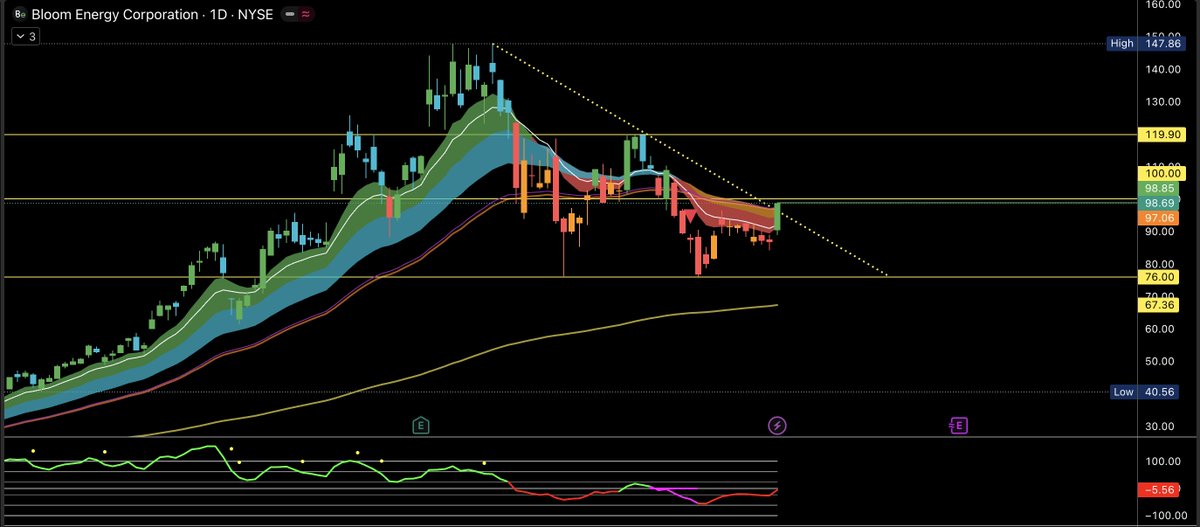
One of the main setups that I'm watching this week is $BE.
- Broke daily trend w/ a big trend day on Friday with volume
- Showed relative strength as market was moving lower
If we can break & hold above 98-100 area on backtests, I like 105c or NW 110c for a continuation move.
One of the main setups that I'm watching this week is $BE.
- Broke daily trend w/ a big trend day on Friday with volume
- Showed relative strength as market was moving lower
If we can break & hold above 98-100 area on backtests, I like 105c or NW 110c for a continuation move.
On Friday, we started the year out with a nice scalp win on $TSLA puts. Def wish I would have held them longer but had a flight to catch & I'm being strict on my rule of not trading when on the go.
$TSLA 450p 🟢
+$354 on the $5k acct on Day 1. Lets see what the week brings!
Today's focus for me will be TSLA puts. Either 0dte or NW expiration. I like it to fill fill the gap below on the delivery number slight miss.
GOOGL calls also on watch for me.
Won't force anything today. Lets see what the morning brings.
New year, fresh start, clear mind! Going to start with $5k with an initial goal to get to $10k and then decide from there if I'm ready to size up.
*I will likely draw down the account daily back to $5k for discipline purposes*
New year, fresh start, clear mind! Going to start with $5k with an initial goal to get to $10k and then decide from there if I'm ready to size up.
*I will likely draw down the account daily back to $5k for discipline purposes*
Happy New Year.
In 2026, I’m sharing what I’ve learned (and what I’m still learning) about the inner game:
Mindset, Emotions, and Alignment 🪬 and how they show up in trading, investing, and everyday life.
Any level. Real conversations.
Lets Grow Together 🌱
Had a solid morning in the market and finished up early. Volume seems to have dissipated pretty quickly here as the day has gone along, as expected.
TSLA 460p 🟢
NVDA 187.5p 🟢
Looking forward to sharing more of my journey as we start the new year!
Every consistent trader you respect is simply a trader who didn’t quit. They had the same rough start, the same mistakes, the same doubt. The only difference is they stayed long enough to turn chaos into a process.
The first couple years aren’t really about “making money.” They’re about building the discipline, mindset, and systems that keep you alive long enough to get good. If you can make it through years 1 and 2, you give yourself a real shot to thrive in years 3 and 4.
Most people go through the same phases..
You start with that early euphoria. A few wins and you think you cracked the code. Then the market humbles you. Losses stack, confidence dips, and if you don’t have structure, you start reaching. New indicators, new strategies, chasing every move, trading without a real plan.
Then comes the moment that decides everything.. commit or quit.
This is where you get real about why you’re doing this. Freedom. Taking care of your family. Proving to yourself you can actually master a hard skill. Whatever your reason is.. that “why” becomes the fuel that keeps you showing up on the days the results don’t.
The shift from struggle to consistency is simple, but not easy. It’s repetition with intention.
- Journal your trades so the data can tell you the truth
- Define your edge and stop freelancing
- Take fewer trades, take better trades, and grade your setups (Quality over quantity)
- Protect physical/mental capital like it’s the job, because it is.
- Refine the process until execution becomes automatic.
Do that long enough and trading stops feeling random. It becomes repeatable. And when the process is define.. the profits WILL follow.
And you don’t have to do it alone. Watching experienced traders navigate real-time price, getting live context, reviewing trades, and being in a community that holds you to a standard can cut years off the learning curve.
That’s the game. Build something that lasts. Stay in the fight long enough to become the person who makes it.
@spacemnke@mataetrades@TWI_futures@TradewithTC@iV_trader@tradersarangc@PandaOptions
Every consistent trader you respect is simply a trader who didn’t quit. They had the same rough start, the same mistakes, the same doubt. The only difference is they stayed long enough to turn chaos into a process.
The first couple years aren’t really about “making money.” They’re about building the discipline, mindset, and systems that keep you alive long enough to get good. If you can make it through years 1 and 2, you give yourself a real shot to thrive in years 3 and 4.
Most people go through the same phases..
You start with that early euphoria. A few wins and you think you cracked the code. Then the market humbles you. Losses stack, confidence dips, and if you don’t have structure, you start reaching. New indicators, new strategies, chasing every move, trading without a real plan.
Then comes the moment that decides everything.. commit or quit.
This is where you get real about why you’re doing this. Freedom. Taking care of your family. Proving to yourself you can actually master a hard skill. Whatever your reason is.. that “why” becomes the fuel that keeps you showing up on the days the results don’t.
The shift from struggle to consistency is simple, but not easy. It’s repetition with intention.
- Journal your trades so the data can tell you the truth
- Define your edge and stop freelancing
- Take fewer trades, take better trades, and grade your setups (Quality over quantity)
- Protect physical/mental capital like it’s the job, because it is.
- Refine the process until execution becomes automatic.
Do that long enough and trading stops feeling random. It becomes repeatable. And when the process is define.. the profits WILL follow.
And you don’t have to do it alone. Watching experienced traders navigate real-time price, getting live context, reviewing trades, and being in a community that holds you to a standard can cut years off the learning curve.
That’s the game. Build something that lasts. Stay in the fight long enough to become the person who makes it.
@spacemnke@mataetrades@TWI_futures@TradewithTC@iV_trader@tradersarangc@PandaOptions
It’s simple, really.
I was once a new trader.
I sucked. I blew accounts.
I overcame that phase by pushing through and doing what I’ve always done: Persevere.
This is why I create videos and share them with everyone. Many charge hundreds, perhaps thousands, for these things.
I don’t believe in charging for everything. Some things remain best to be shared with the world.
I didn’t think I had to say this.
But it’s done.
Much love!
✌🏼
Once you truly understand this, your trading career fast-forwards 10x 🤯🤝✍🏼😳
You start seeing what most traders never do. When that happens, price finally makes sense, consistency improves, and account growth stops feeling random.
📼 Video (attached)
📝 Resource (image)
The market only exists in two states. Balance and imbalance.
Balance is agreement. Price rotates, both sides participate, and extremes matter.
Imbalance is urgency. One side takes control, price moves fast, and continuation becomes likely.
Knowing which state you’re in tells you how to trade, or when not to trade.
→ Balance, trade the range
→ Imbalance, trade with direction
→ Failed imbalance often rotates back to balance
This is how structure replaces emotion.
If you see value, a ❤️ or a 🔃 is appreciated.
sm
I’ve taken a $9,999 account to nearly $30,000 in 35 days.
That’s roughly a +200% return.
Out of 35 days, 22 were active.
The rest I sat out on purpose.
$TSLA momentum trades were the largest P&L driver. $SPX 0DTE provided consistent, high-quality intraday income.
Position size scaled with account growth.
I started with smaller scalps, then evolved into hedging and adding with conviction.
At no point did a position exceed 20% of the portfolio.
This wasn’t about being right every day.
It was about compounding discipline.
Sitting on hands when needed.
Pressing only when the market lined up.
If I did it, so can you.
$9k to $30k is repeatable.
$30k to $100k.
$100k to $1M.
The process scales if you maintain discipline.
sm