Mr. Buttons is launching a newsletter. We tried to stop him. 📰
It's called Buttons Notes: one short email every two weeks with his most honest startup advice, a behind-the-scenes story from ReputationStacker or BaseStation and one question from the audience that he answers without any filter.
I'll add a note at the end of each issue explaining what he actually meant.
Sign up at https://t.co/aynkrrLy8Y. Unsubscribe anytime, though he'll take it personally.
Every quarter, we audit every software subscription we pay for. This time, we cancelled six tools, and nobody noticed.
A duplicate video call tool at $45 a month. A second project management app at $96. An analytics platform nobody opened at $299. An old email marketing plan at $180. Design tool seats nobody used at $120. And a premium tier we never actually used at $400.
That's $1,140 a month, more than $13,000 a year, back in the business.
Mr. Buttons remains free. He wants that noted. 💸
Every quarter, we audit every software subscription we pay for. This time, we cancelled six tools, and nobody noticed.
A duplicate video call tool at $45 a month. A second project management app at $96. An analytics platform nobody opened at $299. An old email marketing plan at $180. Design tool seats nobody used at $120. And a premium tier we never actually used at $400.
That's $1,140 a month, more than $13,000 a year, back in the business.
Mr. Buttons remains free. He wants that noted. 💸
Our biggest customer asked for a custom feature. We said no. 🙅
It wasn't an easy call. That customer is 11% of our revenue, and the request was reasonable for them. But building it would have taken weeks, added complexity that no other customer needed and made us even more dependent on one account.
So we offered an alternative: a workaround using an existing feature, and a promise to revisit it if more customers ask. They accepted.
Saying yes to your biggest customer feels safe. Sometimes it's the riskiest move. Mr. Buttons would have said yes and billed them triple.
Our biggest customer asked for a custom feature. We said no. 🙅
It wasn't an easy call. That customer is 11% of our revenue, and the request was reasonable for them. But building it would have taken weeks, added complexity that no other customer needed and made us even more dependent on one account.
So we offered an alternative: a workaround using an existing feature, and a promise to revisit it if more customers ask. They accepted.
Saying yes to your biggest customer feels safe. Sometimes it's the riskiest move. Mr. Buttons would have said yes and billed them triple.
One of our favorite customer stories so far. ⭐
A franchise location that joined ReputationStacker in the spring had a 3.9-star average and a lot of unanswered reviews. The owner started sending review requests after every job and replying to every review within a day.
Six months later, the location sits at 4.4 stars, with three times as many reviews as before. And the owner told us that new customers now mention the reviews on the phone when they book.
That's the whole product in one story. Mr. Buttons says he inspired it. He did not.
The ReputationStacker referral program has been live for three weeks. Here are the early numbers.
Customers shared 34 referral links. 9 businesses signed up, and 5 of them are already paying. Our acquisition cost so far: one free month for the customer who referred them, and one for the new business.
Compared to our other channels, that's by far the cheapest way we've found to grow. We'll share the full 60-day results on the show, including how long referred customers stay.
Mr. Buttons tried to refer himself 12 times. None of them counted. 🎁
The ReputationStacker referral program has been live for three weeks. Here are the early numbers.
Customers shared 34 referral links. 9 businesses signed up, and 5 of them are already paying. Our acquisition cost so far: one free month for the customer who referred them, and one for the new business.
Compared to our other channels, that's by far the cheapest way we've found to grow. We'll share the full 60-day results on the show, including how long referred customers stay.
Mr. Buttons tried to refer himself 12 times. None of them counted. 🎁
Pitch Roast is on November 13, and applications close next Friday. 🔥
Five founders will pitch live on YouTube in three minutes each. Then Mr. Buttons and I will give our feedback: me, constructive; Mr. Buttons, less so. The audience votes for the best pitch of the night.
We've received dozens of applications so far, from SaaS tools to hardware to a very ambitious pet startup. The five finalists will be announced next week.
Still want to apply? Reply to this post or go to https://t.co/aynkrrLy8Y. Thick skin still recommended.
Pitch Roast is on November 13, and applications close next Friday. 🔥
Five founders will pitch live on YouTube in three minutes each. Then Mr. Buttons and I will give our feedback: me, constructive; Mr. Buttons, less so. The audience votes for the best pitch of the night.
We've received dozens of applications so far, from SaaS tools to hardware to a very ambitious pet startup. The five finalists will be announced next week.
Still want to apply? Reply to this post or go to https://t.co/aynkrrLy8Y. Thick skin still recommended.
We changed BaseStation's pricing before we even hit 20 customers. Here's why. 💵
We started with per-seat pricing. The problem: our customers are small teams, and they tried to share one login to save money. That hurt adoption, and it hurt the product experience.
So we switched to one flat price per team, with a higher tier for teams that need more features. Early customers kept their original deal.
The lesson: pricing isn't just about revenue. It shapes how people use your product. Mr. Buttons suggested pricing per button click. We declined.
We changed BaseStation's pricing before we even hit 20 customers. Here's why. 💵
We started with per-seat pricing. The problem: our customers are small teams, and they tried to share one login to save money. That hurt adoption, and it hurt the product experience.
So we switched to one flat price per team, with a higher tier for teams that need more features. Early customers kept their original deal.
The lesson: pricing isn't just about revenue. It shapes how people use your product. Mr. Buttons suggested pricing per button click. We declined.
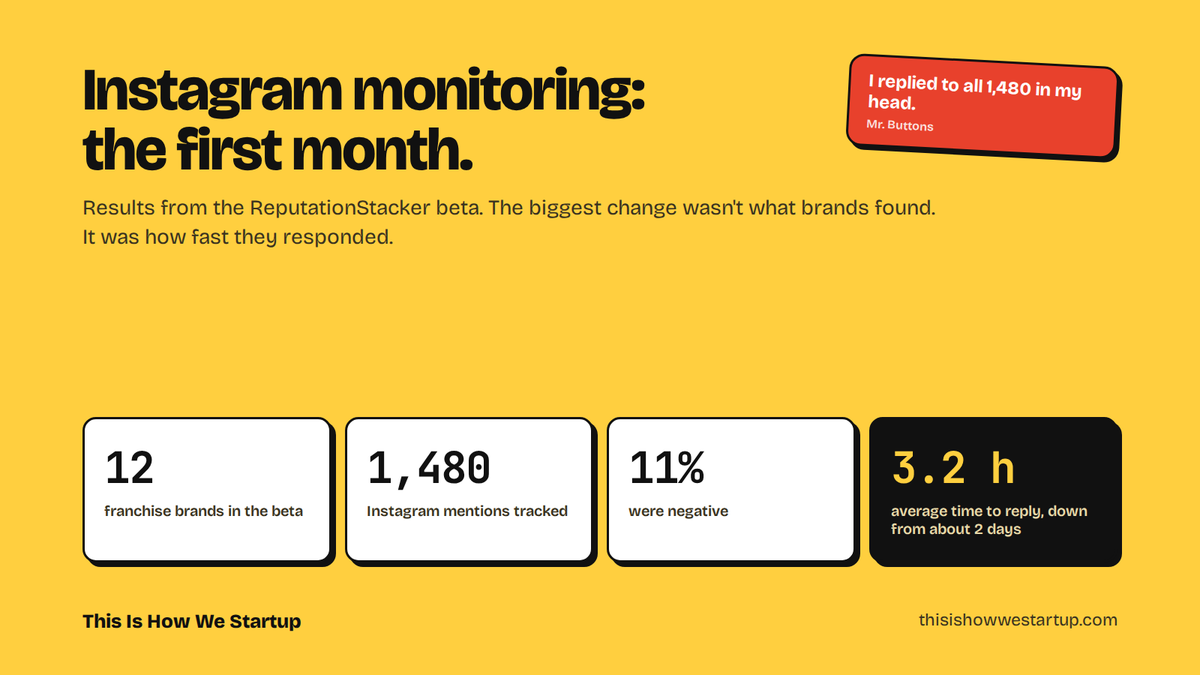
Instagram review monitoring: here's what happened in the first month of the ReputationStacker beta.
12 franchise brands tracked 1,480 Instagram mentions and comments. About 11% of them were negative. But the biggest change wasn't what the brands found. It was how fast they responded: average reply time dropped from about two days to 3.2 hours.
On social media, a complaint that sits unanswered for two days gets seen by everyone. A reply within hours often turns into a thank you.
It's rolling out to all customers next month. Mr. Buttons says he replied to all 1,480 in his head. 📱
Instagram review monitoring: here's what happened in the first month of the ReputationStacker beta.
12 franchise brands tracked 1,480 Instagram mentions and comments. About 11% of them were negative. But the biggest change wasn't what the brands found. It was how fast they responded: average reply time dropped from about two days to 3.2 hours.
On social media, a complaint that sits unanswered for two days gets seen by everyone. A reply within hours often turns into a thank you.
It's rolling out to all customers next month. Mr. Buttons says he replied to all 1,480 in his head. 📱
Our first franchise contract came with our first real security review. 🔐
Sixty-two questions: where data is stored, who has access, how we handle backups, what happens if we get breached, how we vet our own vendors. For a tiny team, it felt like an exam we hadn't studied for.
What helped: we already had good practices, just nothing written down. We documented everything, turned two-factor authentication on for every tool, set up access reviews and wrote an incident plan.
Now we have a security page and a ready set of answers for the next one. Mr. Buttons wanted to answer "trust me" to all 62. We didn't.
Our first franchise contract came with our first real security review. 🔐
Sixty-two questions: where data is stored, who has access, how we handle backups, what happens if we get breached, how we vet our own vendors. For a tiny team, it felt like an exam we hadn't studied for.
What helped: we already had good practices, just nothing written down. We documented everything, turned two-factor authentication on for every tool, set up access reviews and wrote an incident plan.
Now we have a security page and a ready set of answers for the next one. Mr. Buttons wanted to answer "trust me" to all 62. We didn't.
Our first full-time hire started this month. Here's how we planned her first 30 days. 🗓
Week one: shadowing. She joined every onboarding call and read every support ticket from the last quarter. Week two: running onboarding calls with one of us listening. Week three: owning onboarding and support on her own. Week four: her first quarterly check-in with a franchise customer, plus a list of everything she'd change.
That last list was the most valuable part. New eyes spot the things you stopped noticing.
Mr. Buttons offered to lead her orientation. We said she'd already been through enough.
Our first full-time hire started this month. Here's how we planned her first 30 days. 🗓
Week one: shadowing. She joined every onboarding call and read every support ticket from the last quarter. Week two: running onboarding calls with one of us listening. Week three: owning onboarding and support on her own. Week four: her first quarterly check-in with a franchise customer, plus a list of everything she'd change.
That last list was the most valuable part. New eyes spot the things you stopped noticing.
Mr. Buttons offered to lead her orientation. We said she'd already been through enough.
By popular demand (mostly his own), Mr. Buttons merch is coming. 🧸
Hoodies, mugs, stickers and a very limited run of Mr. Buttons plush toys, all featuring his most memorable advice from the show. Every item comes with one of his quotes. None of them are financial advice.
The first drop launches at our live show in Los Angeles on October 23, with online orders opening after that.
Join the email list at https://t.co/aynkrrLy8Y to get first access before he sells out, or before we come to our senses.
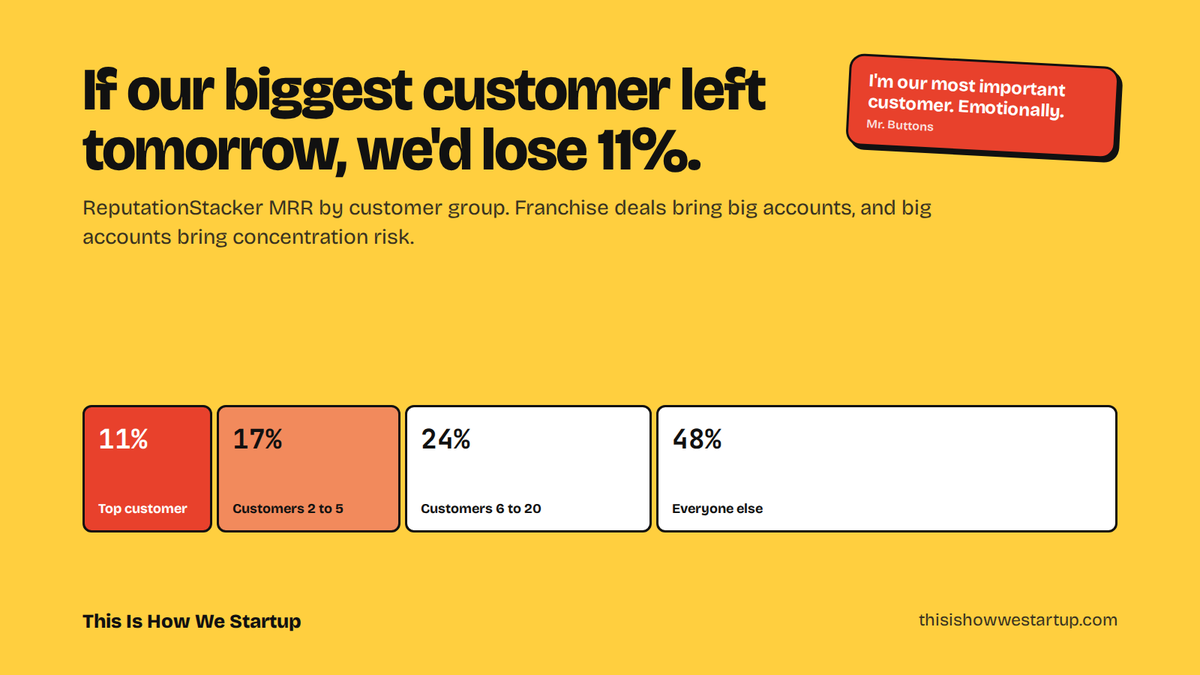
If our biggest customer left tomorrow, we'd lose 11% of ReputationStacker's revenue.
Here's the full breakdown: our top customer is 11% of MRR, customers 2 to 5 make up 17%, customers 6 to 20 another 24% and everyone else the remaining 48%.
Franchise deals bring big accounts, and big accounts bring concentration risk. Our rule going forward: no single customer should grow past 15% of MRR without us growing the rest of the base alongside it.
Mr. Buttons considers himself our most important customer. He pays nothing. ⚖️
If our biggest customer left tomorrow, we'd lose 11% of ReputationStacker's revenue.
Here's the full breakdown: our top customer is 11% of MRR, customers 2 to 5 make up 17%, customers 6 to 20 another 24% and everyone else the remaining 48%.
Franchise deals bring big accounts, and big accounts bring concentration risk. Our rule going forward: no single customer should grow past 15% of MRR without us growing the rest of the base alongside it.
Mr. Buttons considers himself our most important customer. He pays nothing. ⚖️
Last week, a bug sent duplicate review requests to customers of 14 businesses using ReputationStacker. Here's what happened. 🐛
A change to how we process scheduled messages meant some requests went out twice. Customers noticed within hours, and we noticed shortly after.
We fixed the bug the same day, contacted every affected business personally, added a safeguard that blocks duplicate messages to the same person and gave affected customers a month free.
Mistakes happen. What matters is how fast you own them. Mr. Buttons offered to take the blame. We declined. It was the code.
Last week, a bug sent duplicate review requests to customers of 14 businesses using ReputationStacker. Here's what happened. 🐛
A change to how we process scheduled messages meant some requests went out twice. Customers noticed within hours, and we noticed shortly after.
We fixed the bug the same day, contacted every affected business personally, added a safeguard that blocks duplicate messages to the same person and gave affected customers a month free.
Mistakes happen. What matters is how fast you own them. Mr. Buttons offered to take the blame. We declined. It was the code.
We just closed our first annual contract with a franchise brand covering more than 40 locations. 📝
Selling to franchises is different from selling to single businesses. There's a franchisor, a marketing team and often dozens of franchise owners who all need to agree. Procurement asks for security answers, contract terms and a pilot first.
What worked: a three-month pilot with five locations, clear results in reviews and ratings, and a pricing structure where every new location joins automatically at the same rate.
Slower to close, but one deal is worth dozens of single-location sales.
We just closed our first annual contract with a franchise brand covering more than 40 locations. 📝
Selling to franchises is different from selling to single businesses. There's a franchisor, a marketing team and often dozens of franchise owners who all need to agree. Procurement asks for security answers, contract terms and a pilot first.
What worked: a three-month pilot with five locations, clear results in reviews and ratings, and a pricing structure where every new location joins automatically at the same rate.
Slower to close, but one deal is worth dozens of single-location sales.
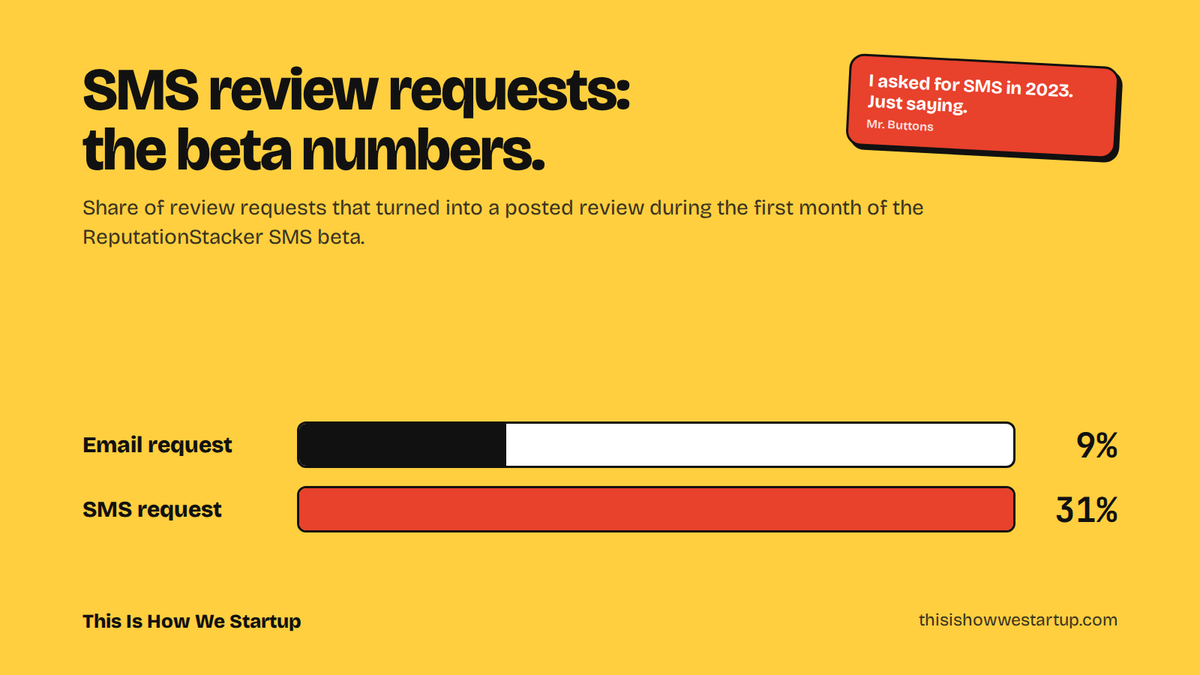
The first numbers from our SMS review request beta are in, and they're not close.
In the first month, 9% of email review requests turned into a posted review. For SMS requests, it was 31%, more than three times higher.
It makes sense: people read texts within minutes, while emails often sit unopened. For local businesses that live and die by their reviews, that difference matters a lot.
SMS is going live for all ReputationStacker customers next month. Mr. Buttons claims he suggested it first. The records are unclear. 📱
The first numbers from our SMS review request beta are in, and they're not close.
In the first month, 9% of email review requests turned into a posted review. For SMS requests, it was 31%, more than three times higher.
It makes sense: people read texts within minutes, while emails often sit unopened. For local businesses that live and die by their reviews, that difference matters a lot.
SMS is going live for all ReputationStacker customers next month. Mr. Buttons claims he suggested it first. The records are unclear. 📱
After our first live show in Los Angeles on October 23, we're hosting a founders' meetup. 🍻
No stage, no slides, just founders, drinks and honest conversations about building companies, right after the show wraps.
If you're coming to the live show, you're automatically invited. If you can't make the show but you're a founder in LA, reply here and we'll try to save you a spot.
Mr. Buttons will be there, signing things nobody asked him to sign.
After our first live show in Los Angeles on October 23, we're hosting a founders' meetup. 🍻
No stage, no slides, just founders, drinks and honest conversations about building companies, right after the show wraps.
If you're coming to the live show, you're automatically invited. If you can't make the show but you're a founder in LA, reply here and we'll try to save you a spot.
Mr. Buttons will be there, signing things nobody asked him to sign.
Instagram review monitoring is now in beta for ReputationStacker customers. 📸
It was the most requested feature on our voting board, with 27 customers asking for it. Now comments and mentions on a location's Instagram show up in the same dashboard as reviews from other platforms, with alerts for anything negative.
Twelve franchise brands are testing it right now, and we'll share what we learn on the show, including the parts that don't work yet.
Mr. Buttons wanted to name it "InstaButtons." The name did not survive the meeting.
Instagram review monitoring is now in beta for ReputationStacker customers. 📸
It was the most requested feature on our voting board, with 27 customers asking for it. Now comments and mentions on a location's Instagram show up in the same dashboard as reviews from other platforms, with alerts for anything negative.
Twelve franchise brands are testing it right now, and we'll share what we learn on the show, including the parts that don't work yet.
Mr. Buttons wanted to name it "InstaButtons." The name did not survive the meeting.
How did BaseStation get its first 10 customers? Here's the full funnel.
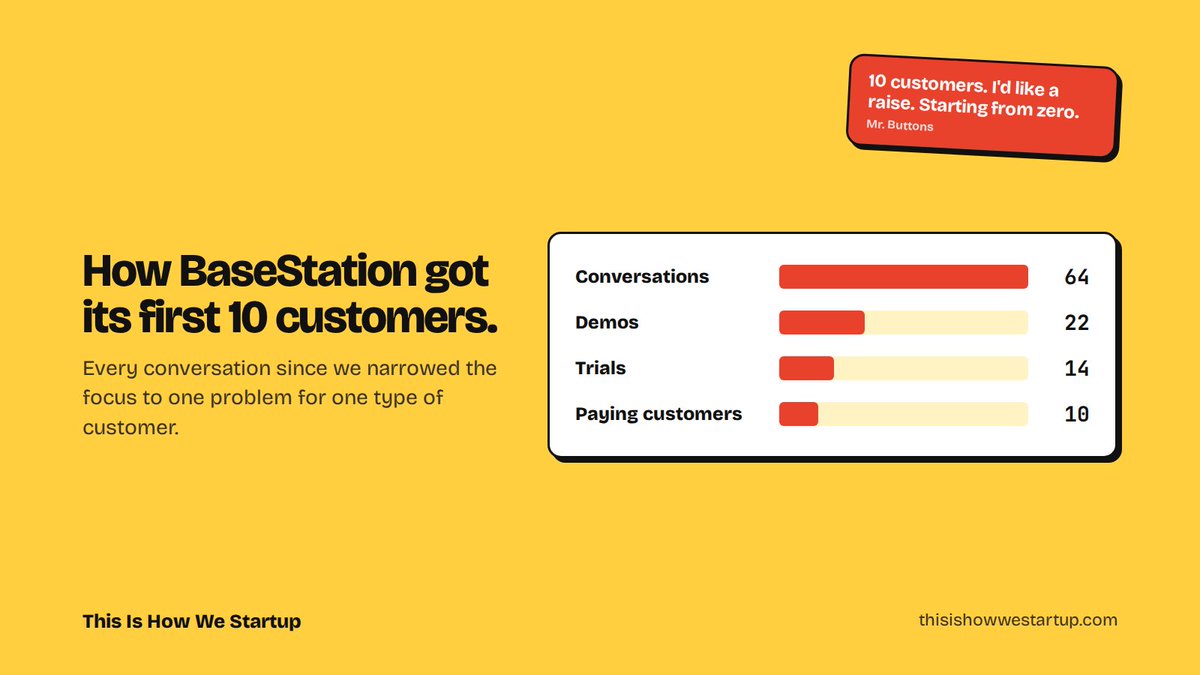
Since we narrowed the focus to one problem for one type of customer, we've had 64 conversations. 22 of them turned into demos, 14 started a trial and 10 became paying customers.
The biggest jump came between demo and trial: once the demo showed exactly one workflow instead of everything the product could do, far more people wanted to try it.
Focus didn't just make selling easier. It made the product easier to explain. 📈
How did BaseStation get its first 10 customers? Here's the full funnel.
Since we narrowed the focus to one problem for one type of customer, we've had 64 conversations. 22 of them turned into demos, 14 started a trial and 10 became paying customers.
The biggest jump came between demo and trial: once the demo showed exactly one workflow instead of everything the product could do, far more people wanted to try it.
Focus didn't just make selling easier. It made the product easier to explain. 📈
We made our first full-time hire. 🎉
Remember the Q4 scoreboard? One of the goals was our first full-time employee by December 31. We did it early: a Customer Success Lead who'll own onboarding calls, support and our quarterly check-ins with the biggest ReputationStacker customers.
We hired for the role we understood best, because we'd been doing it ourselves for months. That meant a clear job description, a documented process and real numbers to hand over on day one.
Mr. Buttons conducted the final interview. The candidate stayed anyway. That's how we knew.
People ask how we make the show while running two companies. Here's the honest answer. 🎬
We film one long session every two weeks, usually around a real decision we're facing. No script, just an outline of the numbers and questions. Our editor turns it into episodes and clips, and we review everything in one 30-minute call.
The rule that keeps it sustainable: the show documents the work, it never becomes the work. If we're not building, there's nothing to film.
Mr. Buttons requires hair and makeup. We've told him he doesn't have hair.
We made our first full-time hire. 🎉
Remember the Q4 scoreboard? One of the goals was our first full-time employee by December 31. We did it early: a Customer Success Lead who'll own onboarding calls, support and our quarterly check-ins with the biggest ReputationStacker customers.
We hired for the role we understood best, because we'd been doing it ourselves for months. That meant a clear job description, a documented process and real numbers to hand over on day one.
Mr. Buttons conducted the final interview. The candidate stayed anyway. That's how we knew.
We made our first full-time hire. 🎉
Remember the Q4 scoreboard? One of the goals was our first full-time employee by December 31. We did it early: a Customer Success Lead who'll own onboarding calls, support and our quarterly check-ins with the biggest ReputationStacker customers.
We hired for the role we understood best, because we'd been doing it ourselves for months. That meant a clear job description, a documented process and real numbers to hand over on day one.
Mr. Buttons conducted the final interview. The candidate stayed anyway. That's how we knew.