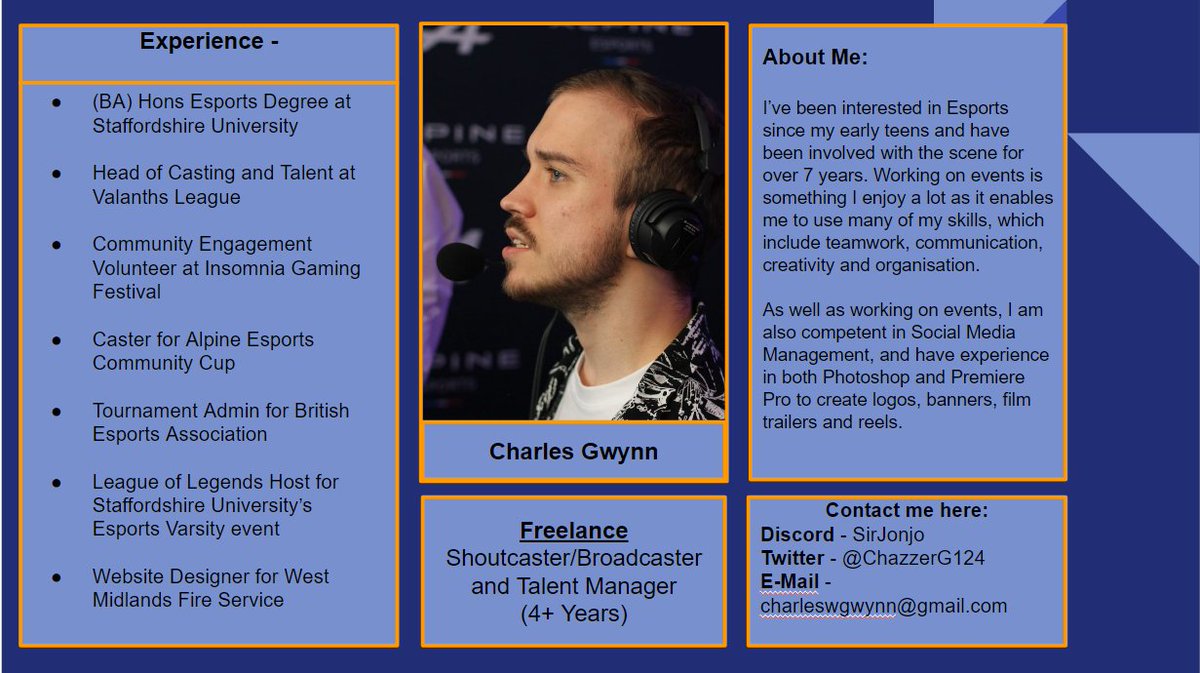
25 | Head Caster @ValanthsLeague | Diamond Top Main | Hawaiian Shirt Expert | DM’s open for work | @TheUKEL League Op | Discord is chazzag25 for enquiries
Hey I'm Charles, and after a short break, I am now looking for any opportunities within the Esports industry!
I'm a keen learner and have experience helping out on a wide variety of different games.
Thanks for taking your time to read. 🙂
We're updating our Community Competition Guidelines and are bringing back Triumphant Ryze to celebrate League's grassroots legacy!
Read more on the updated guidelines: https://t.co/p6P6POijmI
More info on Triumphant Ryze: https://t.co/LQSFGqtWTV
Back again alongside @RLoweth which is always a fun time! VRB face up against - a rather shaky looking so far - G2H, it's not a matchup you're gonna wanna miss!
⚔️ GO4LoL IS BACK ⚔️
Dust off your old mains. Rally your squad. It's time to relive the classics. Go4LoL returns with League Classic, bringing back the competitive spirit for the community that started it all. Whether you were there from the beginning or you're ready to experience it for the first time, this is your chance. Sign up below 👇
Hey all I’m just wondering if anyone would be able to help me improve my laning in League? I’m a top laner d4 elo and I’m just struggling to keep my laning more consistent and not as flippy.
@WelshLeagues is looking for free agents to join there teams both welsh nationals and international players rocket league, valorant, rainbow 6 and CS2 links below
Talking about England's exit of the World Cup.
Thomas Tuchel's game plan against Argentina, his substitutions, the use of high-tempo players and England's footballing DNA.
There has been a lot of discussion about England's game and Thomas Tuchel. I have rewatched the game and came to some important conclusions.
First, let's talk about Tuchel's pressing plan. It wasn't the most aggressive, and I feel it was quite conservative, but it was well organized. England left Argentina's fullbacks free while pressing with the wingers, Gordon and Rogers, from the outside in to press Argentina's centre-backs. Bellingham and Kane stayed centrally and deeper with Argentina's midfielders, Enzo and Paredes. Tuchel wanted to have more players centrally than Argentina, for example by keeping Anderson as an extra player in the middle to deal with Messi if he decided to drop deep to organize play.
Argentina were able to play through third-man combinations inside to find the free fullback quite easily. Once Argentina played to the left fullback, James, at right-back, would push up to press, while Stones shifted across to cover Julián Álvarez. England controlled that side well and closed Argentina down many times. Argentina didn't have any threat in behind, so England could press aggressively. The fullback wasn't going to play in behind because there was no attacking threat, meaning Tagliafico could only play centrally. That also suited England because their plan was to outnumber Argentina in central areas.
But on Argentina's right side, the story was different. The inclusion of Simeone in the starting line-up added attacking threat to Argentina. Whenever the right fullback received the ball, Simeone would make a run in behind, so Spence couldn't really jump out and press like James was doing on the other side. Tuchel had to adjust after the hydration break if he wanted to make the press more aggressive and more logical. So he did. Gordon was now marking the right fullback instead of stepping inside towards the centre-back, Bellingham started pressing Cuti Romero, and left Enzo behind him for Anderson to pick up. It became a much more aggressive press, man-to-man at times. If Gordon, will go and press Cuti, then Bellingham will cover out wide for Gordon. But Spence will never jump out of position.
Those were England's best moments. They started winning duels and playing to their strengths. They are physically superior to Argentina, and Argentina struggle when you press them high aggressively. They don't have a real reference point for playing direct, and only Simeone was able to provide threat in behind. Still, I feel England could have caused Argentina even more problems if they had been a little more aggressive with their press. But it's also fair to talk about the adjustment Tuchel made during the game because it worked well. If you look at the stats, you can see how many more duels England started to win and how Argentina began to attack much less and struggle much more.
Again, my opinion on England with the ball is that, at times, they are too direct. I like the idea of allowing Kane to drop and letting Gordon and Rogers attack the space in behind. It worked at times, like for the goal. Kane dropped deep, released Rogers with a run in behind, Rice won the second ball, found Rogers, and Rogers crossed for Gordon. That was Tuchel's attacking idea, and England scored from it, so that's only fair to acknowledge.
I think England lacked a player like Saka to slow down the tempo of the game, keep the ball under pressure, and allow the team to enjoy longer spells of possession. There are too many players who, whenever they receive or recover the ball, immediately look to accelerate, sometimes making poor decisions, which ends up costing England possession far too often. England have enough players who can attack in behind and be dangerous, so they can certainly afford to sacrifice one of them in order to have more control.
Let’s talk now about what happened after the goal, step by step.
When England scored, they continued to press aggressively. In fact, they had a couple of moments where they came very close to creating chances by winning the ball high up the pitch. Actually, in one of those situations, they were caught in transition because they pressed so aggressively. That was the moment when Spence saved a goal with an incredible tackle. I don’t buy the idea that England retreated after scoring because it simply isn’t true. In fact, England defended quite well in their 4-4-2 for the first 10 minutes after the goal. Argentina didn’t create anything.
But it’s true that England were no longer able to keep the ball. They tried to play from the back, but some of their players made poor decisions. If that had been Tuchel’s instruction, England would have gone long from the very moment they scored. They didn’t. Pickford tried to play short when Argentina pressed man-to-man, which was the ideal moment to go long. Then Pickford played long when Kane was completely free in the middle of the pitch because Argentina had adopted a more conservative press. It’s true that it’s very difficult to play under pressure in a game like this, but Argentina and Spain are able to make good decisions on the ball even under intense pressure.
The game changed in the 65th minute when Nico González came on for Paredes. Argentina started committing many more players forward, with both fullbacks pushing high, making it very difficult for England’s 4-4-2, which eventually ended up pinned back inside its own box. That’s when Tuchel decided to bring on Konsa, adding another centre-back to protect the back line. Again, I don’t think bringing on Konsa was a bad decision. How many times has Scaloni introduced Otamendi to defend in a back five? The problem wasn’t using a back five.
For me, there were two problems, and I’ll explain them.
First, England switched to a back five but defended in a 5-3-2 instead of a 5-4-1. The 5-3-2 has a structural weakness that Messi knows how to exploit: moving into wide areas to deliver crosses. Three midfielders simply have too much width to cover. Messi punished Egypt in the same way because they also defended in a 6-3-1, with only three midfielders covering the width of the pitch. Messi started delivering crosses from those wide areas, and later De Paul did the same. Argentina then began creating almost all of their chances through crosses from the right side. Bellingham should have dropped into the midfield line to help England defend in a 5-4-1.
The second problem was that England lost all of their counter-attacking threat. Gordon looked tired, but in that game context he could still have offered much more than Rogers. After Gordon went off, England had no threat in behind. Rogers was defending as one of the midfielders in a 5-3-2, having to cover a huge amount of ground. With only three midfielders, you can’t expect him to make those defensive runs and still have the energy to lead counter-attacks. It also made little sense to leave Kane on the field without runners around him. In that game context, there wasn’t much he could do.
Tuchel realised the mistake a few minutes later. He brought on O’Reilly for Rice and moved Bellingham into midfield. England then defended in a 5-4-1 and immediately looked better defensively. But another problem appeared, and I don’t think this one was Tuchel’s fault.
With the 5-4-1, England’s wide centre-backs were reluctant to move out of the box. As a result, England’s midfielders had to track the half-space runs for them. So although Tuchel wanted England to defend in a 5-4-1, they actually ended up defending in a 6-3-1.
The same problem remained: too much width for three midfielders to cover. Yes, you protect the box better because all three centre-backs stay inside it, but you also allow easy crosses from wide areas. I always remember what Cruyff said about this: the best way to defend crosses is not to allow them in the first place.
In conclusion, I think it would have been better to defend in a 5-4-1 while keeping attacking threat on the wings. In a 5-4-1, the defensive role of the wingers isn’t as demanding, while they can still provide a huge threat when Argentina commit so many players forward. Egypt were a good example of how much you can hurt Argentina in transition if you keep fast players up front. Players like Rashford or Madueke could have come on. Kane is capable of releasing them with passes into the space behind. Those two players aren’t the most reliable defensively, but in a 5-4-1 their defensive responsibilities are much smaller. Still, Tuchel clearly didn’t think it was worth bringing them on because he didn’t trust them defensively.
The other issue is that England produce very few press-resistant players. Instead, they produce many more high-tempo players who like to play vertically and attack quickly but struggle to receive under pressure, slow the game down, and give the team continuity in possession. Some of the players who can do that (Saka, Mainoo, Palmer...) weren’t used. We can’t expect England to play with too many players of that profile, but I’m sure they would have improved by having at least one of them on the pitch instead of another high-tempo player.
In the end, this is also about the type of players you choose. Argentina and Spain have far more press-resistant players in their starting line-ups, players who can deceive opponents, keep the ball after recovering possession, and help the team transition from defending in a low block to establishing sustained possession. Pedri, Rodri, Fabián, Dani Olmo or Enzo Fernández, Mac Allister, Messi and Julián Álvarez are all examples.
There is also a cultural aspect to this. In England, if you are winning with 15 minutes to go, everyone tells you to kick the ball out of the stadium. It’s a short-term solution because, within a few seconds, the ball is back near your own box. It isn’t logical, but many coaches still ask their players to do it. So you can’t blame English players for something that is rooted in their football culture, they have been taught this since they were young.
The same applies to England producing more high-tempo, vertical players instead of lower-tempo players with better decision-making. In England, those second types of players have a much more difficult pathway to becoming professionals than the first.
It’s unfair to blame only Tuchel for all of England’s structural issues. He made some mistakes, but he also got some things right. It’s easy to say afterwards what he could have done differently, but he had to make decisions in a matter of seconds and under immense pressure.
With all that said, I don’t think England were that far away from being genuine title contenders.
Very impressive analysis from Andros Townsend. Please can we have him on TV somewhere in future instead of some of the utterly hopeless fuckwits that are currently employed - particularly by Sky Sports?!🙄