In your view, will CAF and FIFA approve the "renovated National Sports Stadium" for international matches? Those toilets are a disgrace. The Zimdaily catoonist summed it well! 👌👌👌
🔹The people of Mutare Central have taken MP Brian Leslie James to court for attempting to stay in parliament beyond the term limit without the people’s mandate! See link below 👇🏾: https://t.co/Lod5GD2W1l
This Palestinian boy in Gaza broke down in tears after his glasses were damaged. Amid Israel’s genocidal war on Gaza and blockade on the entry of supplies, it may be impossible for him to replace the glasses.
While NDS2’s eighth priority promises devolution and decentralisation, Clause 20 delivers its exact opposite.
Three further CAB3 clauses compound this institutional harm: (i) Clause 21 abolishes the National Peace and Reconciliation Commission (NPRC), removing the only constitutional channel for processing the deep, largely rural wounds of Gukurahundi and displacement, thereby fracturing the social trust underpinning economic cooperation. (ii) Clause 12 transfers voter registration to the executive-reporting Registrar General, leaving rural voter rolls uniquely vulnerable to manipulation. (iii) Clauses 17–18 dissolve the Gender Commission, eliminating the primary institution directly protecting the rural women who produce the majority of Zimbabwe’s food.
What The Evidence Says: Empowerment vs. Capture
Development economics is crystal clear on what rural communities require to thrive.
Amartya Sen’s capability approach (Nobel Prize, 1998) defines development as the expansion of substantive freedoms: agency over land, local governance, and independent economic choice.
The modern Peruvian economist, Hernando de Soto, demonstrated that secure, collateralisable property rights are the absolute precondition for sustained rural investment.
CAB3 contracts these freedoms rather than expanding them.
The successful models, especially in Africa, are instructive.
Rwanda’s Land Tenure Regularisation (LTR) programme successfully mapped and titled 10.4 million parcels of land, providing roughly 90 percent of poor rural households with secure collateral to borrow against. As a direct result, rural poverty plummeted from 72 percent in 1994 to 38 percent by 2017. Botswana’s House of Chiefs (Ntlo ya Dikgosi) grants traditional leaders a highly respected, constitutionally non-partisan advisory role, allowing Botswana to secure Sub-Saharan Africa’s strongest rural poverty-reduction record.
The historical and empirical lessons are completely unambiguous: empowerment and institutional neutrality drive robust rural development; capture and political patronage systematically destroy it.
Unleashing Rural Development
In 2026, our national priority should be unleashing the immense potential of our rural areas, not stifling it.
Rural Zimbabwe is already demonstrating what is possible. Across every province, diaspora and local investors are actively building durable and beautiful homes, sinking boreholes, fencing homesteads, and launching poultry, horticulture, and agro-processing ventures that create real local jobs.
Development is happening despite policy, not because of it.
Any constitutional change must aim to boost what is currently obtaining by implementing five key reforms:
Bankable communal land: This is a game-changing master reform.
A registrable, transferable, collateralisable right held by communities and households, so a woman in Gutu or a youth in Hwedza can pledge their minda (small fields/pieces of land) and access formal credit.
This is exactly what drove Rwanda’s transformation.
A diaspora- and rural-investment framework: We can help structure tax incentives, matched funding, and rural infrastructure (roads, power, water, connectivity) to de-risk and amplify existing capital flows.
Targeted credit for women and youth: My experience in the banking sector taught me that collateral is a game-changer.
We need to establish movable-collateral registries (livestock, equipment, harvests), warehouse-receipt financing, and dedicated agribusiness funds.
Neutral, accountable traditional leadership: Retain and deepen political neutrality; separate land administration from political mobilisation.
Rural and women development finance: Establishing and adequately resourcing a gender-equity institution and devolving development budgets to put real decision-making authority back into the hands of local communities.
CAB3 and Rural Zimbabwe: Whose Land, Whose Vote, Whose Future?
By Eddie Mahembe, PhD
Introduction
According to Zimbabwe’s 2022 Census, 61 percent of its 15.2 million citizens - about 9.3 million people, approaching 10 million by 2026 - live in rural areas.
Rural constituencies decided the 2023 election, with ZANU-PF averaging around 70 percent in rural assembly contests.
Whoever controls rural Zimbabwe controls the country.
That is not merely a political fact; it is the most important development economics statement about this nation.
While the Constitutional Amendment Bill No.3 (CAB3) is being debated as a legal and governance matter, at its core lies the critical question of rural development.
Furthermore, CAB3, in its current form, collides directly with President Mnangagwa’s own stated agenda and potential legacy.
In November 2025, President Mnangagwa launched the National Development Strategy 2 (NDS2, 2026–2030) at State House, serving as the blueprint for Vision 2030 to achieve a “Prosperous and Empowered Upper Middle-Income Society”. NDS2 explicitly commits Zimbabwe to inclusive growth, decent jobs, devolution, social protection, and strong institutions - commitments fully aligned with the UN Sustainable Development Goals (SDGs) and the AU Agenda 2063.
However, CAB3 pulls aggressively in the opposite direction, creating a profound internal contradiction.
You cannot reach the upper-middle-income society of Vision 2030 on a constitutional road that leads away from inclusive growth, devolution, and strong institutions.
CAB3 and Vision 2030 are travelling in opposite directions, and only one can define Zimbabwe’s future.
A History That Defines Today
The colonial Land Apportionment Act (1930) confined African communities to reserves and co-opted traditional leaders as instruments of dispossession. Independent Zimbabwe renamed these structures but preserved the underlying tenure system under the Communal Land Act (CLA, 1982). Under the CLA, communal land ownership - spanning roughly 16.4 million hectares and housing the majority of rural Zimbabweans - vests entirely in the President and is allocated locally through traditional leaders.
Four decades on, the rural smallholder still lives on land that is not legally theirs.
Yet, the liberation struggle was fought precisely to restore land, dignity, and agency to the African majority under the historic cry, “izwe lethu, ivhu redu, the land is ours”.
That promise must be measured not by who controls the rural areas, but by whether the rural African is genuinely empowered to build a future upon them.
When communal land belongs to the President, traditional leaders control access to it, and those leaders are stripped of political neutrality, the result is not administration - it is total control.
What CAB3 Does to Rural Zimbabwe
Section 281(2) of the current Constitution strictly bars traditional leaders from partisan politics.
Clause 20 of CAB3 repeals this protection, effectively politicising traditional leaders.
The bill's memorandum frames neutrality as a violation of leaders’ individual political rights, a dangerous argument that fundamentally confuses individual liberties with institutional roles.
A leader who controls land allocation and community resources wields systemic power that demands absolute neutrality, just as a judge must subordinate personal politics to the objectivity of the office.
Because communal land vests in the President and traditional leaders allocate it, Clause 20 allows those same leaders to openly campaign for the ruling party - the party of the President who holds their land in trust.
For any rural household perceived to back the opposition, the consequence is stark: insecure tenure, restricted access to basic resources, and a chilling effect on local enterprise.
Development economists recognize this as the political capture of local economic institutions, occurring simultaneously at the apex and the base.
Zimbabwe could remain under Zanu-PF presidential control until 2044 if the proposed Constitution of Zimbabwe Amendment Bill No. 3 (CAB 3) is passed in its current form, political commentators and analysts have warned amid growing national debate over the controversial constitutional changes.
🔴 https://t.co/NEQQVitxwM
🔹The people of Shamva South have taken MP Joseph Mapiki to court for attempting to stay in parliament beyond the term limit without the people’s mandate. See link below 👇🏾: https://t.co/JFhjczeyeB
Voters flood Constitutional Court to stop MPs from extending own terms
♦️ 67 MPs served with court papers after first reading of Constitutional Amendment (No. 3) Bill
https://t.co/11W7s2oviz
And how many Zimbabweans were in Zimbabwe at the time of the Mupungu vs Minister of Justice application?
How many Zimbabweans were there when Mawarire took President Mugabe, Prime Minister Tsvangirai and others to the Concourt in 2013?
Did it matter then that one out of 16 million people made the application? If it didn't matter then, why should it matter now?
As South Sudan’s ailing President Salva Kiir Mayardit clings to power, supported by a deeply corrupt political elite, his country is sliding towards a frightening humanitarian catastrophe. Famine. Millions face food insecurity, access to basic healthcare remains severely limited, and ordinary citizens continue to bear the burden of decades of misgovernance and conflict.
Despite being richly endowed with natural resources, including significant oil reserves, South Sudan has failed to translate its wealth into development and prosperity for its people. Instead, vast national resources have been squandered and systematically looted by a corrupt and incompetent elite, leaving many citizens trapped in poverty while the country’s immense potential remains unrealised.
ITV News’ John Irvine has lifted the lid on this tragic story in a powerful ten-minute report from South Sudan.
The report exposes the harsh reality facing millions of South Sudanese as the country grapples with deepening poverty, widespread food insecurity, a collapsing healthcare system, and the consequences of years of corruption, conflict, and failed leadership in one of Africa’s most resource-rich nations.
I feel like an artist should only do these podcasts/ interviews when they have something to address/ push. These niggas just want to use Winky D to boost their views. Nothing for Winky D there!
🔹The people of Pumula have taken MP Sichelesile Mhlanga to court for attempting to stay in parliament beyond the term limit without the people’s mandate. See link 🔗 below 👇🏾: https://t.co/OTwhIDMBua
It’s simple @CyrilRamaphosa tell your friends from Zanu PF to stop messing up Zimbabwe. Tell your friends from FRELIMO to stop messing up Mozambique. The next time you go to the @edmnangagwa crime farm tell him straight that South Africa has had enough.
Good evening @hwendec
Are you against Constitutional Amendment Bill No. 3, or are you only against it in its current form and intend to propose changes?
I ask because your statement does not explicitly say that you will vote against the Bill outright. Your tweet is ambiguous.
The real issue here is whether one supports Constitutional Amendment Bill No. 3 or opposes it. Amendments may be proposed and accepted, but they will not alter the central provisions of the Bill, including the extension of the presidential term, the increase of presidential terms from five years to seven years, and other related changes.
There has to be clarity. One either says, “I am against CAB3,” or, “I am for CAB3.” Zimbabweans deserve to know exactly where their representatives stand on this issue.
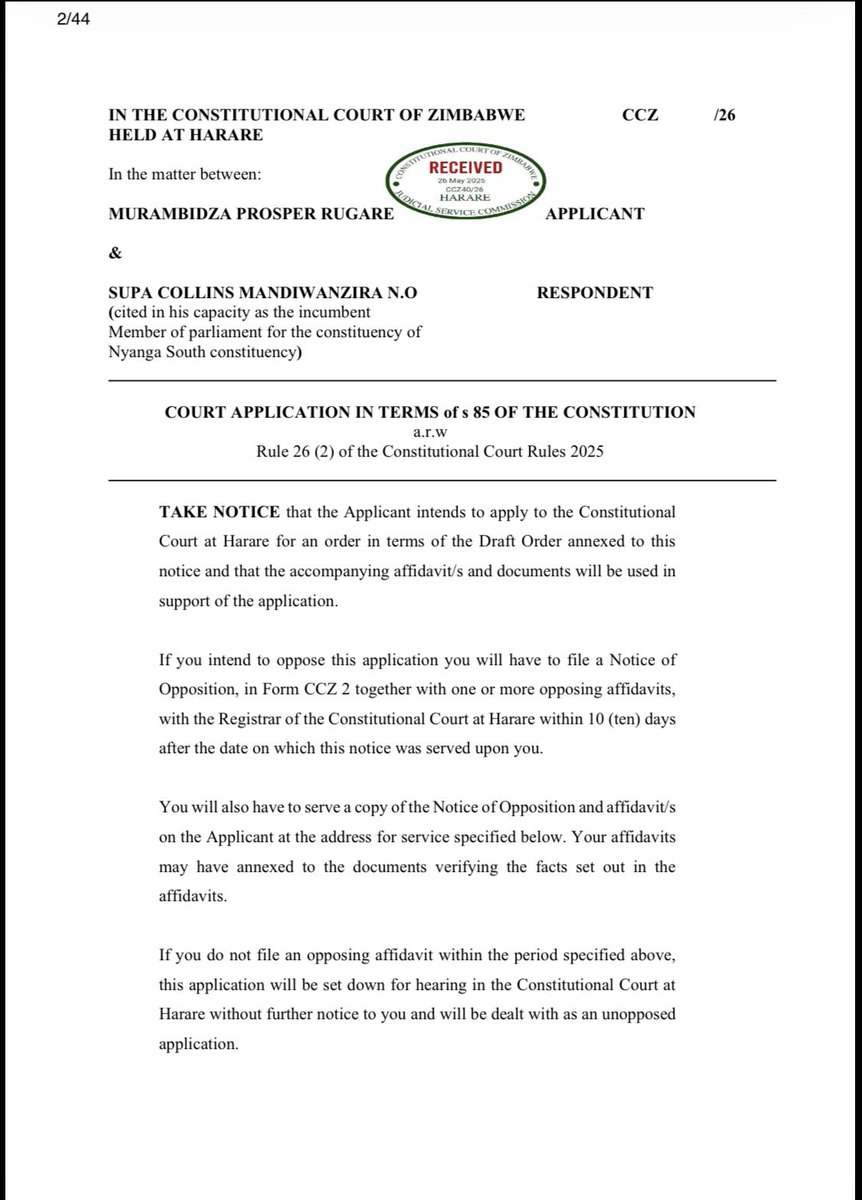
🔹The people of Nyanga South have taken Supa Collins Mandiwanzira to court for attempting to stay in parliament without the people’s mandate and debating CAB3 without consulting the people! See link below 👇🏾: https://t.co/6d052jK2QK