How does anyone buy this nonsense?
-British East India Company — Corporate conquest, taxation, and extraction of wealth from India.
-Dutch East India Company — Military conquest and monopolization of the spice trade.
-Banda Islands massacre — Mass killing and dispossession to monopolize nutmeg production.
-Atlantic slave trade — The buying and selling of millions of enslaved Africans for profit.
-American plantation slavery — Enslaved labor producing cotton, tobacco, and sugar for capitalist markets.
-Royal African Company — A chartered corporation trafficking enslaved Africans.
-Opium Wars — British military force used to secure commercial privileges in China.
-Congo Free State — Forced labor, terror, and mass death in commercial rubber extraction.
-British colonial India — Land dispossession, coercive taxation, and extraction of agricultural wealth.
-British enclosure movements — Common lands enclosed and customary rights extinguished to establish new property relations.
-Indigenous land dispossession — Native American territories seized and transferred into private ownership and commercial development.
-California Gold Rush — Indigenous dispossession and mass violence accompanying mining expansion.
-United Fruit Company — Concentrated landownership, political influence, and exploitation in Central America.
-Amazon rubber boom — Indigenous enslavement and forced labor for commercial rubber production.
-British South Africa Company — Corporate conquest, territorial appropriation, and colonial exploitation.
-Industrial capitalism and labor repression:
-Ludlow Massacre — Armed repression of striking coal miners and their families.
-Homestead Strike — Carnegie Steel's use of Pinkerton agents against striking workers.
-Pullman Strike — Federal troops deployed against railroad workers.
-Battle of Blair Mountain — Armed conflict between coal miners and forces defending mine-owner interests.
-Haymarket affair — Labor repression and controversial prosecutions amid the struggle for the eight-hour workday.
-Triangle Shirtwaist Factory fire — 146 workers killed in a factory with deadly safety failures.
-Company towns — Employers controlling workers' housing, stores, and economic lives.
-Convict leasing — Prisoners, disproportionately Black Americans, leased to private businesses for forced labor.
-Industrial child labor — Children employed in dangerous factories and mines.
-Ford Hunger March — Police and Ford security personnel fired on unemployed demonstrators.
Memorial Day Massacre — Chicago police killed ten people during a steelworkers' demonstration.
Colonial rubber plantations — Coercive labor arrangements supplying industrial markets.
Radium Girls — Workers poisoned by radioactive materials in industrial production.
Asbestos industry — Corporate failures to protect workers and consumers from known health hazards.
Bread and Roses strike — Textile workers fighting low wages, dangerous conditions, and employer resistance.
Imperialism and commercial interests:
Banana Wars — U.S. military interventions protecting commercial and strategic interests.
U.S. occupation of Haiti — Foreign financial control and coercive labor practices.
Guatemala coup of 1954 — CIA-backed overthrow of a government pursuing land reform that threatened United Fruit holdings.
Iran coup of 1953 — British and American intervention amid disputes over oil nationalization and Cold War politics.
Chile, 1973 — Overthrow of Allende followed by dictatorship, repression, and extensive market-oriented restructuring.
Anglo-Persian Oil Company — Unequal oil concessions benefiting British commercial interests.
Colonial Congo mining — Extraction of minerals under coercive and racially unequal colonial institutions.
Apartheid South African mining — Corporate profits supported by a racially segregated labor system.
Indonesia, 1965–1966 — Anti-communist massacres followed by an economic realignment favorable to foreign investment.
Iraqi oil concessions — International petroleum companies securing privileges under British imperial influence.
Financial extraction, fraud, and public bailouts:
Wall Street crash of 1929 — Financial speculation and leverage contributing to economic devastation.
Savings-and-loan crisis — Fraud, reckless lending, institutional failures, and enormous public costs.
Enron scandal — Accounting fraud concealing financial problems and destroying employee and investor wealth.
WorldCom scandal — Corporate accounting fraud on a massive scale.
Financial crisis of 2008 — Predatory lending, securitization, excessive leverage, and widespread foreclosures.
Bank bailouts — Extraordinary public financial support used to stabilize private financial institutions.
Predatory subprime mortgages — Borrowers steered into expensive or unsuitable loans.
Wells Fargo fake accounts — Millions of unauthorized customer accounts created under corporate sales pressure.
LIBOR manipulation — Major banks manipulating benchmark interest rates.
Bernie Madoff Ponzi scheme — Massive financial fraud against investors.
Opioid industry scandals — Deceptive pharmaceutical marketing and failures in drug distribution.
Corporate wage theft — Employers illegally withholding workers' earned compensation.
Price-fixing cartels — Corporations conspiring to raise prices and suppress competition.
Foreclosure-documentation scandal — Improper and defective documentation used in mortgage foreclosures.
Post-Soviet Russian privatization — State assets transferred into private hands amid corruption and insider dealing.
Monopolies, corporate abuses, and public resources:
Standard Oil — Monopolistic practices, preferential railroad rates, and exclusionary competition.
Railroad land grants — Vast transfers of public land to private railroad corporations.
Crédit Mobilier scandal — Corporate insiders extracting profits from federally supported railroad construction.
Teapot Dome scandal — Corrupt leasing of public oil reserves to private interests.
General Motors streetcar controversy — Corporate efforts to monopolize sales of buses and related products.
Tobacco industry deception — Companies concealing or misrepresenting evidence about smoking and addiction.
Bhopal disaster — Thousands killed by a catastrophic gas leak at a Union Carbide subsidiary.
Deepwater Horizon — Catastrophic oil spill involving BP and major failures of industrial safety.
Volkswagen emissions scandal — Corporate deception of regulators and consumers.
Flint water crisis — Cost-driven government decisions and oversight failures exposing residents to contaminated water.
Private prison industry — Corporate revenue derived from incarceration contracts.
Boeing 737 MAX crisis — Corporate safety and regulatory failures contributing to 346 deaths.
East Palestine derailment — Norfolk Southern train disaster releasing hazardous chemicals into an Ohio community.
Love Canal disaster — Industrial chemical waste contaminating a residential neighborhood.
DuPont and PFAS contamination — Industrial pollution, litigation, and allegations of concealed environmental and health risks.
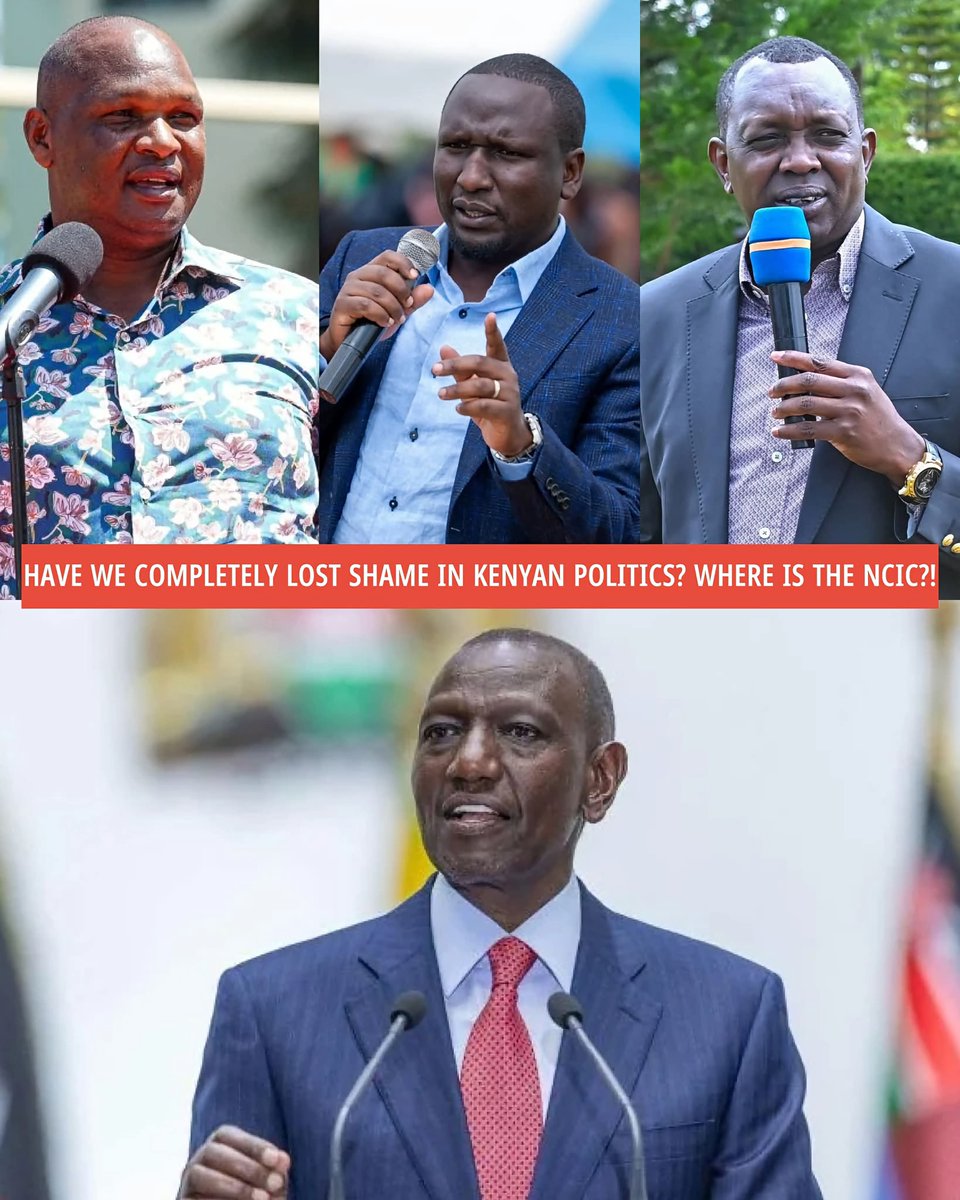
Have we completely lost our sense of shame in Kenyan politics?
What we are hearing from some of our leaders right now is difficult to believe. If we remain silent about the language being used on political platforms today, we risk walking into serious trouble long before the 2027 elections.
In recent days, the President, while speaking in Kisii, used crude and demeaning language against Rigathi Gachagua, describing him as chaotic, foolish, dirty-hearted, and stupid. He also labelled him a master of hate, a conman, and a fraud. When the holder of the highest office in the land resorts to street-level insults, he lowers the standard of public discourse and effectively gives permission for others to go even further.
Oscar Sudi has since made some of the most inflammatory and ethnically charged statements we have heard in a long time. He turned ordinary political disagreement into warnings directed at an entire community. He suggested that Rigathi Gachagua and Uhuru Kenyatta would abandon the Kikuyu community in a ditch, and implied that other Kenyans were waiting for an opportunity to turn against Kikuyus if they did not fall in line. He also accused Gachagua of torturing Kalenjins during his time as a District Officer in Molo in the 1990s, a claim that risks reopening deep and painful historical wounds between the two communities.
At the same time, Sudi publicly body-shamed Uhuru Kenyatta, remarking on the size of his stomach and telling him to go to the gym, leave politics, and raise his grandchildren. He dragged Mama Ngina Kenyatta into the quarrel by calling her an evil woman. Family members who are not active in politics should not be dragged into political fights. He further accused Mt Kenya leaders of preaching tribalism under the guise of unity, and claimed that Uhuru Kenyatta betrayed the Kalenjin community after they supported him in 2013, 2017, and 2022. According to Sudi, Uhuru still owes the Kalenjin a political debt.
Farouk Kibet has repeatedly mocked Rigathi Gachagua’s physical appearance, again referring to him as the man with dirty teeth and a protruding stomach. Aaron Cheruiyot did something similar earlier this week in the presence of the President. All of this has happened within a single week.
Where is the National Cohesion and Integration Commission? Where is the Director of Public Prosecutions? If an ordinary Kenyan made half of these statements, they would likely be arrested by the end of the day. It increasingly appears that some people are above the law while others face its full weight. What kind of justice is this?
Uhuru Kenyatta does not own Kenyan voters. Supporting a candidate five or ten years ago does not create a lifetime obligation. Treating an entire community as if it owes a permanent political debt for past electoral choices is an insult to voters. Kikuyus, like every other Kenyan community, have a constitutional right to change their minds, especially when a government fails to deliver. Kenyans do not belong to Uhuru, Ruto, Gachagua, or any other leader. Voters make decisions based on their daily lives, their incomes, and the quality of services they receive.
Threatening an entire community with isolation or worse because it is unhappy with a government’s performance is not leadership. It is political blackmail and ethnic incitement. If a leader is failing, he should be judged by his record, not by the tribe of his critics. You do not threaten millions of ordinary, hardworking citizens simply because you are losing political ground.
If the NCIC and other law-enforcement agencies will not stop this, then citizens must reject it clearly. We must say no to tribal threats and no to body-shaming. Some of these politicians want Kikuyus, Kalenjins, Luos, Luhyas, Kambas, Kisiis, and other communities to fear one another and retreat into ethnic cocoons instead of uniting around demands for good governance. That is the only tool they have left.
@nankunda6ubt@Meenzie007 Lies!
Ugandans party hard but have never been better than Kenya in music variety.
All clubs in Uganda play the same top 20 day in day out whereas Nairobi has a club for every genre.
William Ruto is no longer running a government; he is running a presidential franchise of fictional destinations. First, it was Bottom-Up. Then Singapore. Now America. Apparently, the only thing this administration has managed to take to the next level is the altitude of its lies.
But here is the problem, Mr (PR)esident: WE ARE STILL WAITING FOR THE BOTTOM-UP YOU SOLD US!
We were promised jobs. We got unemployment dressed up in government statistics. We were promised affordable living. We got a cost-of-living crisis. We were promised economic liberation. We got more taxes, more borrowing and a government seemingly convinced that the solution to every financial problem is to reach deeper into our pockets.
And now you want to take us past America?
“Sir”, some of us are struggling to get past the 15th of the month! Singapore did not become Singapore because Lee Kuan Yew woke up one morning and announced that he would defeat America. America did not become America through presidential motivational speeches.
These countries were built through institutions, discipline, competence, investment and results. Things that cannot be substituted with roadside declarations and presidential theatrics. The most insulting thing about these promises is not even their absurdity. It is the assumption that we are so politically gullible that you can keep changing the destination while never accounting for why we haven't arrived at the first one.
You sold us Bottom-Up. You delivered Bottomless Debt. You promised Singapore. You are now advertising America. At this rate, the only thing your administration is successfully transforming is the art of moving goalposts.
Mr (PR)esident, we don't need you to make Kenya better than America. We need you to make Kenya better than the Kenya you inherited, and better than the Kenya we are currently struggling to survive in.
Stop giving us geographical fantasies. Give us measurable results. A country cannot eat a vision, pay rent with a slogan or educate its children with a presidential promise.
And to Kenyans, the time has come to stop applauding presidential ambition and start demanding presidential performance. We must stop allowing grand promises to reset the national conversation every time the previous ones collapse.
We are citizens, not an audience at a motivational seminar. This is our country, not your political experiment, William. We must demand answers, demand accountability and, when the time comes, exercise our democratic power without fear or sentiment.
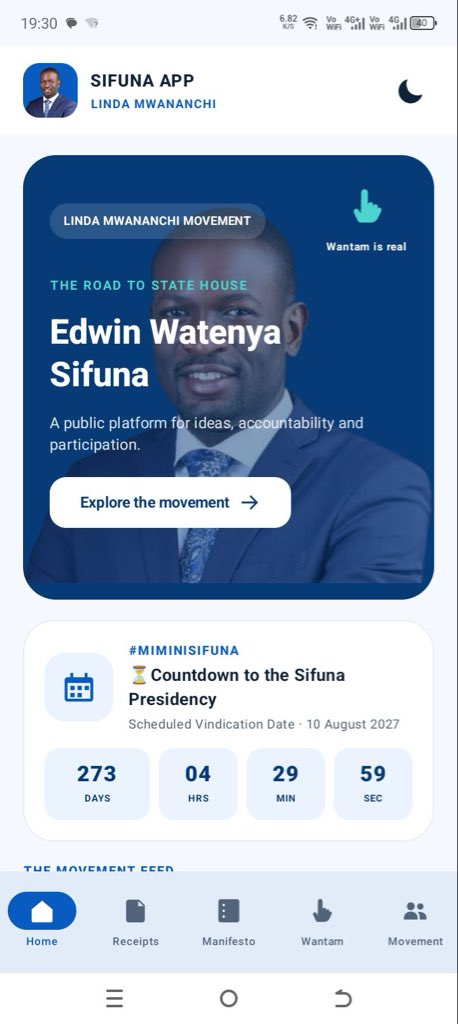
Mr (PR)esident, we have heard your destinations. We have memorised your slogans. Now show us the results. If you cannot deliver the Kenya you promised, spare us the America you are dreaming about. WE ARE DONE BUYING DREAMS ON CREDIT! #Wantam
Sincerely yours, Quincy “Sifuna” Wandera
Why is there still no app for finding someone to drink with? Imagine just swiping and seeing “Bob, 300 metres away, has a 6-pack of Bud Light.” Now that’s a match.