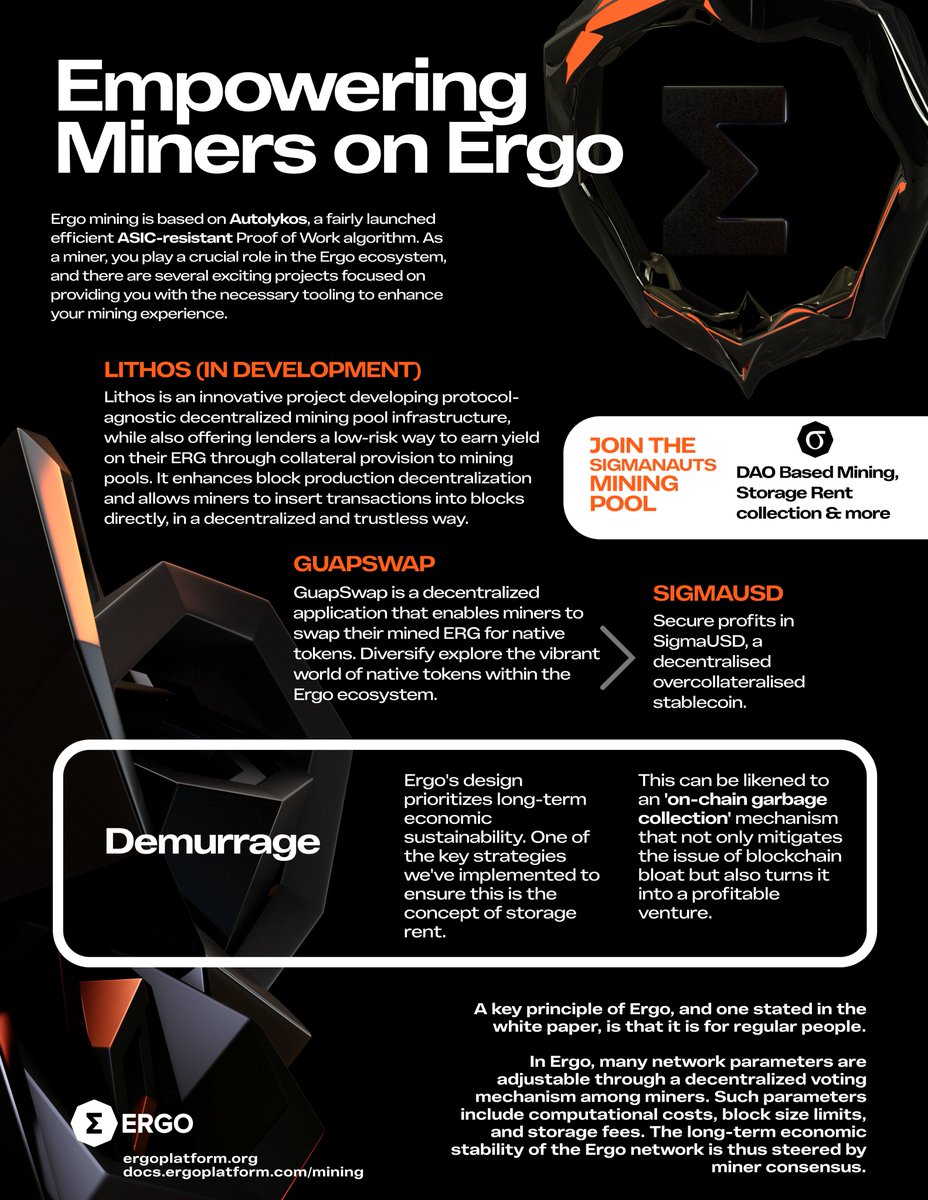
@shishirpai In Lithos, miners submit their own solutions and produce their own blocks. This ensures censorship resistance and better control over votes, storage rent, and MEV. So Ergo governance can return back to being controlled by miners and their hashrate instead of mining pools.
@tmr_erg@LithosProtocol@armeanio@ergo_platform I would say we're on schedule, however we are now working on the rollup contracts and off-chain code which is gonna be the bulk of the work needed for Lithos. If we run into any delays it'll be during this stage.
@armeanio@sigmanaut Trustless pegging and merge mining can help support app-specific sidechains which benefit from the security of Ergo's PoW. Imo this is a great way forward for more complex applications to be created on Ergo, and can serve as an alternative to Layer-2 solutions.
What’s the latest with @LithosProtocol?
The first milestone WIP
Implement Lithos Miner Client:
● Introducing the Solo-Miner / Lithos Client featuring storage rent transactions, MEV, and enhanced transaction selection.
● Lithos emissions and pool functionality contracts
Lithos development is starting.
A universal solution to deliver better economic assumptions to miners and security assumptions blockchains .
@ergo_platform@LithosProtocol
https://t.co/4LjQEXOx6K
Indeed, it became so common these days that people think it is an essential attribute of crypto. No, it is not.
Most of the problems stem from the original sin of the unconstrained account-based programming model of smart contracts.
The model is so attractive for professional developers because they can reuse there skills.
Users, however, mostly unaware of the risks, and of the fact that, due to intrinsic "flexibility" of the "EVM-compatible" smart contracts, developers simply cannot guaranty asset safety. This should change or else users will start to be wary of EVM-compatibility as a sign of a "high risk" or "danger" zone in the crypto world.
On the other side of the spectrum eUTXO-based smart contracts (such as those in @ergo_platform and @Cardano) where you can precisely describe (and also formally verify) the conditions for assets transfer. But, developers need to learn new tricks, which, you know, sometimes can be a really painful cognitive exercise - the main reason of slow adoption of eUTXOs.
@conraddit@ErgoMinnow@LithosProtocol Thanks for letting us know! We'll get that fixed soon. Btw, Lithos is still under-development, it will be an L2 protocol which supports trustless mining pools. We plan to ramp up development starting in the new year.
@sigmaverse_ergo@Ross_Weir@ergo_platform@VitalikButerin I would have to disagree, its quite on topic and the library was specifically designed for PlasmaChains and rollups. Though id say the wording of the tweet is a bit off, as Ethereum is much farther along in terms of these scaling methods. Ofc Ergo is much younger as well.
@SonOfATech@itisabubble @BenLarkey I have no qualms on your other opinions on Ergo (twitter accnt, diff change, etc), but I ask that you at the very least refrain from spreading misinformation.
@SonOfATech@itisabubble @BenLarkey I've seen this misinformation brought up multiple times already in the past. I'm not sure why it continues to prevail. A hard fork by miners is required to change emissions on Ergo. This is no different than Bitcoin, as a hard-fork there could also lead to emission changes.
@CruxFinance@ErgoPadOfficial Excited for the trading floor. More front-ends for SigmaFi is great! It also means additional features can be added, such as loan offers which are not supported by the current SigmaFi frontend.
@zkastn@cafebedouin I believe the limit was either 100 or 200 inputs before the soft fork. Not sure what it is now, given that script execution is more optimized.
SigmaFi was originally going to be primarily miner-focused and called HashrateBonds.
It still is a tool where miners can potentially extend their rewards.
Miners are the initial liquidity providers in proof of work. @Ergo_Platform