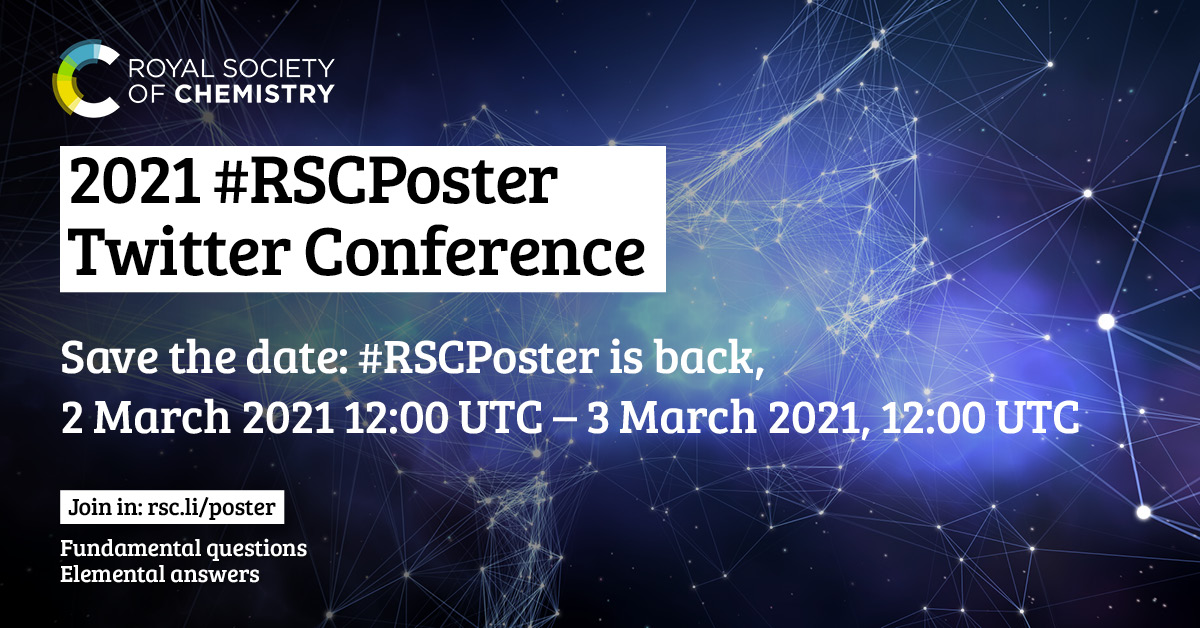
📅 2 March 2021 - Save the date! #RSCPoster 📣
Get ready for another 24 hours of sharing, networking, and engaging with the global chemistry community. Find out more now at ➡️ https://t.co/Klogfx8NB7
🚨 GWPore Conference coming up!!🚨 2-3 February 2021, open to anyone interested in porous materials research 🧽! Talks and posters sought from PhD students and postdocs (there will be prizes 🏆) and social activities 🎊. Sign up till 21 January: https://t.co/6mGhBqUXr3 #gwpore
The Advanced #Composites#PhD programme at the @BristolUniACCIS is still open for applications for 2021 entry! Studentships covering fees and living costs are available.
Find out more ➡️ https://t.co/yUuDMsYG8c
Application deadline: 31 January.
#PhDPosition#FindAPhD
🚨One week till deadline!🚨 We still have presentation slots available at our online Conference (2-3 Feb 2021) on porous materials! To find out how to showcase your work and become part of the international #GWPore network check out our website https://t.co/aO9Wed3uQW
Dexamethasone is widely available and extremely cheap, but researchers are urging caution when interpreting the preliminary trial results
https://t.co/7BVxdqwUeY
#FrontCover: Hydroconversion of perhydrophenanthrene over bifunctional Pt/H-USY #zeolite#catalyst from @IFPENinnovation and @LeuvenU, Part of the Special Collection #FCCat2 https://t.co/NbugU8K2mm
SAVE THE DATE: 3rd EurJOC Virtual Symposium on 1 July 2020, 2-4 PM (CET). Join us for three great presentations by @VarinderAggar11, @BessetTatiana and @CornellaLab
Registration is free at: https://t.co/5Wx45LBdVw #YourJOC
Kovacova et al. investigate solution synthesis routes for fabrication of potassium sodium niobate thin films @PennStateMatSE@PennStateMRI@Xaarplc https://t.co/iK9pT0GYLx
We just got our copy of the June edition of @PhysicsWorld 📰 And we have to say this month's cool front cover is so cool 🎨 We already loved it but when we discovered it belongs to @BristolUniEng's @sonic_bruce and his research group we now love it even more 👍
The Shockley-Queisser limit caps the efficiency of commercial silicon cells to around 29%, but some researchers are hoping semiconducting nanostructures might help us to circumvent the barrier
https://t.co/aX1qBAIIZO