Our new preprint, “Design Principles for Ultra-High-Rate Quantum Codes,” is now available on arXiv!
Joint work with Jong Yeon Lee, Koki Okada, Nishad Maskara, and Hengyun Zhou.
How can we protect more logical qubits with fewer physical qubits? We develop systematic design principles for navigating the tradeoffs among encoding rate, distance, check weight, and blocklength.
Combining pair-partition constructions with a halving transformation, we obtain compact non-CSS codes with weight-10 checks, including [[90,21,11]], [[140,31,15]], and [[200,43,20]]. We identify column weight as a key design parameter and use symmetry to find low-weight logical bases.
This work also subsumes the earlier results of arXiv:2607.14091.
https://t.co/pX122524zB
We’ve just updated our paper:
Pair-Partition Constructions for CPM-Based Quantum LDPC Codes
(arXiv:2607.14091)
This revision strengthens the theoretical foundations of the pair-partition construction and substantially expands the technical details.
New in this version:
• A design theory for the pair partitions underlying the construction
• A detailed construction algorithm designed to facilitate reproducibility
• A rigorous proof of the minimum-distance lower bounds
• A substantially expanded collection of quantum LDPC codes with notable parameters
We’re also updating code parameters, verification data, and evaluation results live on our dedicated project page:
https://t.co/WgLmumREpQ
We hope these additions make the construction easier to understand, reproduce, and extend.
Comments and feedback are very welcome!
https://t.co/OeNNeT0VDI
New preprint with Koki Okada:
Rate-2/3 Girth-8 (3,18)-Regular Quantum LDPC Codes from Two-Branch Finite-Field Bases and CPM Lifts
We construct a rate-2/3 CSS quantum LDPC code with parameters [[34542, 23032, <= 310]] using a two-branch finite-field base and a CPM lift of degree P = 101.
The code is (3,18)-regular: column weight 3 and row weight 18. The Tanner graphs of both H_X and H_Z have girth 8.
Decoder experiments using LLR joint BP with deterministic post-processing show no failures in 10^8 trials at p = 0.01, and a finite-length FER sweep estimates the transition near p = 0.029.
This suggests that structured finite-field bases and CPM lifts provide a promising route toward high-rate, large-girth quantum LDPC codes.
https://t.co/Xp72BoA7s4
For the quantum LDPC code construction in https://t.co/1EclNYZMrI, our current strategy is to tighten upper bounds on the minimum distance as much as possible.
So far, attempts to derive meaningful lower bounds have not been successful. Instead, we track several certified upper bounds and optimize the smallest among them.
Live table:
https://t.co/4kI2E2jrdf
Over the range currently explored, the best certified upper bound appears to grow roughly linearly with blocklength.
At the same time, caution is needed in interpreting this trend. As the blocklength increases, the search cost also grows roughly linearly, and collecting enough samples becomes harder. When the distance is below about 30, BP decoding experiments often recover low-weight logical errors directly. Above that scale, such witnesses become much harder to obtain experimentally.
It is certainly encouraging that, even in large-scale experiments, BP decoding has not produced failures corresponding to very small logical errors. But this is not a proof that the true minimum distance is large.
So while the current data are promising, the true minimum distance could still plateau around 30.
The circuit-level simulations show up to 40% higher thresholds and 30% higher effective distances in loss-dominated regimes compared with existing approaches. When tested on recent experimental data, our hybrid-ML-MLE decoder improved the Lambda factor from 2.14 to 2.24.
Excited to share our new paper on atom loss decoding that achieves optimal distance on surface code. This was an intern project in the summer of 2025, and congratulations to Pengyu Liu, Sam Tan, and Eric Huang who were involved.
Check out the details at https://t.co/Mu9mU55M1g
We also built two new decoders to leverage the power: "Envelope-MLE," an optimal MILP-based decoder that achieves the optimal distance ~d; "Envelope-Matching," a highly efficient MWPM-based decoder reaching ~2d/3. All surpass the previous d/2 limit.
Guided by this framework, we designed the "Mid-SWAP" syndrome extraction circuit that reduces error propagation and reaches the capability of correcting up to ~d atom loss errors.
Atom loss accounts for over 40% of the total errors in recent experiments. Unlike Pauli errors, it’s nonlinear and highly correlated, making it challenging. To address this, we developed the "Pauli Envelope" framework to bounds loss effects into manageable, low-weight Paulis.
New preprint on arXiv.
Title: Breaking the Orthogonality Barrier in Quantum LDPC Codes
https://t.co/1EclNYZMrI
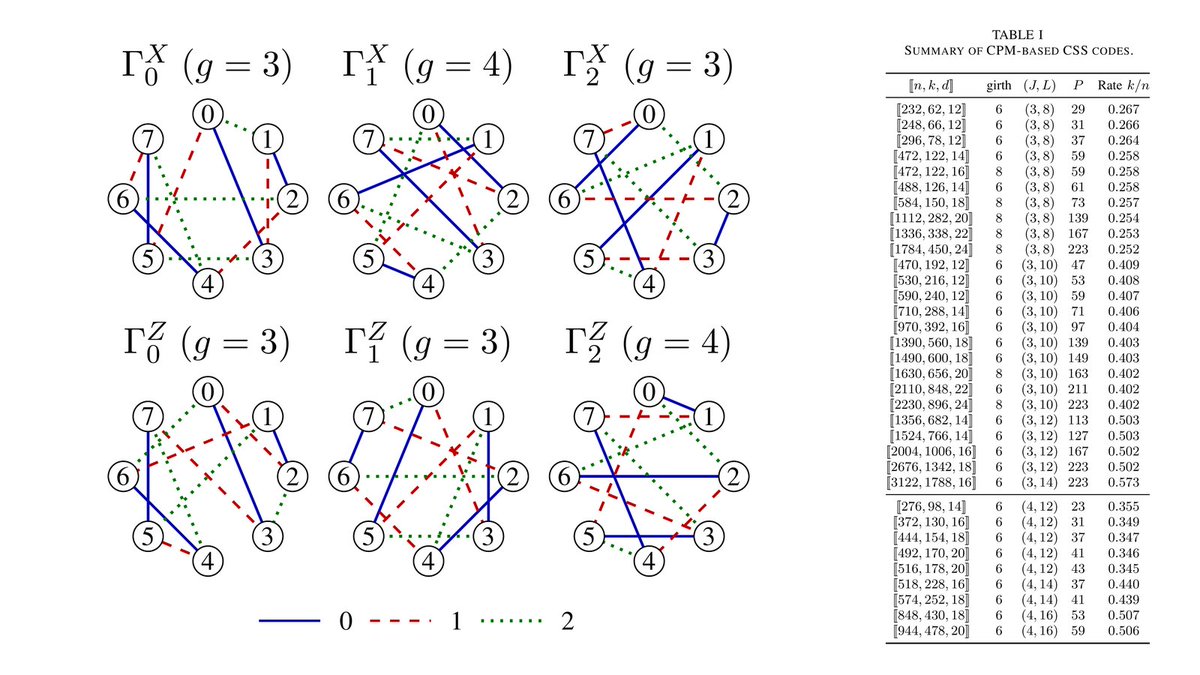
Classical low-density parity-check (LDPC) codes are a widely deployed and well-established technology, forming the backbone of modern communication and storage systems. It is well known that, in this classical setting, increasing the girth of the Tanner graph while maintaining regular degree distributions leads simultaneously to good belief-propagation (BP) decoding performance and large minimum distance. In the quantum setting, however, this principle does not directly apply because quantum LDPC codes must satisfy additional orthogonality constraints between their parity-check matrices. When one enforces both orthogonality and regularity in a straightforward manner, the girth is typically reduced and the minimum distance becomes structurally upper bounded.
In this work, we overcome this limitation by using permutation matrices with controlled commutativity and by restricting the orthogonality constraints to only the necessary parts of the construction, while preserving regular check-matrix structures. This design breaks the conventional trade-off between orthogonality, regularity, girth, and minimum distance, allowing us to construct quantum LDPC codes with large girth and without the usual distance upper bounds. As a concrete demonstration, we construct a girth-8, (3,12)-regular [[9216,4612,≤48]] quantum LDPC code and show that, under BP decoding combined with a low-complexity post-processing algorithm, it achieves a frame error rate as low as 10^{-8} on the depolarizing channel with error probability 4%.
🤡 I added my [MWPF decoder](https://t.co/qhRHqVSTcA) to [stim](https://t.co/o8bl1GD3a7) last September and only recently noticed that the decoding accuracy is way worse than what I got using in-house simulator. I included a fix in mwpf>=0.2.5 (see doc) and it's good to go now!
Our holiday gift this year from QuEra is magic 🪄 https://t.co/aSW0UP5j0R
We experimentally demonstrate magic state distillation on distance 3 and 5 logical qubits on our newly built Gemini-class neutral atom computer.
Our holiday gift this year from @QueraComputing is magic 🪄 We experimentally perform magic state distillation, a key building block of large-scale quantum computers, with distance 3 & 5 logical qubits on our newly built Gemini-class neutral atom computer. https://t.co/1sAYHlidVH
We have a full-time opening on quantum error correction at @QueraComputing! https://t.co/kKBB792kaj. If you know a talented researcher in QEC excited to work on frontier QEC experiments and the path to large scale FTQC, please share it with them


![kasai_lab's tweet photo. Our new preprint, “Design Principles for Ultra-High-Rate Quantum Codes,” is now available on arXiv!
Joint work with Jong Yeon Lee, Koki Okada, Nishad Maskara, and Hengyun Zhou.
How can we protect more logical qubits with fewer physical qubits? We develop systematic design principles for navigating the tradeoffs among encoding rate, distance, check weight, and blocklength.
Combining pair-partition constructions with a halving transformation, we obtain compact non-CSS codes with weight-10 checks, including [[90,21,11]], [[140,31,15]], and [[200,43,20]]. We identify column weight as a key design parameter and use symmetry to find low-weight logical bases.
This work also subsumes the earlier results of arXiv:2607.14091.
https://t.co/pX122524zB](https://pbs.twimg.com/media/HTBzBm3bkAAfiyN.jpg)


![W1LD_44's tweet photo. [Item7]
革命的な素材の組み合わせ、絶対的なパフォーマンス。 世界チャンピオン、Ryan Connolly のシグネチャーモデル、それがRelentlessです。
Ryanは昨年、世界大会で度肝を抜く演技を披露しました。 彼がW1LDに加入した後、私たちは彼の容赦ない(Relentless)構成のために新機種の設計を始めました。
4回の試作を経て生まれたのが、4Aモデルでは新しい、POMボディと真鍮リムの組み合わせです。
真鍮は高密度であると同時に柔らかい素材、それをどのように4Aモデルのデザインに取り入れるか。それは困難な作業でありましたが、完成まで辿り着くことができました。
小径かつ幅広のボディは敏捷性、操作性を高め、真鍮リムは重量配分の可能性を最大限に広げ、圧倒的な安定性をもたらします。
16mmのアクセルも搭載。耐久性に優れ、しっかりと跳ね、競技でのミスもカバーします。
世界チャンピオンが選んだ、この洗練されたデザインをぜひお試しください。
直径:70mm
幅:68.5mm
重量:78.3g
素材 POM+真鍮
価格:15000円
*真鍮リムは全て錆防止処理を施しておりますが、ご使用後はリムを布等で拭くなどして、水分の付着を避けてください。](https://pbs.twimg.com/media/Gt4X9wdW4AAv5xr.jpg)
![W1LD_44's tweet photo. [Item7]
革命的な素材の組み合わせ、絶対的なパフォーマンス。 世界チャンピオン、Ryan Connolly のシグネチャーモデル、それがRelentlessです。
Ryanは昨年、世界大会で度肝を抜く演技を披露しました。 彼がW1LDに加入した後、私たちは彼の容赦ない(Relentless)構成のために新機種の設計を始めました。
4回の試作を経て生まれたのが、4Aモデルでは新しい、POMボディと真鍮リムの組み合わせです。
真鍮は高密度であると同時に柔らかい素材、それをどのように4Aモデルのデザインに取り入れるか。それは困難な作業でありましたが、完成まで辿り着くことができました。
小径かつ幅広のボディは敏捷性、操作性を高め、真鍮リムは重量配分の可能性を最大限に広げ、圧倒的な安定性をもたらします。
16mmのアクセルも搭載。耐久性に優れ、しっかりと跳ね、競技でのミスもカバーします。
世界チャンピオンが選んだ、この洗練されたデザインをぜひお試しください。
直径:70mm
幅:68.5mm
重量:78.3g
素材 POM+真鍮
価格:15000円
*真鍮リムは全て錆防止処理を施しておりますが、ご使用後はリムを布等で拭くなどして、水分の付着を避けてください。](https://pbs.twimg.com/media/Gt4X9wYXAAAZFio.jpg)
![W1LD_44's tweet photo. [Item7]
革命的な素材の組み合わせ、絶対的なパフォーマンス。 世界チャンピオン、Ryan Connolly のシグネチャーモデル、それがRelentlessです。
Ryanは昨年、世界大会で度肝を抜く演技を披露しました。 彼がW1LDに加入した後、私たちは彼の容赦ない(Relentless)構成のために新機種の設計を始めました。
4回の試作を経て生まれたのが、4Aモデルでは新しい、POMボディと真鍮リムの組み合わせです。
真鍮は高密度であると同時に柔らかい素材、それをどのように4Aモデルのデザインに取り入れるか。それは困難な作業でありましたが、完成まで辿り着くことができました。
小径かつ幅広のボディは敏捷性、操作性を高め、真鍮リムは重量配分の可能性を最大限に広げ、圧倒的な安定性をもたらします。
16mmのアクセルも搭載。耐久性に優れ、しっかりと跳ね、競技でのミスもカバーします。
世界チャンピオンが選んだ、この洗練されたデザインをぜひお試しください。
直径:70mm
幅:68.5mm
重量:78.3g
素材 POM+真鍮
価格:15000円
*真鍮リムは全て錆防止処理を施しておりますが、ご使用後はリムを布等で拭くなどして、水分の付着を避けてください。](https://pbs.twimg.com/media/Gt4X9wVXwAALLm-.jpg)


![kasai_lab's tweet photo. Our new preprint, “Design Principles for Ultra-High-Rate Quantum Codes,” is now available on arXiv!
Joint work with Jong Yeon Lee, Koki Okada, Nishad Maskara, and Hengyun Zhou.
How can we protect more logical qubits with fewer physical qubits? We develop systematic design principles for navigating the tradeoffs among encoding rate, distance, check weight, and blocklength.
Combining pair-partition constructions with a halving transformation, we obtain compact non-CSS codes with weight-10 checks, including [[90,21,11]], [[140,31,15]], and [[200,43,20]]. We identify column weight as a key design parameter and use symmetry to find low-weight logical bases.
This work also subsumes the earlier results of arXiv:2607.14091.
https://t.co/pX122524zB](https://pbs.twimg.com/media/HTBzBnBb0AAjs9-.jpg)
![kasai_lab's tweet photo. New preprint on arXiv.
Title: Breaking the Orthogonality Barrier in Quantum LDPC Codes
https://t.co/1EclNYZMrI
Classical low-density parity-check (LDPC) codes are a widely deployed and well-established technology, forming the backbone of modern communication and storage systems. It is well known that, in this classical setting, increasing the girth of the Tanner graph while maintaining regular degree distributions leads simultaneously to good belief-propagation (BP) decoding performance and large minimum distance. In the quantum setting, however, this principle does not directly apply because quantum LDPC codes must satisfy additional orthogonality constraints between their parity-check matrices. When one enforces both orthogonality and regularity in a straightforward manner, the girth is typically reduced and the minimum distance becomes structurally upper bounded.
In this work, we overcome this limitation by using permutation matrices with controlled commutativity and by restricting the orthogonality constraints to only the necessary parts of the construction, while preserving regular check-matrix structures. This design breaks the conventional trade-off between orthogonality, regularity, girth, and minimum distance, allowing us to construct quantum LDPC codes with large girth and without the usual distance upper bounds. As a concrete demonstration, we construct a girth-8, (3,12)-regular [[9216,4612,≤48]] quantum LDPC code and show that, under BP decoding combined with a low-complexity post-processing algorithm, it achieves a frame error rate as low as 10^{-8} on the depolarizing channel with error probability 4%.](https://pbs.twimg.com/media/G-oFX47agAAI5s3.jpg)
![W1LD_44's tweet photo. [Item7]
革命的な素材の組み合わせ、絶対的なパフォーマンス。 世界チャンピオン、Ryan Connolly のシグネチャーモデル、それがRelentlessです。
Ryanは昨年、世界大会で度肝を抜く演技を披露しました。 彼がW1LDに加入した後、私たちは彼の容赦ない(Relentless)構成のために新機種の設計を始めました。
4回の試作を経て生まれたのが、4Aモデルでは新しい、POMボディと真鍮リムの組み合わせです。
真鍮は高密度であると同時に柔らかい素材、それをどのように4Aモデルのデザインに取り入れるか。それは困難な作業でありましたが、完成まで辿り着くことができました。
小径かつ幅広のボディは敏捷性、操作性を高め、真鍮リムは重量配分の可能性を最大限に広げ、圧倒的な安定性をもたらします。
16mmのアクセルも搭載。耐久性に優れ、しっかりと跳ね、競技でのミスもカバーします。
世界チャンピオンが選んだ、この洗練されたデザインをぜひお試しください。
直径:70mm
幅:68.5mm
重量:78.3g
素材 POM+真鍮
価格:15000円
*真鍮リムは全て錆防止処理を施しておりますが、ご使用後はリムを布等で拭くなどして、水分の付着を避けてください。](https://pbs.twimg.com/media/Gt4X9whW8AA8pRV.jpg)