I got a question from a dad recently:
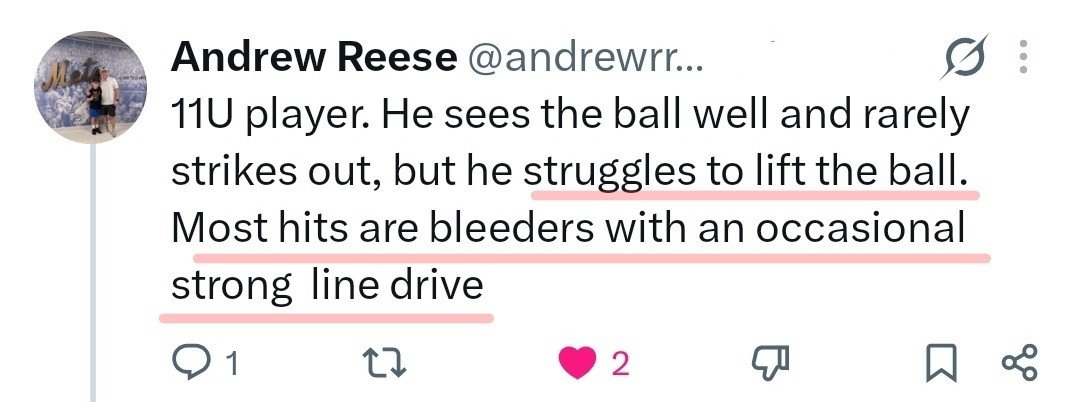
"My son is 11U. He sees the ball well and rarely strikes out, but he struggles to lift the ball. Most of his hits are bleeders with an occasional strong line drive."
Honestly, that's not a bad place to be.
If a player sees the ball well and rarely strikes out, you've already solved one of the hardest parts of hitting.
The problem is what happens next.
Most parents see weak ground balls and think:
"He needs to learn how to lift the baseball."
I actually look at it differently.
Most young hitters don't need to learn how to lift the baseball.
They need to learn how to drive it.
Because when a hitter learns how to drive the baseball, the ball starts carrying on its own.
That's where I use something called the Break The Wall Drill.
I tell hitters:
Don't just hit the baseball.
Imagine there's a wall 6 inches behind it.
Your job is to break the wall.
A lot of young hitters make contact and stop.
The barrel slows down.
The result is bleeders, weak ground balls, and soft contact.
The goal is to keep accelerating through the baseball.
Here's how I'd do it tonight:
Round 1
Place a tee even with the hitter's front foot after stride.
Hit 10 line drives right back through the middle.
The only thought:
Break the wall.
Round 2
Move the tee 6 inches farther out front.
Now hit 10 balls into the pull-side gap.
Again:
Break the wall.
What we're teaching is how to continue through the baseball instead of stopping at contact.
Most hitters who hit bleeders aren't weak.
They're simply slowing the barrel down too soon.
One thing I've learned:
Most young hitters who try to lift the ball end up getting under it.
Most young hitters who learn to drive line drives end up lifting the ball naturally.
So don't focus on lifting the baseball.
Focus on driving it.
The carry will take care of itself.
Thank you for reading,
- Jermaine Curtis
P.S. - If you enjoyed this, and thought it was helpful, please share it.
(This tells me you want more content like this)
Chandler Gilbert CC and South Mountain CC in Phoenix, Arizona are looking to fill open dates in the Spring of 2027 for any out of state teams willing to come to AZ for 5-7 days. 5 game guarantee, a potential 6th game possible.
Week of 2/22-2/28/27
Please contact Jimmy Turk at [email protected] if interested.
The biggest mistake I made as a hitter was trying to learn how to hit the inside pitch.
I was obsessed with it.
I wanted to turn on fastballs.
Hit home runs.
Pull the baseball.
So most of my batting practice was spent trying to hit a pitch that was way out in front.
I remember one series where I couldn't figure out what was wrong.
Every at-bat felt the same.
Ground ball to shortstop.
Ground ball to shortstop.
Ground ball to shortstop.
Then I'd get an offspeed pitch and swing right over the top of it.
I went home frustrated.
Because I was crushing baseballs in batting practice.
But none of it was showing up in games.
One day, my high school coach pulled me aside and said:
"JC, about 7 out of every 10 pitches you're going to see are going to be middle and middle-away."
Then he asked me:
"So why are you spending most of your time practicing the other 3?"
That question hit me.
Because he was right.
I was preparing for the exception.
Not the rule.
From that day forward, I changed how I practiced.
Instead of trying to pull everything...
I started learning how to drive the baseball through the middle and into the opposite field gap.
I learned how to stay through the baseball.
I learned how to let it travel.
And I learned how to hit the pitches I was actually going to see in games.
The funny thing?
I could still turn on an inside pitch when I got one.
But now I wasn't giving away the other 70% of the strike zone.
I followed that advice all through high school.
It helped me earn a college scholarship to UCLA
And eventually...
It helped me play in the big leagues.
One thing I've learned thinking back on that time:
I wasn't struggling because of the pitches I was getting.
I was struggling because of the pitch I was obsessed with.
Thank you for reading,
Jermaine Curtis
P.S. - If you enjoyed this, and thought it was helpful, please share it.
(This tells me you want more content like this)
UCM is looking for multiple teams to play in an early-season tourney.
Jan 29-31 2027. 3 Game Guarantee, Pre Tourney Practice
West Palm Beach Spring Training Complex. Interested please contact:
Kyle Crookes
620-921-5187
[email protected]
Just got off the phone with this hitter in this video, as a recap for this weekend.
A couple weeks ago he had gone hitless in two straight tournaments.
No hits.
Confidence was low.
His dad reached out and said:
"We need to get together."
So we got on the field and went back to work.
The focus wasn't doubles.
The focus wasn't home runs.
The focus was getting back to the middle of the field.
You see, his miss-hits were ground balls to the pull side.
We wanted his miss-hits to be through the middle or into the opposite field gap.
Fast forward to this weekend.
He went 3 for 5.
Had several walks.
Drove in runs.
Executed the plan.
I was fired up for him.
Then his dad asked him:
"Are you happy?"
He said:
"Yeah..."
But then followed it up with:
"I wasn't hitting doubles."
And...
"I wasn't barreling the ball that well."
I laughed and told him:
"What a great place to be."
Think about it.
You weren't at your best.
You weren't squaring everything up.
You didn't feel like you were crushing baseballs.
And you STILL went 3 for 5 with RBIs.
That's progress.
Now if you struggled to get hits this weekend, here's exactly what we worked on:
Round 1: Tee Work
10 swings to the middle of the field.
10 swings to the opposite field gap.
The goal is to find the contact point and feeling.
Round 2: Curveballs
10 swings driving the ball into the opposite field gap.
The goal is learning to stay back and let the baseball travel.
Round 3: Fastballs
10 swings driving the ball back through the middle and opposite field gap.
The goal is learning how to stay through the baseball instead of pulling off it.
Here's Your Action Plan you can do Tonight
✅ 10 swings to the middle of the field off a tee
✅ 10 swings to the opposite field gap off a tee
✅ 10 curveballs to the opposite field gap
✅ 10 fastballs to the opposite field gap
One thing I've learned:
A lot of hitters want to skip steps.
They want doubles.
They want home runs.
They want power.
But before you learn how to hit doubles...
You have to learn how to get hits.
Thank you for reading,
Jermaine Curtis
P.S. If you enjoyed this and thought it was helpful, please share it.
It tells me you want more content like this.
Eastern Michigan University is looking for a pitching development coach, provides the opportunity to get D1 experience. Please send resume and references to Trevor Beerman ([email protected])
When I was with the Cincinnati Reds, my mentor Barry Larkin came into town, and seen me at my worst.
Barry was a mentor of mine.
So naturally, I wanted to show him I could play.
Instead, I had one of the worst series of my career.
Game 1?
I struck out 5 times.
My first and only Golden Sombrero.
For those who don't know, that's what they call it when you strike out 5 times in a game.
The crazy thing is...
I was never really a strikeout hitter.
Game 2 wasn't much better.
I made contact, but I still felt off.
Before the final game of the series, Barry pulled me aside.
He looked at me and said:
"JC, what's going on?"
"You're not playing with a chip on your shoulder."
"Did you forget why you're out here?"
That question hit me.
Because honestly...
I had forgotten.
Baseball had become a routine.
A job.
A grind.
After our conversation, I went back to my locker and grabbed a piece of paper.
At the top, I wrote:
WHY?
Then I started writing.
-I want to provide for my family.
-I want to be successful.
-I want to prove people wrong.
-I want to make it.
The more I wrote...
The more I could feel something coming back.
The fire.
The hunger.
The purpose.
When I finished, I taped the paper inside my locker so I'd see it every day.
That night?
I hit two doubles in the gaps.
More importantly...
I felt like myself again.
So here's what I'd do tonight, if i wanted re-spark the prupose:
Grab a piece of paper and write:
"Why am I doing this?"
Or if you're a parent:
"Why are we doing this as a family?"
Write every reason you can think of.
Then put it somewhere you'll see it every day.
One thing baseball taught me:
When your purpose gets blurry, your performance usually follows.
Sometimes the answer isn't a new drill.
Sometimes it's remembering why you started.
Thank you for reading,
Jermaine Curtis
P.S. - if you enjoyed this, and thought it was helpful, please share it.
(This tells me you wat more content like this)
Before the last Federal Election, I was a strong supporter of keeping Canada together.
I was one of the people who was pushing back against Alberta Independence.
I really thought Canada could start moving in a better direction, with new leadership.
Then the election happened, and the realization finally hit me.
The Liberals have perverted the demographics so severely, that they will never lose another Federal Election.
Canada was never intended to be a dictatorship, but here we are.
So I could either support that, or I could support Alberta Independence.
I chose Alberta Independence.❤️