NATO Threat of Tactical Nukes
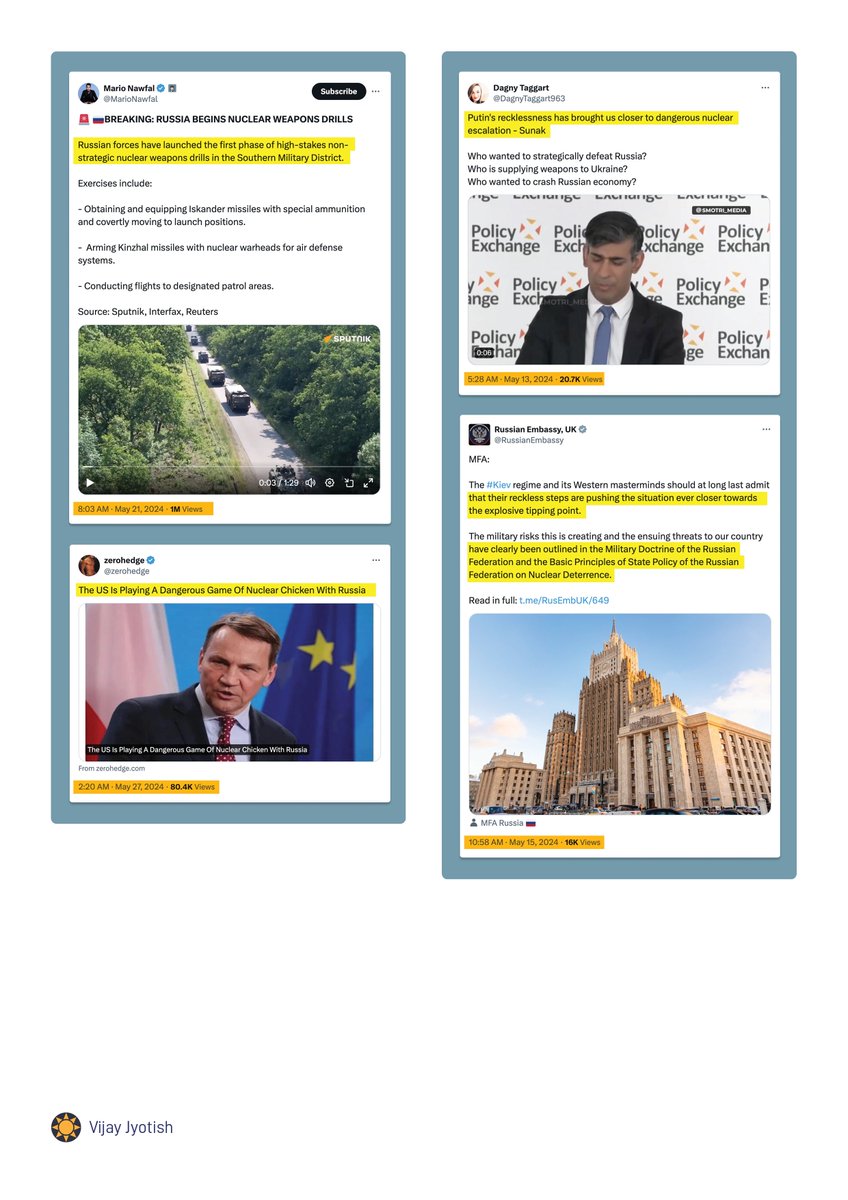
Following a series of setbacks, I predicted that NATO would heighten its rhetoric regarding the potential use of tactical nuclear weapons in April and May 2024. This prediction materialized, prompting a response from Russia, which included the provision of tactical nuclear weapons to Belarus and the execution of tactical nuclear launch exercises during the same period.
@MeidasTouch If it happened occasionally and he just wasn't 'concentrating' it would be different. Every prominent Republican and every member of his campaign team is telling him to stay focused on the issues, stay away from personal attacks, and avoid rambling. Stick to the script. He Can't
"The Enemy Within"
The grind of his war on the truth was accelerating his rapid decline. For years, Trump had waged a battle not only against his political opponents but against reality itself. He had fought facts with sound bites, logic with fearmongering, and consequences with denial. But now, the real enemy wasn’t the Democrats or the media—it was his own body, his own mind, betraying him in the most cruel and inevitable way.
The stories of his decline had been whispered for years, but now, they had broken through to the surface. The New York Times finally did the story—Donald Trump’s cognitive decline was no longer a secret whispered in backrooms or speculated about by pundits. It was now the main story on their site, impossible to ignore, just like the symptoms it described.
“He rambles, he repeats himself, he roams from thought to thought—some of them hard to understand, some of them unfinished, some of them factually fantastical,” the story read. “He voices outlandish claims that seem to be made up out of whole cloth. He digresses into bizarre tangents about golf, about sharks, about his own ‘beautiful’ body.”
It wasn’t just his words that were unraveling. His mind was slipping, and his body—once fueled by vanity and sheer force of will—was following close behind. The Adderall that had once kept him sharp, focused, was no longer enough. He had leaned on it, pushed himself beyond his limits, but now, the body was rejecting its crutch. The sleepless nights, the erratic behavior, the chaotic speeches—they were no longer just political strategy. They were symptoms.
He was losing the war against himself, and for the first time, the public was seeing it for what it was. In his speeches, he would veer off into tangents about his “beautiful body” or how sharks were out to get him. In one particularly baffling moment, he had praised “a great day in Louisiana,” while having spent the day campaigning in Georgia. His mistakes were no longer just political missteps—they were signs of a deeper, more troubling decline.
The article recounted an incident just weeks ago when Trump, in a state of confusion, warned his inner circle that North Korea was “trying to kill me,” though it was clear to everyone he meant Iran. His team had grown used to these slip-ups, gently correcting him, steering him back on course, but the frequency of these lapses was increasing, and the severity was impossible to hide.
Even his most loyal supporters were beginning to whisper. The “strongman” image that had carried him through the past years was cracking under the weight of reality. The man who had once seemed invincible was now showing the world what his closest advisors had known for months—he was unraveling.
The Times article was a tipping point, bringing the whispers into the light. For five weeks after he had withdrawn from the race, Trump had still spoken as if he were running against President Biden, confusing his supporters, his staff, and even himself. The cognitive dissonance that had once fueled his alternate reality was now turning on him, blurring the lines between fantasy and fact in his own mind.
He was fighting a battle that no amount of Adderall could help him win. His body and mind, once the source of his power, had become the real enemies within. And as his empire crumbled around him, the one war he couldn’t afford to lose was being waged inside his own head.
The story of Donald Trump’s decline wasn’t just a headline anymore—it was the reality he could no longer outrun. The man who had spent years dodging accountability, truth, and even his own mortality was now face-to-face with a new kind of reckoning, one that no amount of political maneuvering could stop.
The cracks were deepening. The decline was accelerating. And even as he railed against the “enemy within,” the world watched as the real enemy—his own failing mind—continued to pull him down.
The NY Times finally did a story on Donald Trump’s cognitive decline. It’s currently the main story on their site.
“He rambles, he repeats himself, he roams from thought to thought — some of them hard to understand, some of them unfinished, some of them factually fantastical. He voices outlandish claims that seem to be made up out of whole cloth. He digresses into bizarre tangents about golf, about sharks, about his own “beautiful” body. He relishes “a great day in Louisiana” after spending the day in Georgia. He expresses fear that North Korea is “trying to kill me” when he presumably means Iran. As late as last month, Mr. Trump was still speaking as if he were running against President Biden, five weeks after his withdrawal from the race.”
🔗 https://t.co/4c7XLDH61b
Trump says it’s “very dangerous” for Kamala Harris voters to identify themselves because they’ll “get hurt.”
Question for sane Republicans..
Do you truly think that this is acceptable language for the President of the United States?
Explain your reasoning if you do.
When Hurricane Maria hit Puerto Rico, Trump delayed $20 billion of aid and allowed Puerto Rico to be without power for 181 days.
His botched responses to natural disasters are just a few things you may have forgotten about his presidency.
Poor, desperate, deplorable, cheating, lying GOP. Can you please provide a list of your candidates' crimes? I mean, his larceny, I mean his achievements?
I'll start
This shows nothing negative, except that the do nothing @SenateGOP couldn’t agree on anything enough to get it passed, a historically high 33x, requiring the @VP to do her job.
Just what she will do when elected in November, her job.
What the hell does this mean?
Donald Trump says it’s “very dangerous” for Kamala Harris voters to identify themselves because they’ll “get hurt.”
Is that a threat??
This is masterful. The Lincoln Project is playing mind games with Trump, suggesting JD Vance has secret plans to remove him with the 25th Amendment and take power.
The scary thing? Sounds plausible!
MAGA defends the right to spread lies and defame others by calling it "free speech".
"Free Speech" as protected by the First Amendment has limits. After being sued by Dominion for spreading lies that the vote counting machines were faulty, Fox News had to settle and lose 780 million dollars.
Trump, Leon and other right Wingers are pushing for unlimited speech, the last refuge for crooks and scoundrels.
Unlimited speech is what allowed Nazi Germany to come very close to taking over the entire world. There is no place for it in America.
"The Hurricane of Lies"
By now, the world had grown weary of the endless torrent of lies. But Donald Trump, true to form, persisted, even in the face of undeniable facts. This time, it was Hurricane Helene—a natural disaster that had devastated lives and communities. And yet, Trump managed to turn it into another opportunity to spin his web of falsehoods. His disinformation campaign wasn’t just a flurry of words; it was an orchestrated effort to confuse, deflect, and manipulate the narrative surrounding the federal response to the disaster.
CNN’s resident fact-checker, @ddale8, had seen this playbook before. With surgical precision, Dale put together a timeline that laid out each falsehood Trump had uttered over the course of the week. It wasn’t just one misstep or exaggeration—it was a calculated series of lies meant to erode trust in the Biden administration’s efforts and inflate Trump’s own standing.
Monday: Trump falsely claimed that Biden hadn’t answered calls from Georgia’s governor, a lie meant to paint the president as negligent in the face of a crisis. In reality, the communication lines had been open and active.
Also Monday: Trump took aim at North Carolina, citing baseless "reports" about anti-Republican bias in the state's response to the hurricane. But, as Dale pointed out, there were no such reports—just Trump’s fabrications, designed to stoke partisan anger.
Thursday: Trump falsely claimed that the Biden-Harris response had received “universally” negative reviews. It was a sweeping statement, typical of his rhetoric, but it had no grounding in reality. In fact, many officials, even Republicans, had praised the federal response.
Also Thursday: Trump turned his attention to Vice President Harris, falsely claiming she had spent “all her FEMA money” on housing illegal migrants. It was another lie, designed to tie humanitarian efforts to the border crisis, a favorite target of Trump’s misdirection.
Friday: Trump doubled down, falsely asserting that $1 billion had been “stolen” from FEMA and gone “missing,” supposedly redirected to assist migrants. The claim was absurd and completely unsubstantiated, but Trump’s base lapped it up.
Saturday: As the week wore on, Trump’s lies grew even more egregious. He falsely claimed that the federal government was only giving $750 to people who had lost their homes. The truth was far more complex—$750 was a first step for immediate needs, with more aid on the way—but Trump’s version was designed to inflame.
Also Saturday: Trump closed out the week with yet another falsehood, claiming there were “no helicopters, no rescue” efforts in North Carolina, a blatant lie in the face of the tireless work done by rescue teams on the ground.
For Daniel Dale and millions of Americans, the sheer volume of lies had become overwhelming. It was a never-ending cycle, and even when the truth was exposed, the damage had often already been done. Trump’s lies weren’t just misstatements—they were weapons, aimed at creating division and undermining trust in the government. They weren’t about Hurricane Helene at all; they were about keeping Trump relevant, keeping his base enraged, and keeping the spotlight on him, no matter the cost.
The people on the ground—those who had lost their homes, their livelihoods, and their loved ones—were the real victims. And yet, in Trump’s world, their pain was just another opportunity to spin a narrative, to fuel his endless quest for power and attention.
But the tide was turning. The fact-checkers, led by people like Daniel Dale, were relentless.
Each lie was exposed, dissected, and laid bare for the public to see. The tsunami of truth was washing away the disinformation, even if it took time. The world was over Trump’s lies, and while his base clung to them, the broader public was beginning to see the man for what he was—a purveyor of falsehoods, caught in a cycle of his own making.