Q2 2026
Production: 451,758
Deliveries: 480,126
Energy storage deployments: 13.5 GWh
Our Q2 Company Update will be streamed live on X on July 22 at 4:30pm CT
→ https://t.co/hD2NM6J2L6
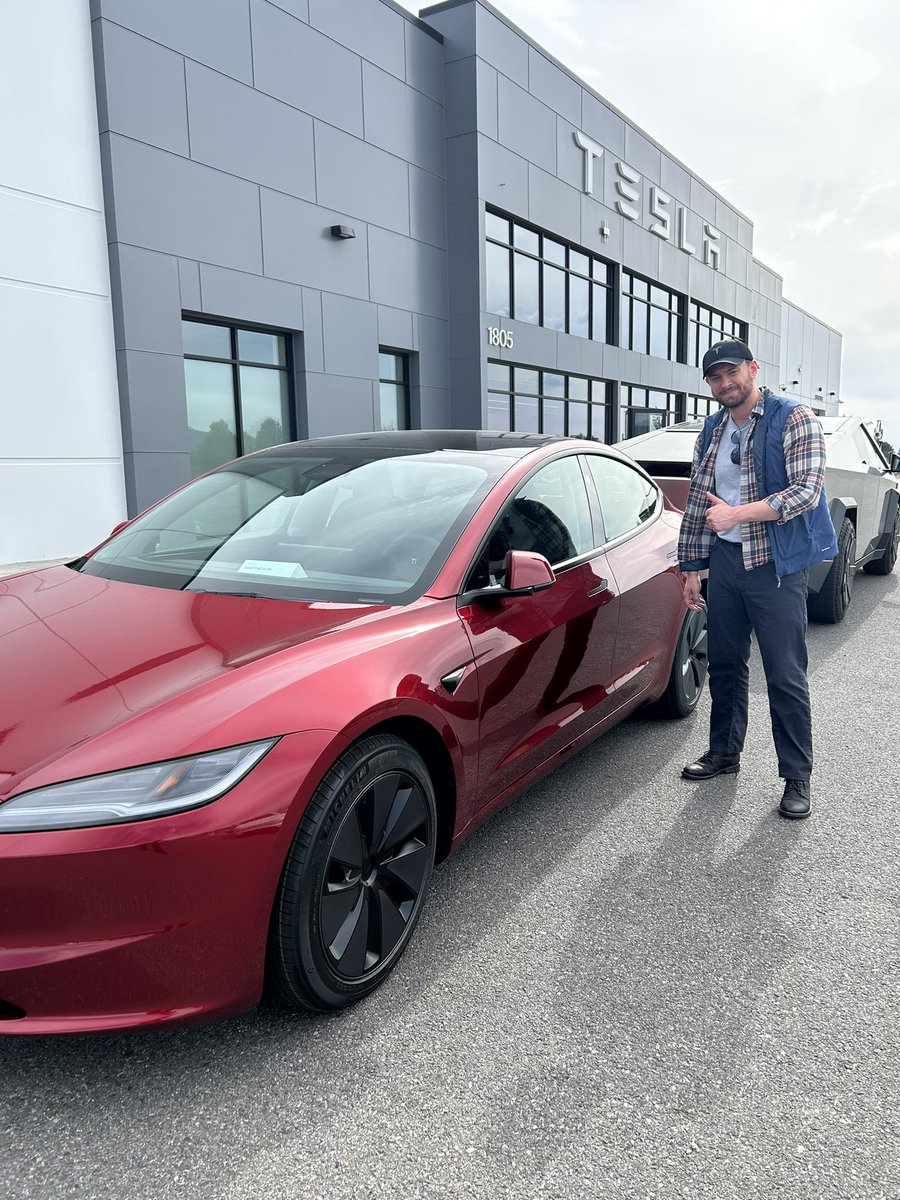
Two friends ordered the Launch edition tonight. One of them with the image below just got into her first Tesla less than three months ago. She’s already upgrading and giving her 2026 to her daughter. She’s gone from zero to biggest Tesla advocate in less than 90 days.
Model Y L Launch Edition includes:
1 year of FSD
1 year of Free Supercharging
1 year Premium Connectivity
Launch Series badges on Interior, Exterior, Door Sills, and Puddle lights
Suede Dashboard Wing
Free Tow Hitch
And all paint, interior and wheel options are included as well
Just wondering… who’s ordering the new Model Y L? 🙋🏻♂️
Tesla just launched the Model Y L (6-seater Long Wheelbase) in the US & Puerto Rico.
Performance & Range
• 0-60 mph in 4.4 seconds
• 325 miles EPA range
• Improved airflow, efficiency & overall range
Seating
• Front: Heated/ventilated seats + powered thigh cushion
• 2nd row: Heated/ventilated captain’s chairs w/ powered armrests + one-touch fold
• 3rd row: Heated seats w/ power recline, one-touch fold + child seat anchors
Cargo & Practicality
• 89 cu ft trunk space - with all 6 passengers still fits 28" + 20" suitcases each, frunk holds another 20", plus bikes/snowboards easy
• Larger tailgate + bigger windows for great visibility & views from every seat
Ride & Quiet
• Upgraded acoustic glass + suspension for minimal road noise
• Adaptive damping for smooth & stable ride
• Staggered tires for enhanced grip
• Improved airflow throughout
Tech, Comfort & Safety
• 16" front + 8" second-row touchscreens + 19-speaker immersive audio
• Upgraded 50W wireless charging pads w/ active cooling + ports for all seats
• Full safety optimized for 2nd & 3rd rows (seat belts + side airbags)
• FSD Supervised + integrated Grok AI
Congratulations to the @Tesla on the launch!
Congratulations to all HW3 Tesla owners!
Today marks the end of a journey that began back in 2019.
Tesla sold HW3 with the promise that it had the hardware needed for Full Self-Driving. Many owners believed in that vision early, purchasing FSD outright for $8,000-$15,000, years before it could deliver its full potential. Those purchases helped fund the continued development of Tesla’s FSD program.
As AI models rapidly evolved, HW3’s limited memory bandwidth became a real engineering challenge. Millions of owners watched HW4 continue advancing while their cars remained on FSD v12.6.4 for more than 15 months.
Instead of abandoning roughly 3-4 million HW3 vehicles, Tesla built a new solution.
Using model distillation, Tesla compressed the intelligence of FSD v14 into a purpose-built model optimized specifically for HW3.
Today, FSD v14 Lite officially began rolling out to early-access HW3 (AI3) owners.
The result:
• Near-feature parity with FSD v14 in supervised driving
• Smoother, more responsive driving
• Parking, reversing, and arrival options
• Improved comfort and safety
• Wider rollout over the coming weeks
This timeline I made tells the story of one of Tesla’s biggest software engineering challenges - from an ambitious promise, through hardware limitations and years of development, to delivering a meaningful upgrade that will impact 4+ million legacy Tesla vehicles.
Major win for the @Tesla_AI team! 👏
FSD v14 Lite is now rolling out to AI3 early-access customers. Based on the feedback, will rollout to more customers over the next few weeks.
This build distills the driving behavior from AI4’s v14 series into both the camera and compute config of AI3. It includes destination options and speed profiles on city roads, but more importantly significantly improved safety.
We hope you’ll enjoy it, once the build ships wide.
Happy birthday to my wonderful son. @elonmusk has given me 55 years of joy.
It’s so much fun to celebrate with family and friends.
His cake is a rocket and a moon base 🎂🎂🎉
Today is @elonmusk's 55th birthday.
In those 55 years, he has only:
• Founded or co-founded 7 multi-billion- or trillion-dollar companies
• Made EVs mainstream
• Pioneered reusable rockets, reducing the cost of access to space
• Created 600,000 jobs (direct+supply-chain)
• Paid out more than $100B in salaries
• Restored astronaut launches to American soil
• Built a global satellite internet constellation used by millions and that connects schools in remote areas, hospitals in isolated regions, supports emergency responders after natural disasters, and more
• Created trillions of dollars in wealth for his company's shareholders & employees
• Enabled paralyzed/disabled people to control computers using thought, bringing more independence
• Created the most productive automotive factory in the U.S. (Tesla's Fremont factory)
• Created the Model Y, which become the #1 bestselling car in the world (first EV to do so)
• Created the first private company to dock with the International Space Station and send astronauts to orbit
• Became NASA's primary commercial launch provider
• Developed the first point-to-point self-driving system (FSD), improving road safety
• Built some of the world's largest and most advanced factories
• Built the world's largest fast-charging network for EVs
• Built one of the world's largest AI supercomputers
• Built operational underground transportation tunnels under Las Vegas
• Helped build what became PayPal and transformed online payments
• Done more than any single individual to accelerate the advent of sustainable energy
• Became the world's greatest entrepreneur
Maybe one day Elon will actually accomplish something 😉 Happy Birthday!
So...
$TSLA is packing parking lots with Robotaxis, releasing the First Responders Guide, pumping out record Cybercabs daily all the while NHTSA officially changes the rules that favours driverless cars with no pedals & steering wheels...
Yup, something definitely feels imminent and really soon.
Cybercab does not have a steering wheel or acceleration and brake pedals like a traditional car. It’s purpose‑built entirely for autonomy
As production ramps up, millions of Tesla Cybercabs will roll out of the factory, driving themselves and handling transportation everywhere
From day one, it’s designed as an autonomous vehicle:
• Two seats
• One large screen
• No driver controls
The goal is simple:
Cybercabs leave the factory and go straight into Tesla’s autonomous ride‑hailing fleet
• Driving themselves
• Moving people around cities
• Scaling transportation without a human behind the wheel
Cybercab is where transportation becomes autonomous by design
Everyone is buzzing about Elon Musk and SpaceX launching a phone service. As of this week it is official, they told IPO investors they are coming for the US mobile market.
So let me walk through what it would actually take, because the dream and the engineering are two different animals.
Start with the network. Starlink direct-to-cell already works. The satellites are basically cell towers in space. But physics is the catch. A satellite 300 miles up can handle texts and basic data out in the open. It cannot see through a roof. The moment you step inside, into a basement or a parking garage, the sky connection dies.
So a real phone service cannot be satellite only. It has to fall back on a ground network instantly. That is why the smart money says SpaceX either rents towers through an MVNO deal, or goes nuclear and buys T-Mobile or AT&T outright, which is actually being floated. The $17 billion in spectrum they just bought is the tell.
The hard part is not the rockets. It is the invisible handoff between satellite and ground.
Then the phone itself. Musk says he would build one as a forcing function. But that needs a hardware partner, custom chips, and years. He admits it is two years out.
And the software. Remember the Fire Phone? Amazon tried this and died in a year, because a phone with no apps is a paperweight. No banking, no Uber, no group chat, dead on arrival.
But Musk owns X, Grok, and Starlink. He could bake messaging, payments, and a real AI assistant into the OS itself. The everything app. That is the only version with a prayer.
So what would it take? Spectrum he is buying. A network he must rent or own. A phone two years out. A new OS with apps from day one. And a seamless handoff that makes it all feel normal.
That is a mountain. He is one of the few who might climb it.
And here is where I land. I do not care whose name is on the phone. iPhone and Android have run a cozy duopoly for fifteen years, and your bill reflects exactly how much competition they feel. None.
Bring on a third option. Make them sweat.
Competition is the only thing that has ever lowered a price in the history of the world.
Write that down. 🦋
Wow, this is so cool. The Tesla Cybercab has exterior microphones on the B-pillars so first responders can speak to Tesla Support from outside the vehicle.
There is speakers on the underside so first responders can have a two-way conversation from outside (plus additional speakers and mics in the cabin). So smart.
Starlink is preparing to become a full-fledged mobile carrier
The telecom industry could be about to undergo one of its biggest shifts in decades
According to the Financial Times, SpaceX plans to launch a direct-to-consumer mobile service, taking on AT&T, Verizon, and T-Mobile head-on
The foundation is already in place:
• $17B+ acquisition of EchoStar wireless spectrum
• FCC approval secured
• Exclusive spectrum for next-generation Direct-to-Cell services
Instead of relying on carrier partnerships, Starlink could soon sell mobile plans directly to consumers
NEWS: California small fleets can now buy a Tesla Semi for as low as $50,000 by stacking two state incentive programs, Tesla Semi announced today.
The Tesla Semi MSRP is $290,000.
HVIP, the existing Clean Truck and Bus Voucher program, gives $120,000 off each Semi for up to 20 trucks.
CCFR, California's new Clean Fuel Reward program launching today, gives an additional $120,000 off each Semi with no purchase limit.
Combined, that is $240,000 in incentives. Net cost to a small fleet would be $50,000 per Semi.
That is 83% off the sticker price.
CCFR has $250 million available in 2026 and over $1 billion committed through 2030.
The program is funded by California's Low Carbon Fuel Standard, not federal money. It is independent of any federal EV credit changes.
Tesla Semi has captured 965 of 1,067 HVIP applications in California from January 2025 through February 2026. That is roughly 90% market share.