I was very honored to speak with Alexander Mercouris of the Duran about the war in the Persian Gulf and the broader war against BRICS and the multi-polar world.
https://t.co/hUlYBPNrSf
@RebeccaYChan@RebeccaYChan I published an article titled Economic Chemotherapy on April 12th. People are starting to realize I was right. https://t.co/tjEPpxfT2r
I agree with Ryan Perkins' @ChinaIndicator analysis. Look at US position/policy papers and Bessent's record.
Secret Plan to Destroy BRICS and Crash China w/ Ryan Perkins https://t.co/ukuwHXSgkv via @YouTube
Saudi East–West Pipeline: Drone attacks launched from Iraqi territory have severely damaged the pipeline, with operations expected to remain substantially disrupted for 3–5 weeks. Saudi and Iraqi authorities confirm the drones originated from Iraqi territory. According to Radio Free Europe, Iran has denied responsibility. AFP separately reported that Iraqi security forces found drone launchers in the al-Tib area of Maysan, close to the Iranian border. Iran-aligned Iraqi militias deny responsibility saying “We would be proud if we did it,” and no other group has claimed the attack. Throughout the war, Iran has denied targeting GCC energy infrastructure. So, the question is, who is blowing up GCC energy infrastructure and to what end?
https://t.co/8AC8Ub8ZwD
@JoshYoung@WSJ Since April, I have explicitly stated the U.S. war in the Persian Gulf was designed to orchestrate a coordinated fuel-food price spike starting in September and escalating toward the end of the year.
https://t.co/wqSsvgL33w
@Craig_Steinke Who blew it up? Iran has repeatedly denied targeting GCC energy infrastructure throughout the war. Saudi says drones launched from Iraq. Houtis have denied responsibility. Who is destroying GCC energy infrastructure?
The data are converging toward the hypothesis what I outlined in April.
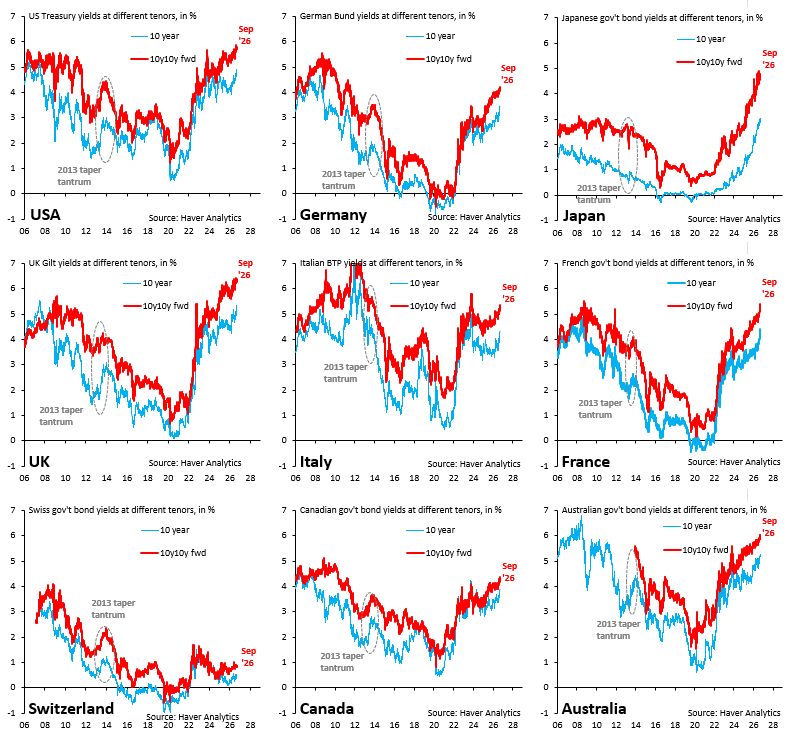
Hormuz remains impaired. Saudi Arabia’s East–West bypass is offline. Russian refining is under pressure. Diesel is at record stress. Energy inflation is appearing in CPI/PPI, central banks are repricing, and sovereign yields are rising.
Food will follow. Agricultural inputs are moving first; consumer food inflation has yet to break decisively higher.
Energy → fertilizer/freight → food → inflation → bonds.
We are now well into that transmission chain.
#Oil #Inflation #Hormuz #Bonds #FoodPrices
@piranino Thank you. There is a lot more on my blog. In the interview I only really covered the initial formulation which I proposed in April. Since then I’ve written numerous updates and expanded upon the hypothesis.
I was very honored to speak with Alexander Mercouris of the Duran about the war in the Persian Gulf and the broader war against BRICS and the multi-polar world.
https://t.co/hUlYBPNrSf
What's amazing about the global bond sell-off is how many people are saying rising yields are about strong growth. Seriously!? You think rising yields in Japan, France, Italy or UK are about growth? We're in a global debt shock. Not a global growth shock.
https://t.co/jYf8dyylvD
1/10
The energy market calm is not resilience. It is suppression.
The latest update to the Petroyuan Trap series examines what happens when the compressed spring releases—and why China and India are at the centre of the Trap.
In this article I first argued the purpose of the Iran war was to close the Strait of Hormuz. Economic Chemotherapy, 12th April.
https://t.co/xrMFKf7yvl
1/10
The energy market calm is not resilience. It is suppression.
The latest update to the Petroyuan Trap series examines what happens when the compressed spring releases—and why China and India are at the centre of the Trap.
I’ve been arguing since April the primary purpose of the Iran war was to createthe economic conditions for a financial trap indended to create leverage to force China into a Plaza Accord type arrangement. Here @BenjaminNorton responds to a WSJ article arguing economic sanctions should be used to coece China into accepting it. These economic sanctions will amplify the pressure created by the Trap caused by US actions in the Gulf of Hormuz.
https://t.co/DFnCcI6Xo2
Over the past ten months, in this series I’ve traced the convergence of fault lines growing beneath the U.S.-centric financial system. So far, this year, the series has covered three geographically distributed but intimately connected vulnerabilities. The events we’ve seen so far in August are not separate events. They are the convergence of these three fault lines. The yen crisis and the South Korean AI-supply-chain stock collapse are visible fractures that represent different aspects of the AI stock boom rupturing: the funding and the physical supply chain with energy prices as an accelerant.
https://t.co/pWhME9jvxV
The ECB published a scenario analysis that describes one of the vulnerabilities highlighted in the Trap hypothesis: The macroeconomic consequences of a prolonged disruption to Gulf energy exports. Its findings position China at the centre of them.
https://t.co/XRByVtgfLP
I was very honored to speak with Alexander Mercouris of the Duran about the war in the Persian Gulf and the broader war against BRICS and the multi-polar world.
https://t.co/hUlYBPNrSf
"A broader conflict causing major damage to energy infrastructure could push prices as high as $150, Bank of America warned." BoA
https://t.co/pR7xHNKoun