China automotive & manufacturing insider | Former overseas lead at major Chinese OEMs | Helping global distributors with sourcing, KD & OEM partnerships
Xiaomi’s first overseas battle will therefore be unusually concentrated:
One country.
One 50,000-unit target.
No tolerance for channel disorder.
Germany will show whether Xiaomi’s China playbook can survive contact with Europe’s toughest major car market.
So before Q4, some channels may be able to show an authorization, quote prices and even take deposits.
But they are unlikely to secure stable supply.
They may have the authorization—but not the cars.
My judgment: to protect the German launch, Xiaomi will block or suspend bulk orders that could feed parallel exports.
China-spec cars circulating overseas before the official launch would disrupt pricing, warranty, software, service and brand positioning.
During the Beijing Auto Show in April, Xiaomi formally authorized an overseas sales channel to export China-spec vehicles.
But authorization on paper does not guarantee vehicle allocation.
In China’s auto industry, the contract and the cars are two different things.
The target is enormous.
Germany registered about 545,000 BEVs in 2025. A 50,000-unit first-year target equals more than 9% of that market.
For context, Tesla sold 19,390 cars in Germany that year; BYD sold 23,306 across all powertrains.
Germany-spec vehicles are expected to be delivery-ready by the end of 2026, while the sales launch and order intake could begin in Q3.
That timetable also explains why Xiaomi now has a strong incentive to impose tight control over overseas supply.
Why Germany?
This is not purely a market-driven decision. It is also connected to the internal power dynamics within Xiaomi Auto—particularly the rivalry between its Beijing and Shanghai teams.
I’ll leave it there for now.
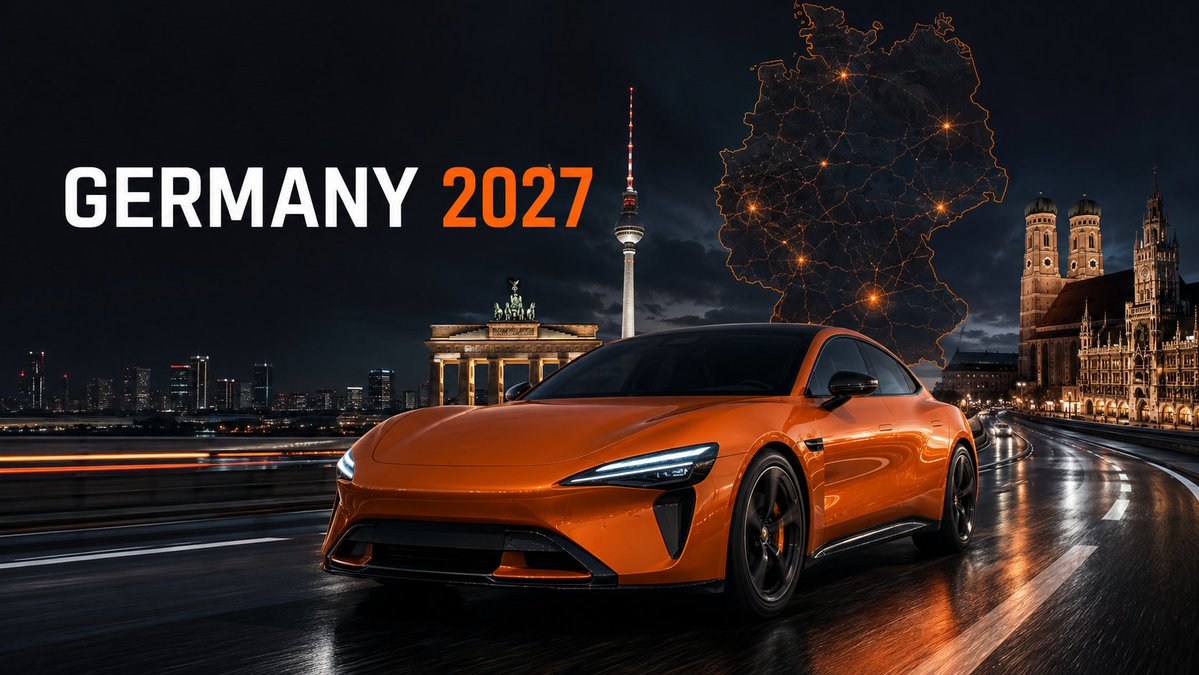
Xiaomi Auto is not really “going global” in 2027.
It is going to Germany.
Its German team has been given a 50,000-unit sales target—effectively Xiaomi Auto’s entire overseas target for the year.
Here is what is really happening. 🧵 #xiaomi
Publicly, Xiaomi has confirmed Europe as its first overseas destination for 2027 and established an EV R&D and design center in Munich.
Internally, the focus is much narrower: in its first overseas year, Germany is essentially the whole plan.
The mandate is unusually blunt: if the German team fails to sell 50,000 cars in 2027, the whole team walk.
The team is already hiring and building the commercial organization.
This is not a pilot launch. It is a make-or-break campaign.
My interpretation:
BYD is not completely banning parallel exports.
Instead, it is using inventory age to separate two channels:
• new vehicles for official overseas networks
• aged inventory for non-official export channels
This is a more precise form of channel control than a simple export ban.
It also shows that BYD is becoming increasingly determined to protect overseas pricing, authorization and distributor relationships.
BYD’s control over parallel exports is becoming more sophisticated.
According to industry contacts, BYD internally classifies vehicle inventory by age:
• C inventory: less than one month after production
• B inventory: one to three months
• A inventory: more than three months
This classification is now being used as a channel-control tool.
The policy has two effects.
First, it protects official overseas distributors from competing against freshly produced China-spec vehicles.
Second, it turns unofficial export channels into an inventory-clearance mechanism.
Parallel exporters may still obtain vehicles — but mainly the vehicles BYD’s domestic system has already struggled to sell.
My view:
BYD is not simply “localizing” its overseas business.
It is attempting to turn the operating model developed in the Americas into a global organizational template.
The key question is whether a model that worked in one region can be copied into Europe and the Middle East without destroying institutional knowledge and operational continuity.
Localization can strengthen an overseas organization.
Poorly managed localization can also dismantle one.
Whatever the private history, the business implication is clear: Stella is not merely another regional executive. She now holds exceptional authority over BYD’s global expansion.
How is BYD reorganizing its overseas business?
According to industry contacts, BYD’s international passenger-vehicle business was traditionally divided into four major regional organizations:
• Asia-Pacific
• Middle East & Africa
• Europe
• The Americas
In recent years, however, the internal balance of power has changed significantly.
Asia-Pacific has so far remained relatively independent from this restructuring.
The reason is straightforward: its market performance has been strong.
Its regional head has also been promoted to a senior group-level position, giving the organization greater political weight inside BYD.