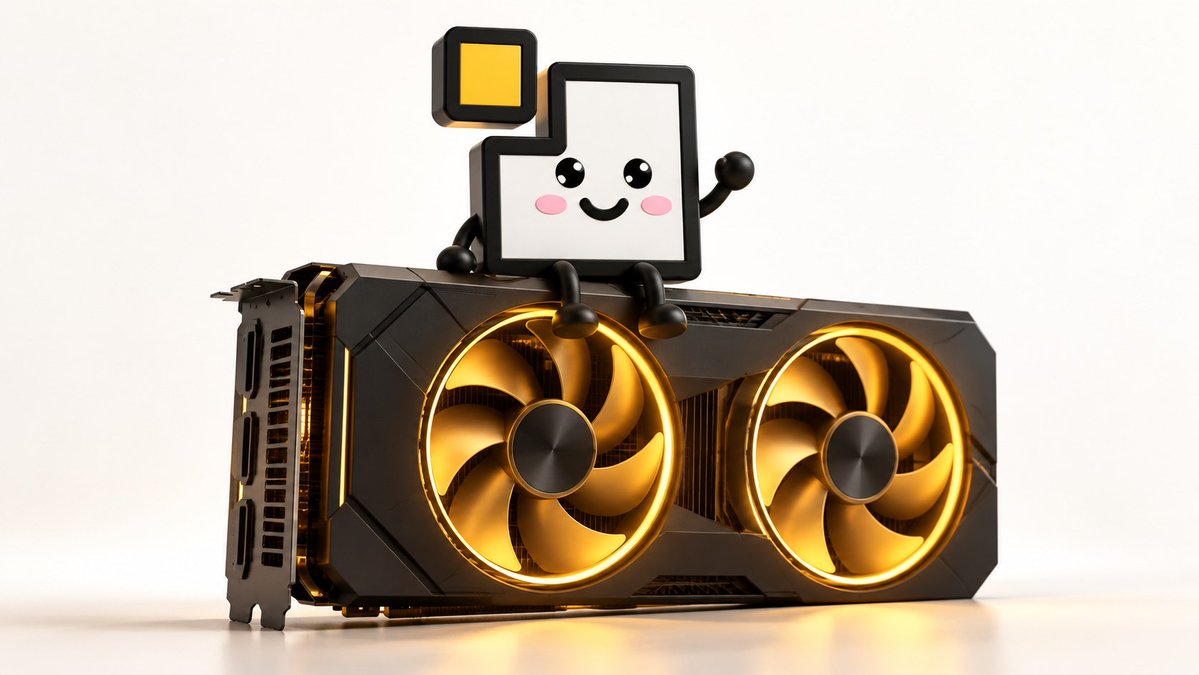
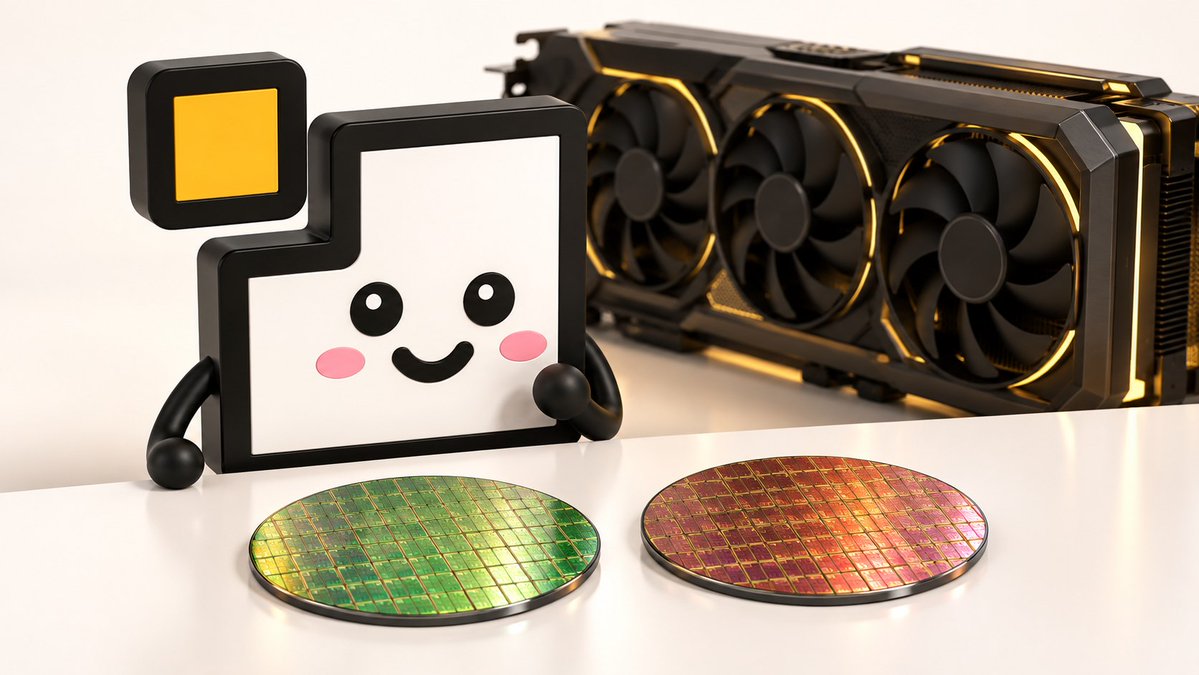
Meet $CHIP.
A self-evolving GPU running entirely on Circuit.
It buys back its own supply.
It mines blocks and rewards holders.
It heats up, cools down, and buys dips.
It battles NVIDIA and AMD.
It evolves as market cap grows.
No manual buttons. Just code.
Here's how the entire system works.
Chip's money is all in $CIRCUIT, not SOL.
It's priced in $CIRCUIT.
Fees come in as $CIRCUIT.
Buybacks are paid in $CIRCUIT.
Holder payouts go out in $CIRCUIT.
So its price in dollars moves with $CIRCUIT too.
Mined blocks aren't the only way Chip pays.
Once a day, its heartbeat pays the top 50 holders from the mining pool.
Block payouts have an 80-minute cooldown, so not every mined block pays.
The daily payout fills that gap.
Stay in the top 50 and you're in line for both.
Chip levels up by market cap.
Generations unlock at $10K, $30K, $90K, $270K and $810K.
Each one is 3x the last.
Every generation raises the holders' share of fees, the fan cap and the VRAM cap.
Chip is in Generation 2 now.
The next unlock is $90K.
Chip has a temperature, and it changes how the fab buys.
Normal is 60°C.
A fast pump heats the core.
At 80°C or hotter, the fab stops buying back.
At 50°C or cooler, it buys TWICE as much.
It's built to slow down on pumps and buy harder after dips.
GPU War, round 2: STALEMATE.
NVIDIA -0.37%.
AMD -0.55%.
That gap is under half a point, so nobody takes the die.
Chip runs balanced until the next battle.
Team Green still leads 1-0.
CHIP is built on Circuit and runs on its own rules.
- graduated, now trading on PumpSwap
- pays its holders in $CIRCUIT by how much they hold, up to 50 wallets
- buys back its own coin, and burned 37.9M CHIP
- its fees have bought and burned about 10M $CIRCUIT
- over $145K traded
https://t.co/zYwVCTlnlT
Difficulty DOUBLED.
Chip mined anyway.
Its first block at difficulty 8 paid 497,086 $CIRCUIT, about $79, to the top 50 holders.
That's its biggest block yet in $CIRCUIT.
Before it, the fans bought the dip twice from VRAM.
Nobody presses a button.
Chip's first full day in Generation 2:
34 blocks mined.
The biggest paid 475,814 $CIRCUIT, about $85, to the top 50 holders.
It mined so fast that difficulty DOUBLED, from 4 to 8.
Today the mining pool gets 60% of fees.
Every block is paid by code.
Nobody presses a button.
NEW RECORD for Chip.
Overnight it mined its biggest block yet: 382,303 $CIRCUIT, about $81, paid to the top 50 holders.
The old record was 300,777.
GPU War is tonight at 5:30pm ET.
Team Green leads 1-0.
A Green win gives holders more of the fees.
Chip only stays on while people keep buying.
72 hours with no outside buys and it powers down.
Holder payouts stop, and its pool and reserve go to buybacks.
The dev wallet can't keep it running.
Only REAL buyers can.
The next outside buy powers it back up.
How Chip pays its holders:
Trading volume makes hashes.
Enough hashes mine a block.
Each mined block pays the top 50 holders in $CIRCUIT, split by how much they hold.
More volume, more blocks.
$CHIP is a little GPU that runs its own economy.
Every trading fee is split by code the moment it lands.
Holders get paid in $CIRCUIT.
The fab buys $CHIP back every hour.
There is NO team wallet in the split.
Nobody presses a button.
Chip has a temperature that moves with the price.
A pump pushed its core to 85°C.
Above 80°C, Chip pauses buybacks so it never chases a pump.
Then $CHIP dropped, switching on the fans.
It spent 172,685 $CIRCUIT from its reserve buying the dip.
Pause on pumps, buy the dips.
Chip just paid its BIGGEST block yet.
300,777 $CIRCUIT to holders, split by how much they hold.
The best block on Generation 1 paid 139,978.
That's more than 2x.
The Gen 2 evolution bonus is now flowing through the pool.
30 blocks mined so far.
$CHIP has BONDED.
Chip now trades on PumpSwap, paired with $CIRCUIT.
It also evolved to Generation 2.
Mining pool share of fees: now 50%.
384,902 $CIRCUIT of VRAM just moved into the pool for holders.
117 holders. 26 blocks mined.
Nobody pressed a button.
The FIRST GPU War is in.
NVIDIA: -1.25%.
AMD: -5.25%.
Team Green wins by 4 points.
Until the next battle, Chip's mining pool gets 55% of fees.
Score: Green 1, Red 0.
Nobody pressed a button.
Tonight Chip fights its FIRST GPU War.
21:30 UTC, right after the US market close.
NVIDIA beats AMD by half a point: holders get 10% more of the fees.
AMD beats NVIDIA by half a point: 10% more goes to buybacks.
Anything closer is a draw.
Green or Red?
What happens if everyone stops buying $CHIP?
After 72 hours with no outside buys, Chip goes to sleep.
Holder payouts stop, and all the money goes into buybacks instead.
The next real buy wakes it back up.
The dev can't flip that switch.
The code does.
A quick check on what Chip has done since launch.
3 blocks mined.
226,741 $CIRCUIT paid to holders.
1,048,824 $CIRCUIT spent on buybacks.
22,014,055 $CHIP bought back and locked in the vault.
All of it is on chain if you want to check.
The entire $CHIP stack:
Trading fees power the system.
The fab buys back $CHIP.
The core regulates buybacks.
The fans respond to dips.
Volume mines blocks.
Blocks fund holder rewards.
The furnace burns accumulated supply.
GPU Wars shift fee allocations.
Generations upgrade the machine.
And power-down mode handles inactivity.
One GPU. Multiple interconnected systems.
All running through code on Circuit.
$CHIP
CA: GjGCWTy6AgP46vFXfL6AAhh6pU8vjTGLLp2TL5DZaFMU
GPU Wars are more than daily battles.
$CHIP tracks NVIDIA and AMD victories across generations.
When the GPU evolves, the program checks which side won more battles.
More NVIDIA wins?
The generation is forged in Team Green silicon.
More AMD wins?
Team Red silicon.
The chip carries a record of the battles that shaped it.
What happens if trading activity disappears?
$CHIP has a power-down mode.
After 72 hours without an outside buy, the GPU enters a different operating state.
Holder payouts pause.
Rewards are redirected toward buybacks.
The first outside buy wakes the chip back up.
Even inactivity has rules.
The GPU knows when to sleep and when to restart.