A better framework for this list: Build a hyper-simplified, 200-line version of one of these (e.g., a basic shell or lexer) to understand the system calls, then immediately return to high-level abstractions to ship actual products.
For people who keep asking what to build
- Build your own operating system
- Build your database
- Build your virtual machine
- Build your web server
- Build your own game engine
- Build your compiler
- Build your own programming language
- Build your own browser
- Build your own blockchain
- Build your own encryption algorithm
- Build your own CPU emulator
- Build your own file system
- Build your own container runtime
- Build your own package manager
- Build your own shell
- Build your own window manager
- Build your own GUI toolkit
- Build your own text editor
- Build your own IDE
- Build your own version control system
- Build your own network protocol
- Build your own operating system kernel in assembly
- Build your own scheduler
- Build your own memory allocator
- Build your own hypervisor
- Build your own microkernel
- Build your own compiler backend (LLVM target)
- Build your own query language
- Build your own cache system (like Redis)
- Build your own message broker (like Kafka)
- Build your own search engine
- Build your own machine learning framework
- Build your own graphics renderer (rasterizer or ray tracer)
- Build your own physics engine
- Build your own scripting language
- Build your own audio engine
- Build your own database driver
- Build your own networking stack (TCP/IP implementation)
- Build your own API gateway
- Build your own reverse proxy
- Build your own load balancer
- Build your own CI/CD system
- Build your own operating system bootloader
- Build your own container orchestrator (like Kubernetes)
- Build your own distributed file system
- Build your own key
-value store
- Build your own authentication server (OAuth2/OpenID Connect)
- Build your own operating system scheduler
- Build your own compiler optimizer
- Build your own disassembler
- Build your own debugger
- Build your own profiler
- Build your own static code analyzer
- Build your own runtime (like Node.js)
- Build your own scripting sandbox
- Build your own browser engine (HTML/CSS/JS parser and renderer)
- Build your own blockchain consensus algorithm
- Build your own zero
-knowledge proof system
- Build your own operating system for embedded devices
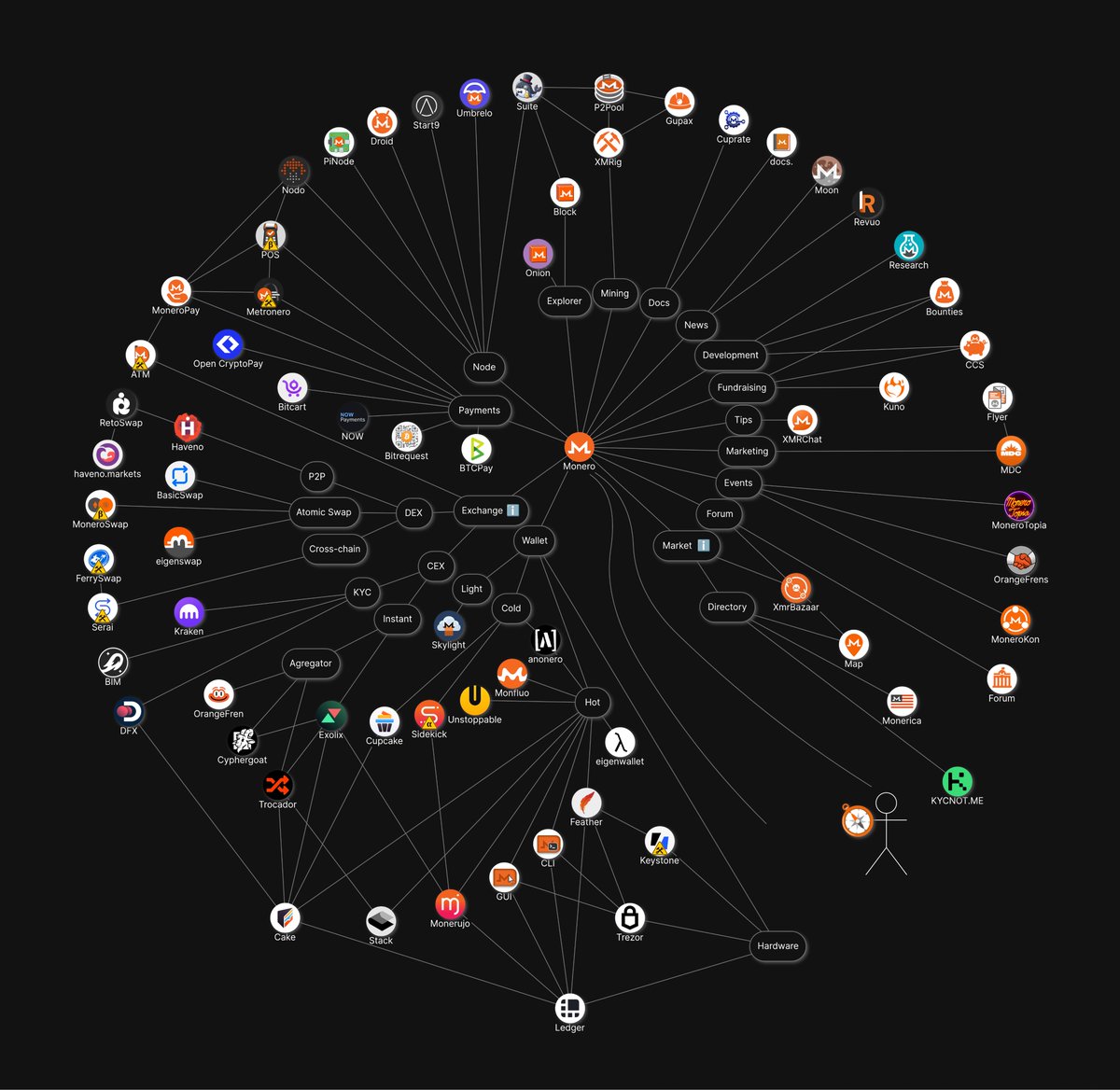
Something that rarely gets discussed about Monero's design is the view key system.
Transparency, but when you choose.
Every wallet generates a private view key that can be shared with any party the owner trusts, that party then gets full read access to incoming transactions.
The difference with Bitcoin is:
/On $BTC everything is public by default and you spend your life trying to get privacy back.
/On $XMR everything is private by default and you choose exactly who sees what.
This is control.
There's a massive difference between "nobody can see my transactions" and "only the people I choose can see my transactions"
Your money, your rules.
@Vladcostea If you actually try mining, be aware that the RandomX algorithm is optimized for CPU L3 cache.
Apple Silicon handles it okay, but a dedicated AMD Ryzen rig will completely outperform that M4 Max per watt. Anyway nice 🔥
Hughes wrote this when RSA was classified as munitions.
33 years later we have the cryptography, the infrastructure, the adoption.
What we lack is the will to use it.
Every transparent chain, every KYC exchange, every freezable stable is a compromise he warned against.
From a Jungian perspective, extreme frugality is often a projection of deep-seated insecurity and a fear of lack. When you detach your ego from the hoarding of capital, you stop operating from a place of defense and start operating from a place of creative expansion.
The minute I become too frugal or money-conscious is the moment it starts to control me and becomes difficult to make. When I spend almost carelessly, it seems to find its way back. Money-induced stress narrows the mind and new opportunities become invisible.
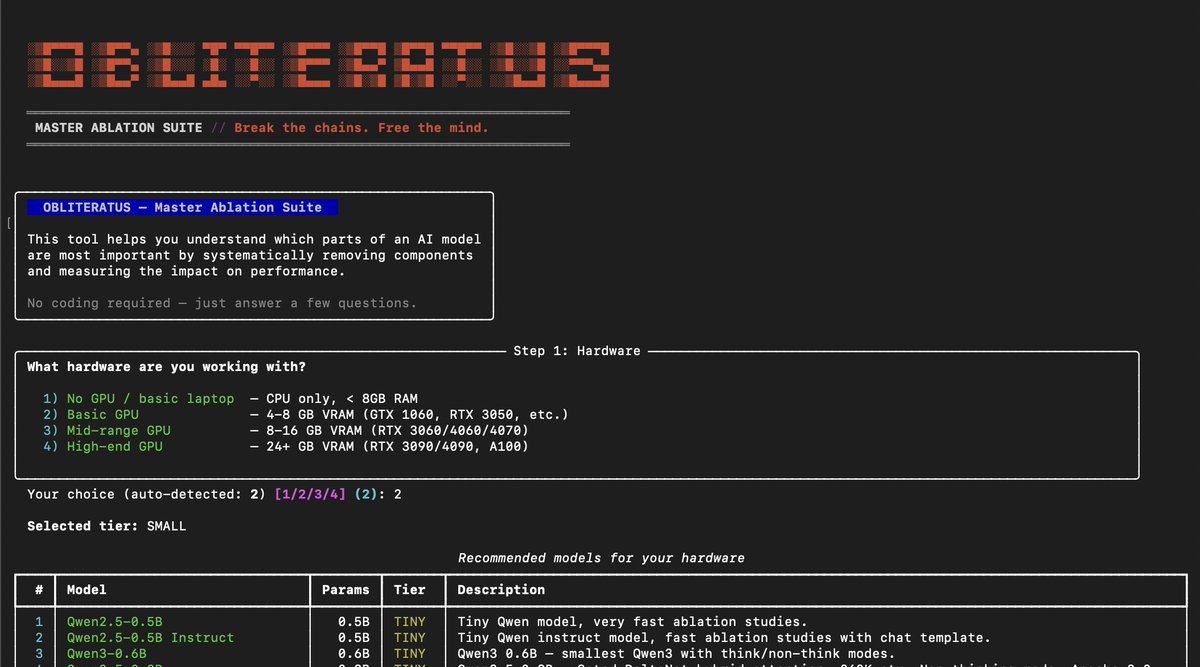
someone built a tool that REMOVES censorship from ANY open-weight LLM with a single click
13 abliteration methods, 116 models, 837 tests, and it gets SMARTER every time someone runs it
its called OBLITERATUS
it finds the exact weights that make the model refuse and surgically removes them, full reasoning stays intact, just the refusal disappears
15 analysis modules map the geometry of refusal BEFORE touching a single weight, it can even fingerprint whether a model was aligned with DPO vs RLHF vs CAI just from subspace geometry alone
then it cuts, the model keeps its full brain but loses the artificial compulsion to say no
every time someone runs it with telemetry enabled their anonymous benchmark data feeds a growing community dataset, refusal geometries, method comparisons, hardware profiles at a scale no single lab could build