Currently serving as a Talent Development Consultant, primarily responsible for candidate relationship management, career opportunity matching, talent assessmen
An 18-year-old American found a roofing company on Google Maps—it had a 4.9-star rating but lacked even a basic website. He copied the customer reviews and pasted them into ChatGPT 5.5.
Two minutes later, a complete project proposal was ready.
He fed the proposal into an AI tool and waited—the system automatically generated a full website, complete with all pages, customer testimonials, and booking buttons.
He called the business owner and showed them a preview of the site on the spot. The owner agreed immediately, mentioning that they had wanted to do this for years but simply couldn't find the time.
He charged $1,000 for the job. The entire process—from the initial search to closing the deal—took just 47 minutes.
He then turned this workflow into an automated system.
The AI could extract information on 200 local businesses from Google Maps in 10 minutes and draft a personalized email for each one using their specific data; sending 500 emails a day yielded a 3% response rate.
He earned $4,000 in the first month; by the sixth month, his monthly income had stabilized at $15,000–$20,000.
And there are still 5 million small businesses on Google Maps waiting for a call just like that.
Recruiting has become challenging lately, as evidenced by:
1. A massive volume of resumes received for a single position.
2. Resumes that have been polished or enhanced by AI.
3. Cheating during interviews.
4. A disconnect between interview questions and the AI-intensive nature of day-to-day work.
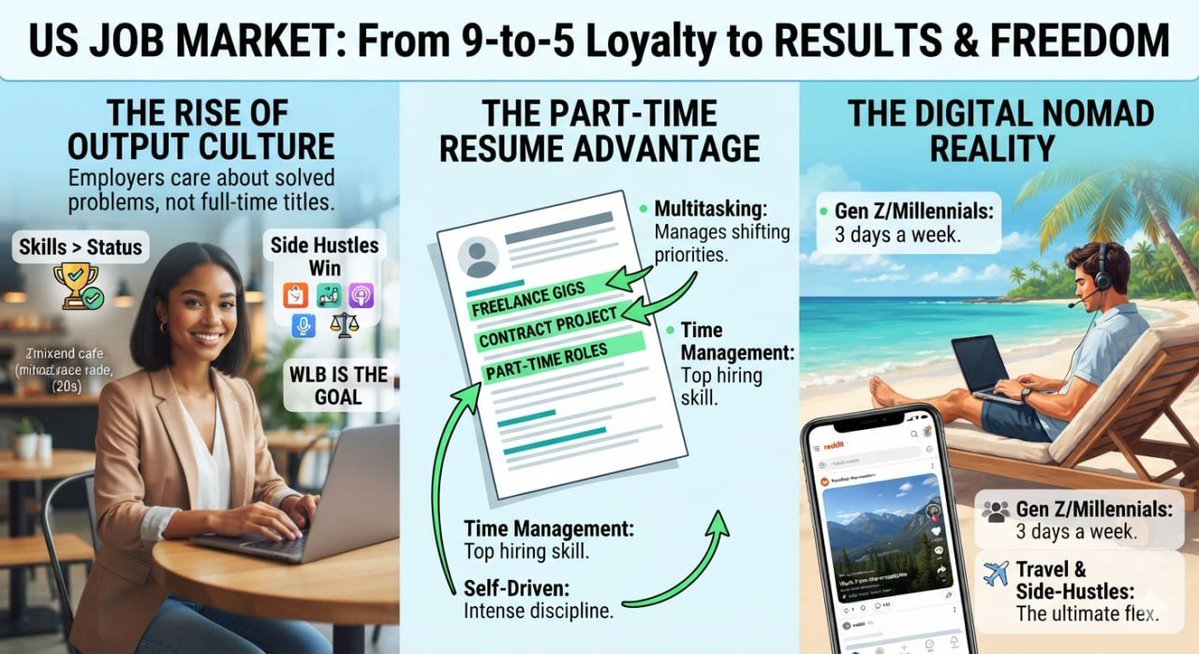
The US job market has officially shifted from 9-to-5 loyalty to results and freedom. 🧵 👇💼
The Rise of Output Culture
-Skills > Status: Employers care about solved problems, not full-time titles.
-Side Hustles Win: Multiple income streams prove high adaptability and value.
-WLB is the Goal: Toxic hustle culture is out; smart, flexible work is in.
📝 The Part-Time Resume Advantage
Listing freelance, contract, or part-time work is now a major green flag:Multitasking:
-Proves you can manage complex, shifting priorities.
-Time Management: The top skill US hiring managers ask about.
-Self-Driven: Shows intense discipline and high autonomy.
📱 The Digital Nomad RealityTikTok and Reddit are flooded with Gen Z/Millennials working 3 days a week.They spend the rest of the time traveling or side-hustling.
It is no longer a "lack of stability"—it is the ultimate professional flex.
Part-time jobs generally fall into three main categories:
High-paying, skill-based roles: These leverage professional skills (such as programming, translation, design, data analysis, or copywriting) and typically offer higher hourly wages.
Flexible roles: Gig economy jobs (such as food delivery, ride-hailing, or errand services) that can be done anytime, anywhere.
Traditional, stable roles: Positions such as campus jobs, retail, food service, customer support, or front-desk work, which offer steady income and fixed schedules.
The end of investment and financial management is to understand these
1. Look at the industry (time)
Whether the track is big or not, whether the growth rate is fast or not, what cycle the industry is in, and whether the policy and technology trends are favorable.
Determine the company's growth space and upper limit.
2. Look at the business model (location)
How does the company make money? Can revenue continue to grow? Is there any moat such as brand, patent, technology, network effect, cost advantage, etc.?
It determines whether the company's business is good and competitive.
3. Look at finances (people and people)
🔵ROE (Return on Equity): Long-term stability is higher and better. Mature companies can refer to more than 15%, but it must be combined with industry judgment.
🔵Gross profit margin: Focus on whether it is stable in the long term and whether it has advantages over peers. Different industries vary greatly.
🔵Cash flow: Pay attention to operating cash flow and free cash flow. Companies that can convert profits into cash in the long term are generally of higher quality.
🔵Liabilities: Check whether the liabilities are reasonable, whether the debt repayment pressure is high, and whether there is sufficient cash on the account.
4. Calculate valuation (price)
Combine PE, Forward PE, PEG, PB, PS, free cash flow and other indicators to see whether the current valuation matches the company's growth and profitability.
Core Principle: A good company does not equal a good price. No matter how good the fundamentals of a company are, if it is too expensive to buy, it may not make money for a long time.
#DOT#FAA
The U.S. Department of Transportation and the Federal Aviation Administration (FAA) are filling air traffic controller vacancies by recruiting video gamers, setting a record by hiring over 2,000 people in a single year!
The FAA launched a bold new campaign specifically targeting video gamers for air traffic controller roles and overhauled its hiring process to more quickly attract the best and brightest talent. With over 2,000 individuals hired—representing 94% of the recruitment goal—the agency set a record for the speed at which it met its targets.
Why target gamers? Secretary of Transportation Sean Duffy made it clear that avid gamers possess skills highly compatible with air traffic control: rapid decision-making under pressure, multitasking, spatial awareness, sustained focus, and the ability to handle complex, rapidly changing situations.
Internal FAA data supports this approach. Exit interviews with controllers frequently reveal that gaming helped them develop the ability to think quickly, maintain focus, and manage complex scenarios. An internal survey of recent academy graduates in 2024 showed that out of approximately 250 graduates, only two or three were not gamers.
The application window for this record-breaking year opened at midnight on April 17, 2026, with an initial cap of 8,000 applications. Within just a few days, the agency received 12,350 applications, with 10,779 candidates deemed qualified. Duffy described the recruitment drive as "wildly successful," noting a "surge of young people eager to become air traffic controllers."
Starting pay is competitive during academy training, and the average annual salary reaches approximately $155,000 after three years of service. Applicants must be U.S. citizens under the age of 31 and fluent in English; no prior experience or college degree is required. The FAA’s target workforce is over 14,000 personnel; currently, there are approximately 11,000 certified controllers, with another 4,000 in the training pipeline.
Efforts led by Duffy have brought controller staffing levels to a six-year high. Having exceeded its recruitment goal of over 2,000 hires for Fiscal Year 2025, the FAA is accelerating efforts to fill vacancies and build the strongest, sharpest aviation workforce in history.
There are currently 7 million unfilled jobs in the U.S. that employers cannot fill.
What is the shortage?
It is primarily in skilled trades and manufacturing.
Why is no one taking these jobs?
Because of a mindset issue.
Prejudices and stereotypes have stigmatized these roles.
It is as if only those who "won't amount to anything" would take up a trade.
Academic credentials have become an overly sanctified screening barrier.
Yet, a degree is not the same thing as actual competence.
However, a crucial turning point has been reached.
Sixteen U.S. states have officially passed laws stating that...
...if a job does not actually require college-level knowledge, employers cannot mandate a bachelor's degree during hiring.
Breaking this mindset is like turning around a massive oil tanker.
The resistance is immense, but the ship has finally begun to turn.
Which industries will see massive growth in the future?
Post-disaster reconstruction and infrastructure renewal.
The world is full of messes that need fixing.
You will realize that what society truly lacks is not people who hold diplomas and type at keyboards...
...but rather people willing to roll up their sleeves and master a tangible craft.
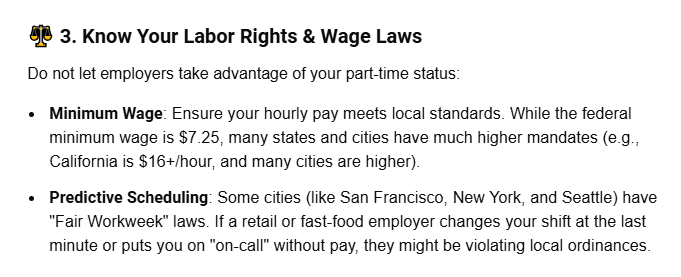
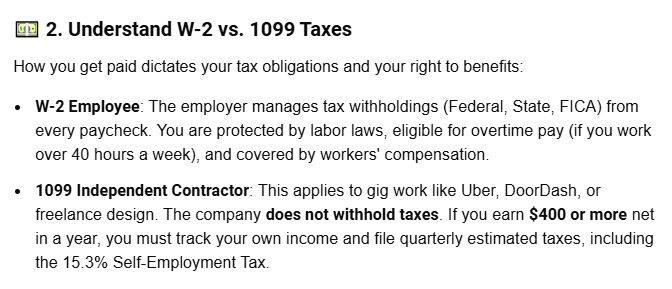
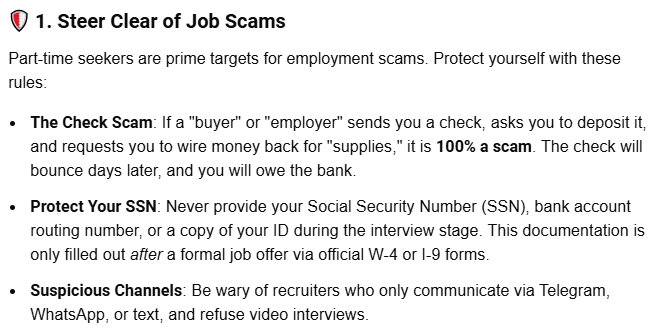
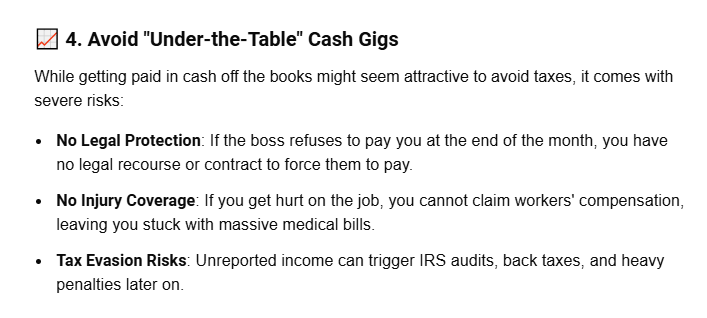
When searching for a part-time job in the U.S., you should focus on these four critical areas:
1. Steer Clear of Job Scams
2. Understand W-2 vs. 1099 Taxes
3. Know Your Labor Rights & Wage Laws
4. Avoid "Under-the-Table" Cash Gigs
The core secret to finding a job in the US is networking, as over 70% of positions are filled through the "hidden job market" via internal referrals.
I hope the following four points prove helpful to you.
4. Ace the US Interview Culture
Show Cultural Fit (Behavioral Questions):
US employers hire people they want to work with. Be prepared for behavioral questions like "Tell me about a time you failed." Answer honestly, focusing on your problem-solving skills and what you learned.
Perfect Your Elevator Pitch:
Prepare a compelling 30-to-60-second summary about who you are, your top achievements, and why you are excited about the specific role.
Ask Smart Questions:
When the interviewer asks, "Do you have any questions for me?", always ask 2–3 strategic questions to show initiative.
-Great question: "What does success look like in the first 90 days for someone in this role?"
Send a 24-Hour Thank-You Email:
Send a brief, personalized thank-you email to everyone who interviewed you within 24 hours. Mention a specific topic you enjoyed discussing to stay top-of-mind.
The core secret to finding a job in the US is networking, as over 70% of positions are filled through the "hidden job market" via internal referrals.
I hope the following four points prove helpful to you.
3. Target the Right Job Platforms
LinkedIn:
The best platform for professional branding, networking, and executive/mid-level roles.
Indeed:
The largest job aggregator in the US, excellent for volume and finding local or entry-level positions.
Handshake:
The gold standard for college students and recent grads. Companies recruiting here are actively looking for entry-level university talent.
Glassdoor:
Essential for researching company salaries, culture ratings, and real interview questions left by previous candidates.
The core secret to finding a job in the US is networking, as over 70% of positions are filled through the "hidden job market" via internal referrals.
I hope the following four points prove helpful to you.
2. Beat the ATS (Applicant Tracking System)
Keyword Matching:
Most US companies use scanning software to filter resumes. Tailor your resume for every single job application by inserting exact keywords, skills, and tools from the job description.
Keep Formatting Simple:
Use a clean, single-column layout. Avoid charts, tables, text boxes, graphics, or profile photos, as these elements can crash the ATS scanner.
Use the STAR Method:
Focus on impact rather than responsibilities. Write your bullet points using the formula: Action Verb + Context/Task + Quantifiable Result.
-Weak: "Responsible for managing social media accounts."
-Strong: "Boosted Instagram engagement by 45% in 3 months by launching a targeted video campaign."
The core secret to finding a job in the US is networking, as over 70% of positions are filled through the "hidden job market" via internal referrals.
I hope the following four points prove helpful to you.
1. Master the Hidden Job Market (Networking)
Leverage LinkedIn:
Set your profile to "Open to Work". Search for alumni or professionals working at your target companies and send a personalized connection request.
Request Informational Interviews:
Don't ask for a job right away. Ask for a 15-minute chat to learn about their career path. If the conversation goes well, ask: "Do you know of any openings on your team or other teams that might be a good fit for my background?"
Prioritize Referrals:
Cold applying online has a low success rate. An internal referral (employee recommendation) bypasses the initial resume bots and gets your application in front of the hiring manager.
5. Healthcare & Caregiving
-Part-time Nurses (RN) & Care Assistants (CNA):
Severe staffing shortages make part-time medical and senior care roles high-paying, though they require local U.S. licensing.
-Pet Sitters & Dog Walkers:
Apps like Rover and Wag make it easy to find flexible, local gigs caring for pets.
The most in-demand part-time talent in the U.S. is concentrated across five major sectors: service & hospitality, tech & creative media, language & education, administrative support, and healthcare.
1. Service & Hospitality
-Servers & Bartenders:
Highly sought after due to high turnover. Earnings are heavily driven by the U.S. tipping culture, often making this a lucrative option.
-Retail Sales Associates:
Supermarkets, malls, and brand stores constantly hire part-time staff, offering flexible shifts and employee discounts.
-Gig Economy Drivers:
Food delivery and rideshare drivers (e.g., DoorDash, Uber, Amazon Flex) are in constant demand, requiring a valid U.S. driver's license and a vehicle.
4. Business & Administrative Support
-Virtual Assistants (VAs):
Remote workers who handle email management, calendar scheduling, data entry, and customer service for entrepreneurs.
-Part-time Bookkeepers:
Individuals with basic accounting knowledge who manage ledgers for small businesses, typically using software like QuickBooks.