Mostly true. What matters is securing the long-term future of consciousness, both on Earth and other heavenly bodies.
We cannot just focus on Earth, because there are irreducible external (eg massive meteor) and internal (eg global nuclear war) cataclysmic risks.
The Moon is faster to make self-growing, but is more susceptible to problems on Earth. Mars will take longer to make self-growing, because it is so hard to reach, but is more secure from Earth disasters for that same reason.
Both the Moon and Mars should have self-growing civilizations. Making this happen is the prime directive of SpaceX.
Switzerland has made it illegal to place live lobsters into boiling water, following increasing scientific evidence that crustaceans may be sentient, capable of experiencing pain.
Over recent decades, research has challenged the idea that lobsters operate on simple reflexes alone. Studies suggest their nervous systems are more complex, showing behaviors that go beyond automatic reactions and point toward decision-making under distress.
For example, experiments with related species like hermit crabs have shown they will abandon their shells, essential for protection, when exposed to electric shocks. This kind of trade-off suggests an ability to weigh risk in order to avoid harm.
Lobsters themselves possess nociceptors, specialized nerve cells that detect damaging stimuli such as heat. When exposed to extreme conditions, they don’t just react momentarily; they can exhibit prolonged behavioral changes, indicating a deeper response.
Under the new law, lobsters must be stunned before being cooked, either mechanically or electrically, to reduce suffering. The legislation also bans transporting lobsters on ice, requiring conditions that more closely reflect their natural environment.
Supporters view this as a necessary step forward. Many scientists argue that if there is credible evidence an animal can feel pain, it deserves consideration similar to that given to birds and mammals.
But this raises a bigger question.
With billions of crustaceans used globally each year, and practices varying widely—should other countries begin to rethink how these animals are treated?
Source: CNN, “Switzerland bans boiling lobsters alive.”
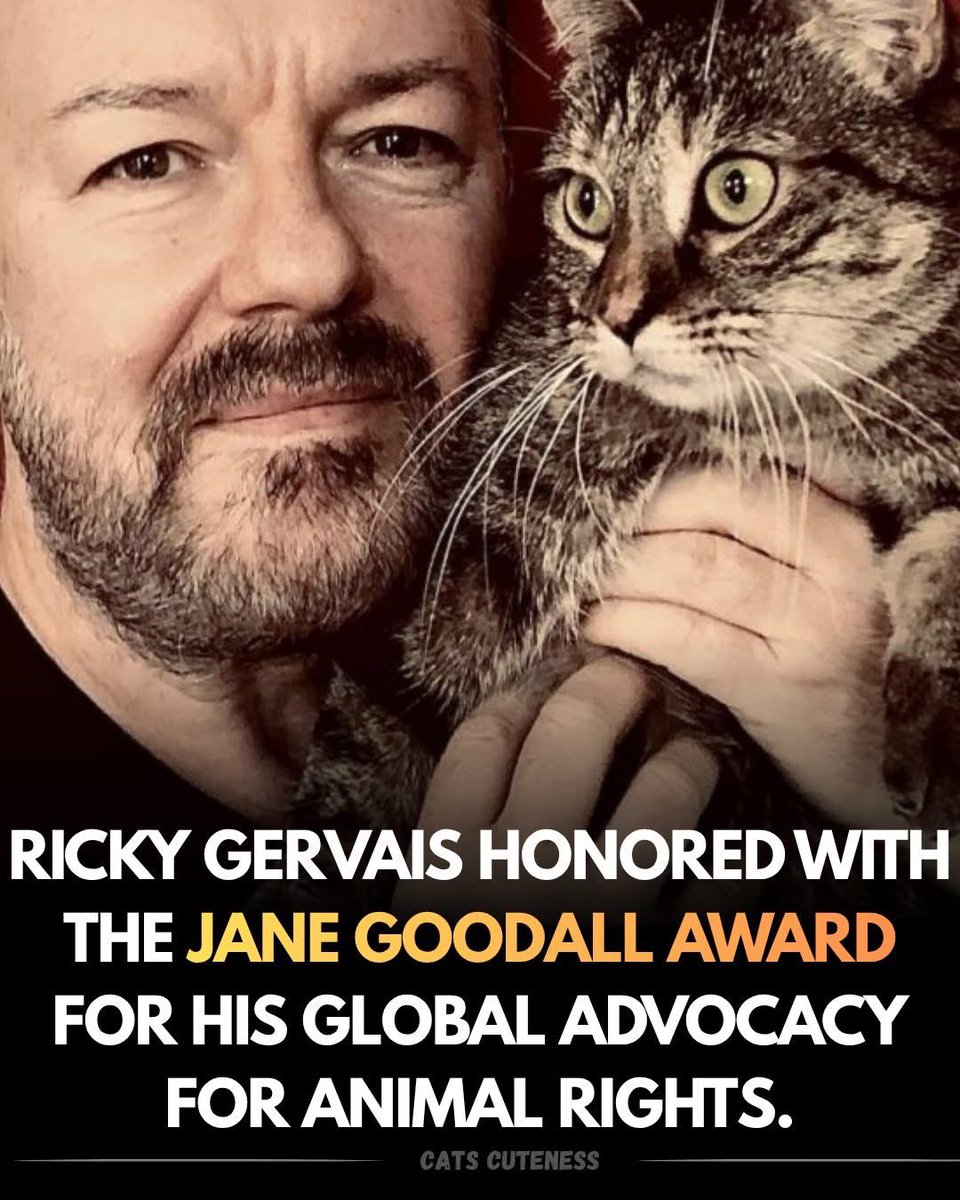
An actor who has given millions to support animals is now being recognized on a global stage.
Ricky Gervais has been awarded the Jane Goodall Award for his ongoing efforts to stand up for animals and call out cruelty worldwide.
Using his platform, he’s brought attention to issues like animal testing, fur farming, and trophy hunting—while also supporting charities and funding real change.
Inspired by Jane Goodall’s legacy, the award honors those deeply committed to protecting animals and the planet.
Supporters say this moment shows the impact of using influence for good—and how one voice can help spark global awareness.
Because real advocacy isn’t just words—it’s action.