The pilot who celebrated America’s 250th anniversary with a special flight that included a map of (most of) the US, took the feedback about the map into consideration.
Knockoff is now live!
Filter out the knockoff crap brands on Amazon.
Sorry to brands like WNPETHOME, EHEYCIGA, YXYL, LU&MN, JOYIN, TOMY, GODONLIF, YOOJEE, LINGTENG, LANEIGE, VISCOO, BIODANCE, COOFANDY, BALENNZ, TOSY and LUENX.
https://t.co/9mLk0EAsfG
Some celebrate with a party, some celebrate with fireworks, this pilot is celebrating America’s semiquincentennial with a very special flight. #America250
This is what’s known as an “FBO” (Fixed Base Operator). It’s kind of like dropping into a gas station for airplanes.
They sell fuel, but offer many other services as well. Some are very simple; just a shack you can get out of the rain w/ a bathroom. Others are elaborate…they may have showers, rest facilities, a kitchen or attached restaurant, gift shop, etc..
They often have a “crew car” available for you to drive into town. Some of those are nice, others are retired police cars bought at auction with 200k miles. Just depends.
Some have hangar space & will put your jet to bed overnight instead of just tying it down outside. Then they’ll pull it out in the morning at whatever time you tell them.
At Ellington Field in Houston, we got free beer & rooms if we dropped in & bought fuel. At Grand Junction, we got free pizza. Alexandria would let you pre-order a Shrimp Po’Boy over the radio for $1.50 as you got on approach.
Alliance Fort Worth staffed the FBO with pretty, flirty young women & you got a free rental car if you filled up. There were always a bunch of military jets there on the weekend.
In Bangor, you could order live Lobster to take home & they’d bring it to the jet.
Prestwick Scotland was famous for giving you good Scotch at a deep discount if you purchased fuel. Sometimes free if you purchased a lot of fuel.
Anyway, the point is the FBOs are competing for business & often distinguish themselves by the amenities they offer. It’s fun to drop in to one the first time. The really good ones get a reputation & when you flight plan, you pick them for a fuel stop.
I’ve got quite a few pilot followers, so I’d like to ask them to describe their memorable FBO experiences & amenities in the comments. Maybe share a picture of the crew car. I think the sum of these comments will help you get a better idea of FBOs than I can offer in a post.
Stargate Trivia: Casting Stargate: Atlantis
While SG-1 was my first love (We were together for seven years!), my time on Atlantis proved equally memorable. The show was possessed of a similar tone in its mix of high adventure and humor, yet proved distinct in its exploration of Ancient mythology and an unfamiliar galaxy as seen through the eyes of a new set of heroes. Atlantis offered a sense of wonder and camaraderie born of isolation and constant danger.
Whereas team SG-1 could always go home at the conclusion of their adventures, the members of the Atlantis expedition (at least for those first few seasons) could only draw comfort from the city of Atlantis itself – and, of course, each other. It was unique and compelling yet, at the same time, comfortingly familiar.
Nowhere is this more evident than in its opening theme, composed by the late Joel Goldsmith, which is, at turns fresh, haunting, stirring and, throughout, discernibly Stargate.
Stargate: Atlantis wasn’t originally planned as a companion to Stargate: SG-1. It was intended to replace the long-running series. The only problem was, with eight seasons under its belt, SG-1 wasn’t quite done yet. And fans (and the network) weren’t done with it either. And so, instead of passing the torch and segueing to a new Stargate series, we ended up producing both. In retrospect, it was quite an achievement: 40 hours of television in a year! Today's productions can barely manage a quarter that output, but Stargates SG-1 and Atlantis delivered two fantastic 40 episode seasons before SG-1 took its final bow. It wasn’t easy, but it was certainly made easier by all of the enormously talented individuals who made it happen, from the office staff and crew to the cast and my fellow writer/producers.
Still, it was not without its challenges. Take casting, for instance. It may surprise you to know that, when it comes to producing a show, not everybody cares about costumes or set design or whether the script’s fifth act denouement is emotionally satisfying - but everybody, and I do mean EVERYBODY, has an opinion on casting. Studio and network execs, producers, hell, even your significant other peering over your shoulder as you screen the auditions on your laptop, will want to weigh in. Of course, the more voices in the mix the more likely there are to be disagreements. So it is with every production and Atlantis was no different. Various individuals envisioned these characters in various ways and, as a result, consensus was only achieved after many auditions, calls-backs, heated discussions, and not-so-gentle reminders that our start date was fast-approaching and we really needed someone to say the lines on camera.
The part of Carson Beckett was one of the first we cast. The other producers were in Rob’s office, screening the first batch of local auditions when Brad called me in and told me to check out the guy onscreen. I hadn’t imagined Beckett with a Scottish accent but, after watching Paul McGillion (@PaulyMcGillion) in the role, I couldn’t imagine him without one. He’d brought something unexpected to the part, something we all responded to.
Elizabeth Weir was not an easy character to pull off. She had to be smart, confident and strong yet needed to exude a certain warmth and empathy we were looking for in the civilian leader of the expedition. When it came time to (re)casting the role, several established names were considered (One had her own hit genre show back in the day while another went on to break out on a hit show soon after), but it was Torri Higginson (@torri_higginson) who managed to strike just the right balance and vault her name to the top of the list.
The role of Teyla Emmagan was a tough one to cast. Like Weir, she needed to be a strong, empathetic leader. But she also required something even more important – quite literally, an other-worldly quality that made her unique. Some equally talented actresses auditioned for the role but, as good as they were, they were never quite able to achieve that gravitas Rachel Luttrell (@rachel_luttrell) pulled off with such grace and seeming ease.
Former VJ Rainbow Sun Francks (@RainbowFrancks) won the role of Lieutenant Ford on the strength of a great audition, preceded by an equally great audition with a funny hat. I recall Brad Wright on the phone with our casting agent, advising him to ensure there would be no hat worn in the callback for fear the network would fixate on it. There wasn't, they didn't, and Rainbow delivered.
The role of John Sheppard was the second to last one cast. It came right down to the wire and there were several candidates in play. The character was originally conceived as a good ole southern boy, so it only made sense that Ben Browder’s name was bandied about early. However, he was too busy shooting Peacekeeper Wars to warrant consideration. A number of other actors were considered (one went on to play the lead in a hugely popular show the following year while another made his mark as a handsome heart throb on another hugely popular medical series) but it was Joe Flanigan (@JoeFlanigan) who won the part based on his ability to pull off the devil-may-care attitude Brad and Robert were looking for.
We come to the final role cast, a character who, in many ways, embodied everything Atlantis was about: exploration, discovery, fun, humor, and seat-of-your-pants-Holy-Sh&%-how-the-hell-am-I-going-to-get-out-of-this-adventure. And he almost didn’t make the trip to Pegasus. Originally, the casting call went out for a completely different character, an earnest young doctor who would lend the team much-needed medical support on their off-world ventures. Unfortunately, no one could agree on an actor to fill that role.
If the casting of Sheppard went down to the wire, then the casting of this final part went a step past it. Finally, days away from production, Robert Cooper had an idea: Forget the doctor character. Why not use an established character from SG-1? How about Rodney McKay played by David Hewlett (@dhewlett)? The writers were on board, but some executives weren't weren’t sold on the idea. They found him annoying! I mean, hell yeah, but he’d be sooo much fun to write for! Rob got on the phone and went to bat for Rodney, pointing out that the character had come a long way since first being introduced way back in SG-1’s 48 Hours. He’d evolved, going from annoying jerk to endearingly irritating. To this day, I’m convinced that they weren’t totally convinced but, with production poised to commence, they relented, I suppose figuring they could just replace the character somewhere down the line. No one, even those who loved the idea of having the endearingly irritating Rodney McKay on board could have predicted how hugely popular the character would become.
How do you think we did?
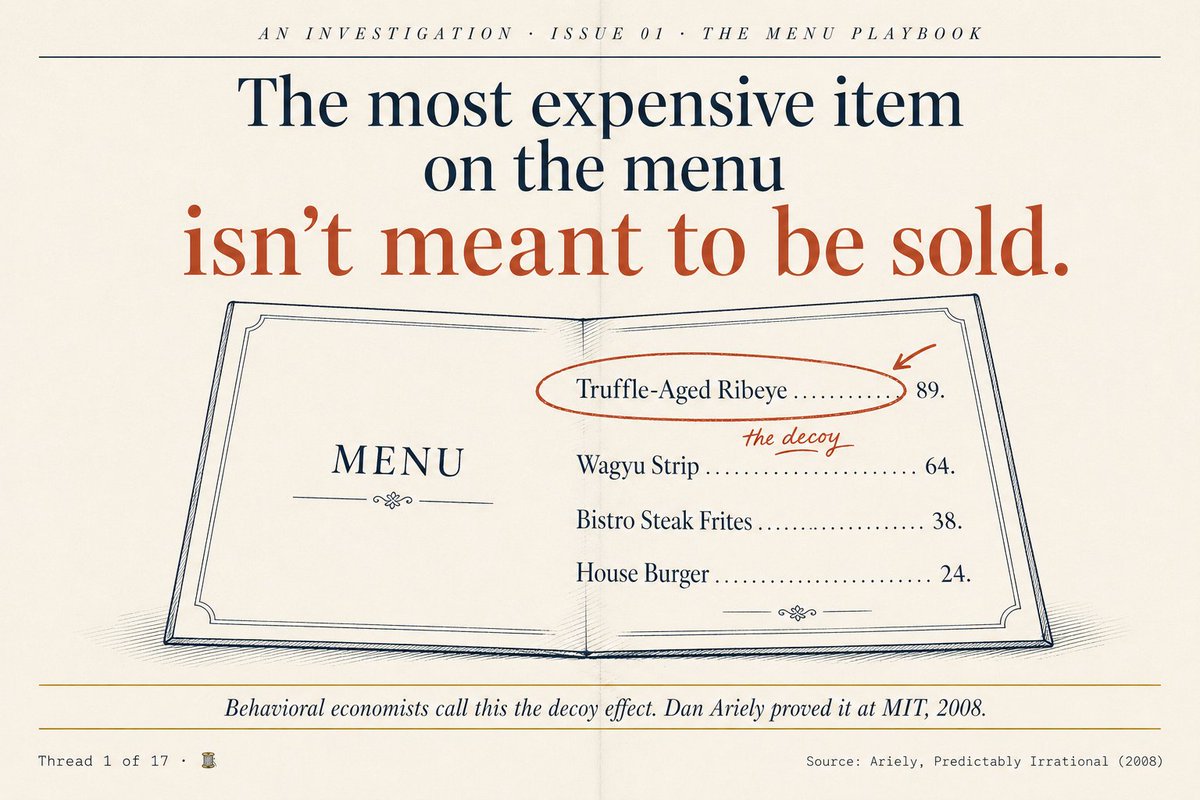
The most expensive item on a restaurant menu isn't meant to be sold.
It exists to make the second-most-expensive item look reasonable.
Behavioral economists call this the decoy effect. Dan Ariely proved it at MIT in 2008.
Every menu you've eaten from this year uses it. Plus 10 more tricks.
I pulled the playbook. Here's how each one hijacks your brain. 🧵
At least the “basket” the probe goes into is soft. On the KC-135 it’s rigid…pilots called it the “Iron Maiden” & it could bang you up pretty good.
This is the “Probe & Drogue” method of air refueling. It’s slower than the Boom method due to the fuel transfer through a smaller hose, but is preferred by many; essentially the Boom method is only used by the U.S. Air Force & countries that buy jets developed for the Air Force.
The Boom was preferred by General Curtis LeMay, who insisted on it for thirsty bombers, leading the Air Force to adopt it. The Navy chose the drogue.
Contact from the receiver’s probe pushes the drogue & fuel line back slightly, creating slack which is taken up automatically. If this slack is not taken up, a sine wave can develop & the drogue can whip violently.
The basket contains small lights for night refueling. It also has sensors that detect when the probe is secured, signaling to the Boom operator to begin fuel flow via transfer pumps.
These drogues are mounted to the wings in Wing Air Refueling Pods (WARPs). WARPs are not something typically left on the jet & are installed only when mission requirements dictate. A small turbine propellor at the front of the WARPs supplies electricity, but the jet has to be specially modified with the fuel lines & electrical connections to enable a WARP. Only a handful of KC-10s were so modified; if I recall correctly, adding WARPs had a 5,000 lb weight penalty total.
Otherwise, tankers generally have a built-in drogue stored in the fuselage. In the event the drogue is unable to be reeled back in after refueling, some tankers have a “guillotine” blade that can be triggered to drop & sever the line. Preferably over unpopulated areas.
The drogue basket assembly will break away from the hose under enough stress. Many fighters have returned to base with a basket stuck on the end of the probe. In rarer circumstances, the basket can bring home a probe that breaks off.
While the KC-135 can carry WARPs, it has no integrated drogue system. Instead, a special attachment is fitted to the end of the boom with a short hose, giving it a drogue…but this makes it unusable for boom receivers. The KC-135 drogue, as mentioned before, is also rigid rather than soft. Where a normal drogue collapses unless air flows through it, making it soft if a receiver bumps into it, the “Iron Maiden” of the KC-135 was capable of doing a lot of damage.
Astronaut Tim Peake demonstrates aboard the International Space Station, a stationary object in microgravity will tumble aimlessly with even the slightest tap. But once a gyroscope begins to spin, it instantly locks into a rigid geometric plane, stubbornly refusing to be tilted.
This phenomenon is driven by angular momentum. The rapid rotation creates a powerful resistance to outside forces, granting the object an invisible, unyielding stability.
This is far more than a simple physics trick. This exact principle of spin stabilization is what keeps the massive space station perfectly oriented as it orbits the Earth; a profound reminder that in the chaotic vacuum of space, sometimes the only way to stay perfectly still is to keep moving.
@repjackbergman Over 50,000 unidentified children are waiting for rescue. Urge Congress to move on the Renewed Hope Act to rescue children seen in abuse images. These children cannot wait!
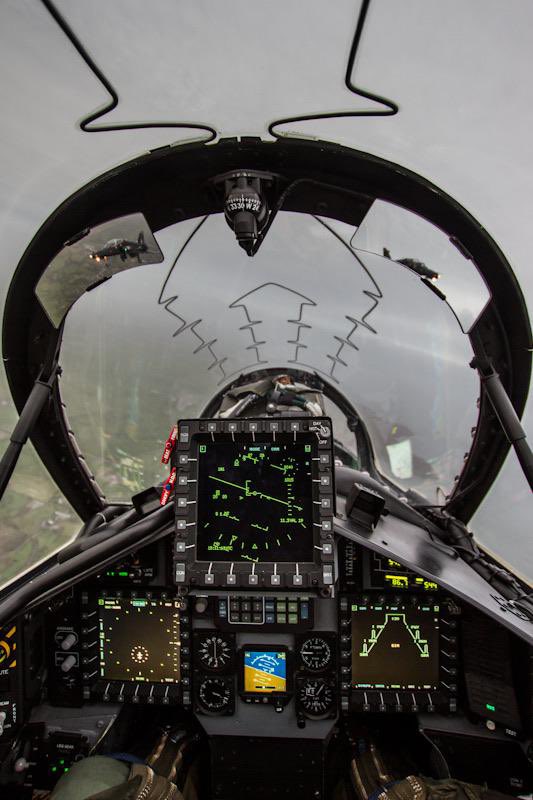
The “wavy” lines in the canopy glass (plastic) are not antennas…they are explosive cords.
In the movies, an ejection is preceded by the jet’s canopy being blown off. “Goose” got killed in Top Gun because it didn’t happen fast enough & the seat hit the canopy.
Some jets took a different approach, though. Rather than jettison the canopy, which is complicated & can fail, why not just blow it up? Shatter it into a thousand pieces that won’t hurt the pilot. This can shorten the ejection sequence, too, as you don’t need to allow as much time for the canopy to clear the ejection path (we’re talking fractions of a second, but still…).
Anyway, this is the design they came up with. It’s known as a “Canopy Fracturing System”. It’s automatically triggered when you pull the ejection handle, but can be manually triggered as well without ejecting. I suppose that might be useful if smoke is accumulating in the cockpit.
Now, jets that blow the whole canopy off instead of blowing it up have a somewhat complicated system to accomplish this. The system has to release the hooks locking the canopy onto the jet; it often does this by pushing hot gas from an explosive through tubes that push the hooks back (there are several methods, though). Kind of like firing a gun.
Both systems can fail, though the explosive cord is considered very reliable…they put it in the F-35 (and I had it on the T-6). As a backup, the top of the ejection seat has a little pointy end on it. In theory, this point should hit the canopy before your head does if the canopy is still there in an ejection, shattering it before the canopy shatters your spine. I’d guess that has happened before, but I can’t recall any examples.
Older jets sometimes got around all of this by just ejecting you downward. A hole would open up in the floor & the seat departs that way. The disadvantage here is obvious…you’ll have a higher minimum safe ejection altitude. This system still exists in the B-52. The seats back then were not quite as sophisticated as they are now…
Today’s seats detect your orientation. If you eject while inverted, the seat will fire just enough to get you out of the jet, then right itself to point upward & fire again. When the seat has done its job, it automatically cuts the belts & straps that held you in & departs. The seat itself contains the parachute…so when you strap in, you’re strapping on the parachute…obviously, the seat doesn’t cut that, it’s the parting gift.
The parachute has a barometric sensor that automatically deploys it if below a set altitude. If flying over high terrain (higher than the standard set altitude), you can rig it to immediately deploy the parachute on seat separation.
The parachute also has an emergency oxygen bottle. This is not automatic, but pulling a cord will start the short flow of oxygen (I think it’s like 4 or 5 minutes, can’t remember). The hose for your oxygen mask is connected to the jet but is designed to break-away from the jet at the connection in an ejection; a smaller hose connects to a point on the parachute harness that will provide the emergency oxygen.
The seat also contains a small survival kit & may be fitted with an automatically inflating raft for water landings. These will dangle underneath you as you descend.
Ok, that’s about all I can recall off the top of my head. The ejection sequence is very, very short…pull the handle & you’ll be gone before you know it. In two-seat jets, the back seat goes first to prevent them from being burned by the rocket on the front seat. There is a sequencing lever in the jet that allows pilots to select if both seats will fire if any ejection handle is pulled, though…so you can select that each seat must pull its own handle. Useful if doing orientation rides for non-pilots…you don’t want them ejecting you, too.
The Billion-Dollar Typo of the Tongue.
In 1976, a young graduate student named Shashikant Phadnis was working in a London lab researching new insecticides. His team had just synthesized a highly experimental chlorinated sugar compound.
His supervisor handed him the chemical and asked him to "test" it. But Phadnis, unfamiliar with his British supervisor's accent, misheard the instruction. He thought he was told to "taste" it.
Without a second thought, the student took a pinch of the potential bug poison and put it directly on his tongue. He didn't drop dead. Instead, he experienced an overwhelming, mind-bending burst of sweetness.
He had just discovered a compound that was 600 times sweeter than sugar, completely calorie-free, and remarkably heat-stable.
That single misunderstood syllable birthed Sucralose. Today, you know his accidental pesticide as the artificial sweetener Splenda.