The destruction of the Kerch Bridge’s arch and the blockage of the shipping channel by its debris affect far more than Russia’s transport links with occupied Crimea. It triggers a chain of disruptions to maritime and river transport, grain and oil exports, military logistics, and the economies of entire Russian regions. Debris from the bridge blocks the Kerch–Yenikale Canal, cutting off direct access to the Black Sea for the ports of Rostov-on-Don, Azov, Taganrog, Yeysk and Temryuk, as well as occupied Mariupol and Berdiansk. But the consequences extend further. Through the Don and the Volga–Don Canal, the Sea of Azov is connected to the Volga, the Caspian Sea and Russia’s vast network of inland waterways.
The main target of the Ukrainian strike is the military logistics network supplying occupied Crimea. The Kerch Bridge remains an important supply route for Russian forces, and Ukraine will seek to put it permanently out of service. Moscow cannot count on restoring the bridge and shipping through the Kerch Strait without interference while the war continues. The loss of road and rail links forces Russia to reroute cargo through occupied southern Ukraine, where transport routes are already supplying the front. Crimea will not be completely isolated, but Russia will lose an important fallback option for its military logistics. The fewer supply routes remain, the harder it becomes for Russia to supply its troops and hold occupied territory.
The second major blow is to Russian grain exports. According to S&P Global estimates, the route through the Kerch Strait and the Azov–Don system accounted for around 28% of Russian wheat exports in August 2026. This puts more than a quarter of exports of one of Russia’s main agricultural commodities at risk. Some grain can be rerouted through other ports, but this requires rail capacity, freight wagons, grain storage facilities and available terminals. All of this costs money and takes time. Grain will accumulate in storage, export contracts will go unfulfilled, transport costs will rise, and the prices paid to Russian agricultural producers will come under pressure.
It was Russia that blockaded Ukraine’s Black Sea ports in 2022, withdrew from the grain deal in 2023, and continued destroying Ukrainian grain silos, terminals and port infrastructure. It is now also systematically targeting production facilities themselves: in November 2026, Russian strikes shut down Astarta’s soybean processing plant and damaged Kernel’s oilseed crushing plant. The destruction of the power grid further paralyses the processing and storage of agricultural products. Russia is systematically destroying Ukraine’s agricultural supply chain, from production to exports, while trying to push Ukraine out of global food markets. If Moscow now loses the ability to ship its own grain through Kerch, along with grain stolen from occupied Ukrainian territories, this is a direct consequence of the war it launched.
The third blow is to Russian petroleum product exports. Some fuel from refining centres in the Volga region and the Kama basin reaches Black Sea export routes via the Volga, the Volga–Don Canal and the Sea of Azov. Blocking passage through Kerch severs this transport chain. Russian carriers will have to find alternative ports or shift cargo to rail. This means additional costs, delays and competition for transport capacity. All of this comes against the backdrop of Ukrainian strikes on Russian refineries, which have already reduced fuel production and shipment capacity. Novorossiysk’s major oil terminals do not depend directly on the Kerch Strait, but access through the Sea of Azov has been an important export route for some producers in Russia’s interior.
The fourth blow is to the freight transport system as a whole. The problem extends beyond vessels unable to pass through the canal. A ship stuck in port cannot make its next voyage. Grain that cannot be shipped out fills storage facilities. A terminal at capacity stops accepting new cargo. A producer loses a buyer, a carrier loses revenue, and an exporter loses a contract. Even after passage is restored, these losses will not automatically disappear: accumulated cargo will have to be moved, and disrupted schedules will have to be reorganised. In this way, a single blocked canal creates problems for businesses and transport companies far beyond the Sea of Azov.
The fifth blow is to Russia’s railways. Cargo previously transported by water will have to be shifted to overland routes. But the rail network does not have unlimited spare capacity. Moving additional millions of tonnes of grain, petroleum products and other goods requires freight wagons, locomotives, track capacity and port terminals. This additional cargo will compete with existing freight flows, including military shipments. Russian Railways will be able to absorb some of these volumes, but at the cost of delays, higher logistics costs and the displacement of other freight.
The sixth blow is to naval logistics. Through the Volga, the Volga–Don Canal, the Don and the Sea of Azov, Russia has been able to transfer certain small warships and auxiliary vessels between the Caspian Flotilla and the Black Sea Fleet. Blocking the Kerch–Yenikale Canal deprives it of this direct route. The Caspian Flotilla, of course, retains its ability to operate in the Caspian Sea, while other inland waterways maintain connections to northern maritime basins. But the usual route from the Caspian to the Black Sea through the Sea of Azov becomes unavailable to these vessels. Russia loses another means of rapidly redeploying part of its naval forces between theatres of operations.
The seventh blow is to occupied Mariupol and Berdiansk. Russia is trying to incorporate these Ukrainian ports into its own transport system, using them for cargo shipments, military logistics and the removal of resources from occupied territories. Without access to the Black Sea, their role is sharply diminished. Russia will therefore lose the benefits it derives from the port infrastructure it seized during the war.
Moscow must recognise that Ukraine is unlikely to allow it to restore, without interference, transport infrastructure used to sustain Russian aggression. The Kerch Bridge supports Russian military logistics, giving Ukraine every reason to continue strikes aimed at putting it permanently out of service.
This is the central irony: the Kremlin built the bridge as a symbol of Crimea’s annexation, only to create a critical and highly vulnerable transport hub whose damage can paralyse routes deep inside Russian territory. The bridge Putin intended to bind Crimea to Russia forever may now cut off a substantial part of Russia itself from direct access to the Black Sea.
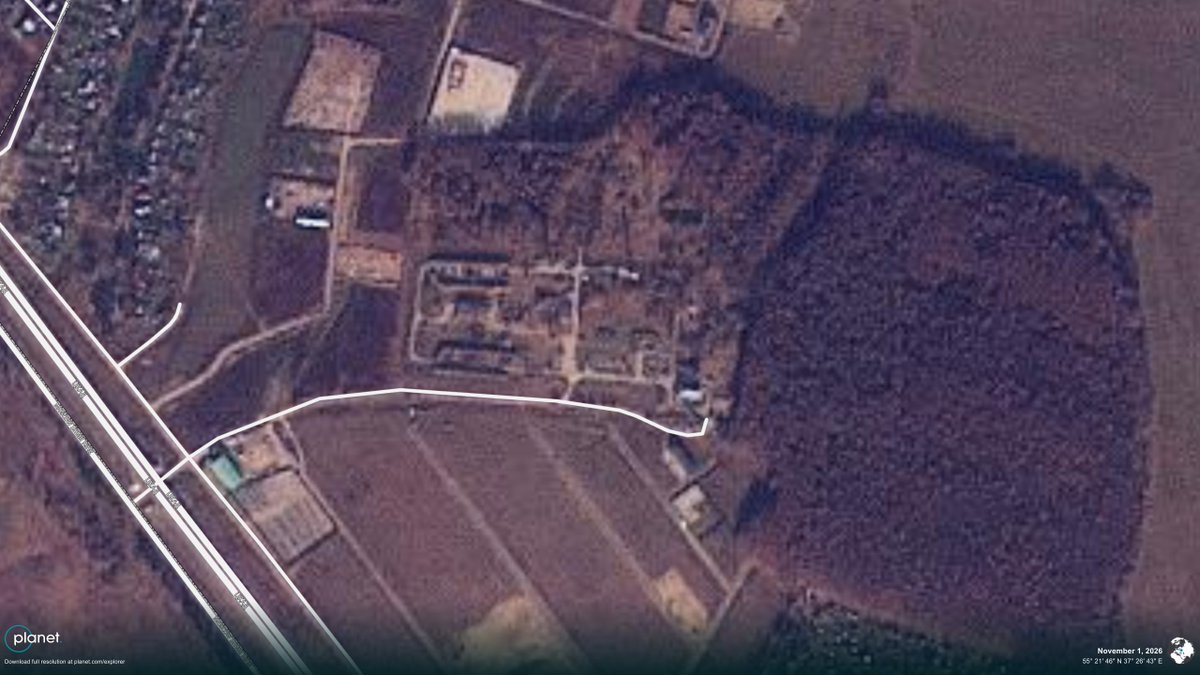
Fascinating thread here about how Yandex is putting in fake forests and using other measures to hide Russian air defense sites.
This one (55.36303, 37.4445) - apparently an S-400 site - was recently forested.
Compare here:
Yandex, Google (June '23), and Planet (two weeks ago)
Ukrainian defense company TENCORE has demonstrated an AI-assisted armored ground robot for battlefield casualty evacuation at the European Defence Innovation Forum in The Hague. The vehicle combines autonomous control functions, ballistic protection and thermal-signature reduction. A camera, microphone and speaker allow operators to communicate with wounded soldiers during evacuation. Five Ukrainian companies presented their technologies to Dutch military personnel and Defense Ministry officials. #Ukraine
Notably, UK has never sanctioned a single company building settlements in Turkish-occupied Northern Cyprus, despite its treaty obligations to protect the Republic of Cyprus. This is not about international law, it is about making Judea judenrein.
The absolute state of the knuckle-draggers in the replies... "He's Jewish!"
No, Aaron is a very common first name among non-Jewish people in Britain, of English, Scottish and Welsh ancestry. It's no different to someone being called Joshua. Both are biblical names of Hebrew origin, but neither tells you anything about someone's ethnicity or religion. His surname doesn't indicate Jewish ancestry either.
As for what he did, disgusting. Some people are saying three years is too long. The reality is that he probably won't get anything close to that. More likely, he'll receive a relatively short suspended sentence.
I think it's fairly safe to assume that, given the ongoing war and repeated Ukrainian strikes, the road arch span will remain destroyed for good at least until the end of the war.
For reference, the original construction timeline:
• August 2016 — assembly of the road arch on land began.
• July 2017 — assembly was completed.
• October 2017 — the arch was installed over the navigable channel.
That's around 14 months, without even accounting for the additional work now required to remove the collapsed steel structure, assess and repair the damaged supports, and restore the road surface.
The only real question is whether the railway arch will remain standing or meet the same fate.
Girl’s Home Fashion Videos Spark Police Crackdown in Iran!
This is Ghazal. A young, talented Iranian woman who turned a corner of her own home into a fashion runway.
She has no studio. No professional lights. No designer clothes. Just her phone, her walk, and the confidence of a professional model. Like the models you see on the biggest stages of fashion.
Ghazal's Instagram page, with more than 31 thousand followers, has been blocked by the morality police, with a notice from the security police.
Think about it. She hurt no one. She simply walked, posed, and existed in her own home. For this, her talent is treated as a crime.
In any free country, Ghazal could be on her way to becoming a real model. In Iran, she must fear a police case for the simplest form of self expression.
How many singers, dancers, artists, and models is this regime burying before the world ever hears their names?
The Islamic Republic is an Apartheid regime. It is the enemy of women, of beauty, and of freedom.
To the famous fashion brands of the world, to the supermodels whose faces are on every billboard: Ghazal cannot speak to you. But you can speak for her. Show your solidarity. Invite her. Cast her. Use your stage, because she is not allowed to have one.
@UAGApartheid
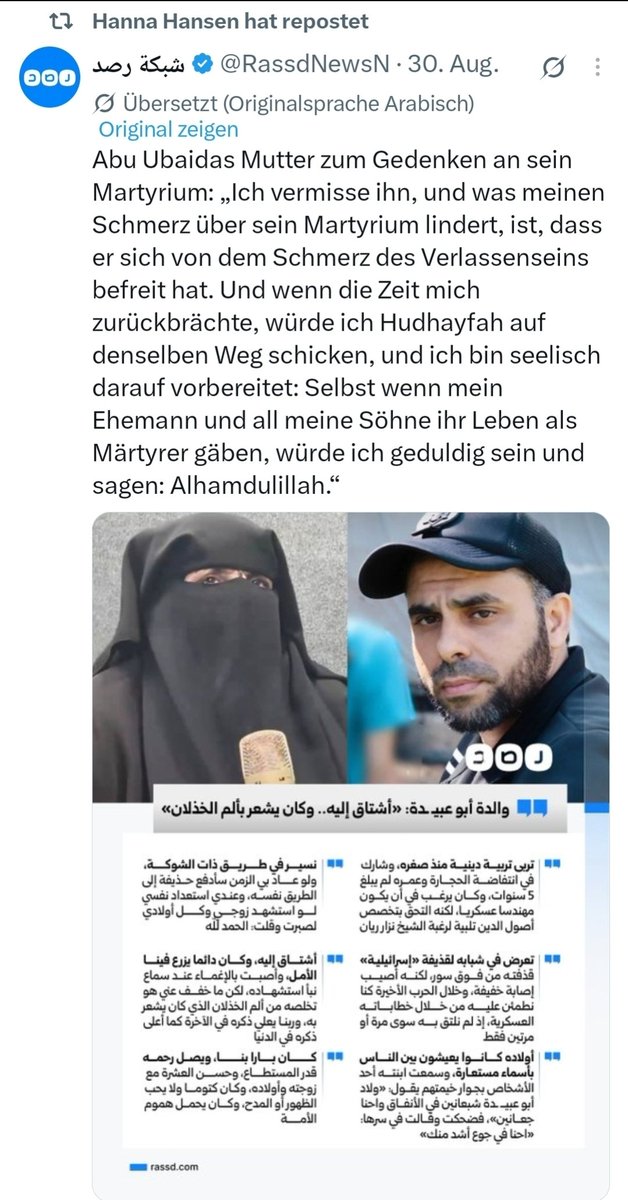
Turboradikalisierung live: Hanna Hansen, Identifikationsfigur der deutsch-salafistischen Szene, posiert jetzt mit Pistole im Wald.
Überraschend ist das nicht. Zum Jahrestag des 7. Oktober feiert sie das Massaker als "Sieg". Sie teilt die Märtyrer-Verklärung von Hamas-Sprecher Abu Ubaida und einen Gruß an Osama bin Laden als "Shaykh" mit dem Wunsch, er möge ins Paradies kommen. Das Waffenfoto ist nur das nächste Kapitel.
#HannaHansen #Salafismus
A Jewish community centre in London hosts British doctors who are thinking about leaving the country because of antisemitism.
An Israeli clinic chain hands out a job flyer. A few of its clinics are beyond the 1967 line.
The regulator's answer is a compliance probe into the Jewish community centre.
The doctors are looking at the exit because Jews feel pushed out of British life. The probe lands on the place that tried to help them.
Who exactly is the Charity Commission protecting here?
Part of the Crimean Bridge collapsed into the Kerch Strait after a second attack in 24 hours damaged its road arch, multiple sources confirm. Road and rail traffic across the bridge has been halted.
"Doctor" Sabreen's beauty center in Gaza City, The Saraya Intersection, next to Zoom Optics.
Timestamps: 6 days ago (Nov '26) + 15 Oct '26
#TheGazaYouDontSee
Links in 1st response