The full talk will be available publicly shortly for any who may be interested and covers some updated data, but also questions around buying within the present market and the present uncertainty around that.
A comparison across 2 years of collecting data (2023 vs 2025), showing the growth of the deleterious blockwork problem around Clare and Limerick, as well as some other areas of Ireland.
Some important notes on the data in the following tweets.
The density colours are indicative at this stage but the next map iteration will work on further clarity on incident rate. There has been an increase in the density of occurrences in Donegal across those 2 years which isn't picked out in the map at present.
Lovely trip visiting Limerick, and thanks to @engineerireland for the invite to speak, and to the University of Limerick for hosting an event. However, shocked at the potential scale of the impact in Clare and Limerick from the deleterious blockwork problem.
One of the reasons this matters is both the ultimate solution (i.e. demolition and rebuild as recommended in the revised standard), but also setting up a suitable testing regime to cover conveyancing purposes. Some properties that will fail will still look ok at the moment.
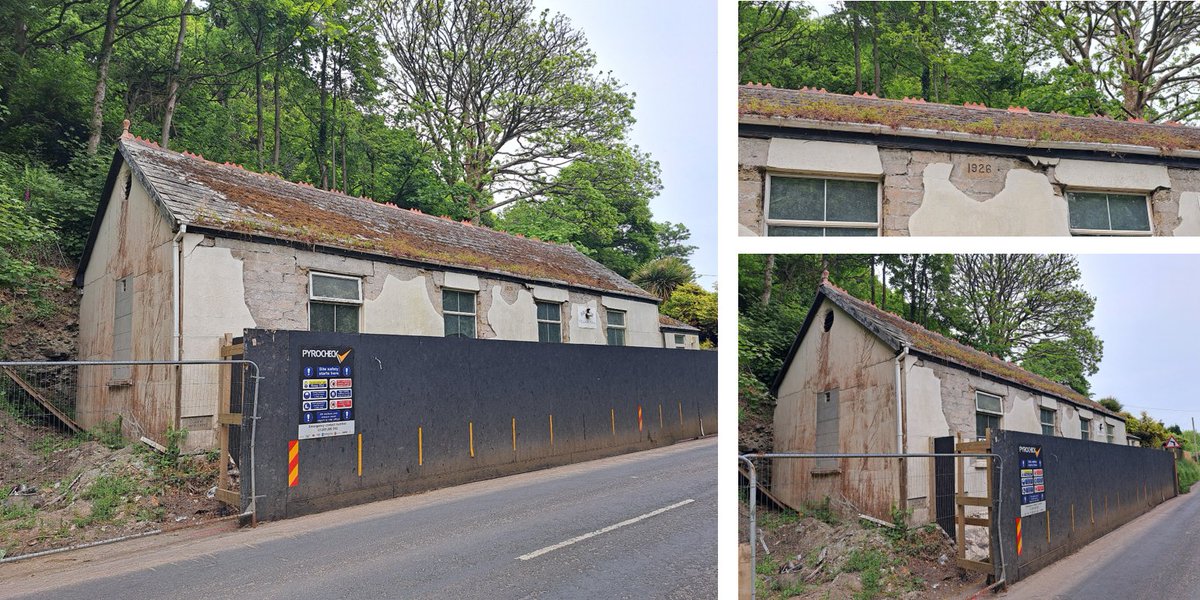
Reading the redraft of I.S.465 I was reminded that not all ISA occurs quickly. The example below is a hall built in 1926 (Cornwall) that is now Unsound - it's taken nearly 100 years to get to this point - slow, but ultimately critical failure.
Important notice: public consultation for I.S. 465 now open
A second, fully revised edition of I.S. 465 has been developed and the NSAI has launched a public consultation.
I.S. 465 is "Assessment, testing and classification of damaged buildings containing concrete blocks containing harmful substances."
Full details of I.S. 465, and the commenting system, are available here - https://t.co/PzWcLwvunZ
This public consultation will close on Wednesday, May 28th.
#HaveYourSay
A bit of petrographic "tinsel" as we are winding into the Christmas break. This is rare red acicular dumortierite growing within a quartz vein. The vein X-cuts the section so as to leave the dumortierite like a piece of tinsel draped across the sample #geoart#thinsectionthursday
@Liosa81@ProfPaulDunlop Hi Líosa, if the concrete type across all samples is the same then that would be unlikely. As an e.g, across the several thousand properties we have now tested we have never prepared a phyllite block and not seen pyrrhotite. It's a statistical possibility - but a very low one.
Coming back to #Irish petrography - sometimes you see Fe oxide staining in hand specimen but rarely such a good example in thin section - this happens when Fe from the oxidising pyrrhotite in the phyllite leaches into the surrounding binder. And it's not just Fe.
Intriguing one from general petrography analysis with what looks like a xenolith of a rounded basalt hosted within another basalt.
Both are compositionally very similar suggesting eruption, solidification, erosion & then eruption again.
#thinsectionthursday#petrography
@Liosa81@ProfPaulDunlop The aggregate type also matters. The phyllite that is the dominant problem aggregate throughout Donegal is weak and friable (breaks easily along planes in the rock), meaning the pyrrhotite is readily exposed during crushing.
@Liosa81@ProfPaulDunlop We have made that latter argument in recent conference papers - all of which are public. For the screenshot you have provided the TS is 0.45, which is below the 1.0 where pyrite is dominant.
This is very interesting. Cultural reasons were different obviously but can have an older maternal age with high fertility rates.
Raising fertility rates is something the West will need to grapple with in the not far distant future of course - interesting to see how it does.
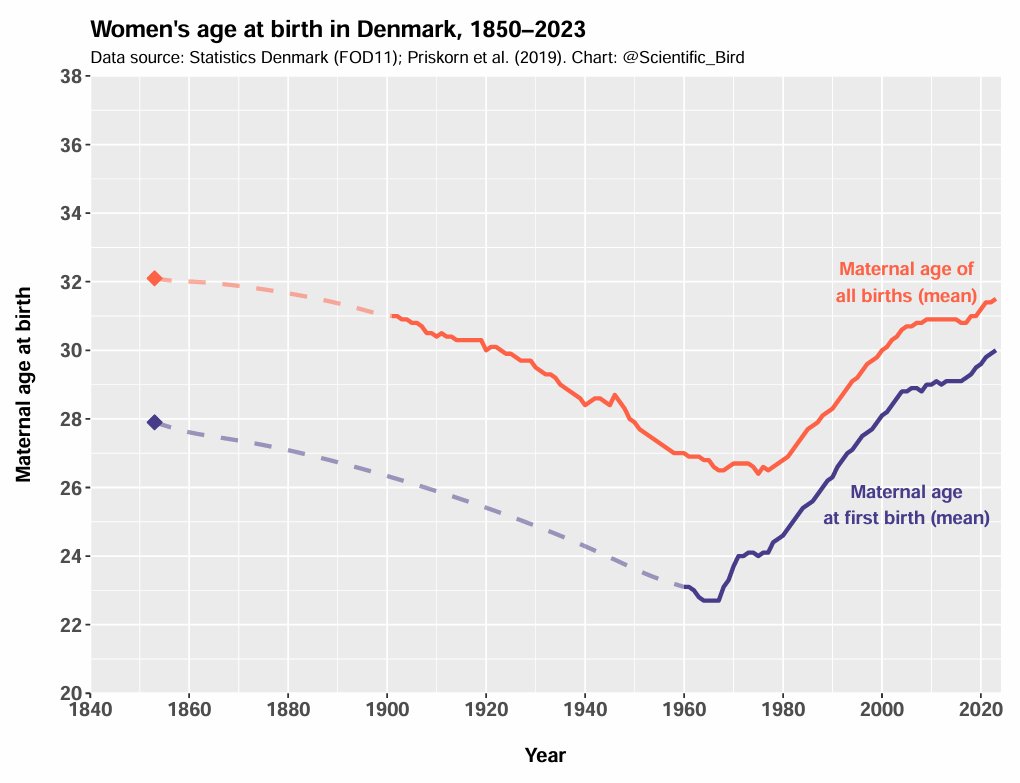
In Denmark in the 1850s, the age of women's first birth was surprisingly high: average of 28 years old. This can be observed from parish records. Despite this, fertility was high.
This was due to an 1824 law prohibiting marriage if you couldn't financially support your family.
After 7.5 years in the House, I did not get to speak, on behalf of all those who've written, for even 3 minutes, on one of the most important and contested Private Members' Bills we've had... Proof that this is NOT the way for us to legislate on these matters #AssistedDyingBill