A Saxophone Went to Work on the Space Shuttle...
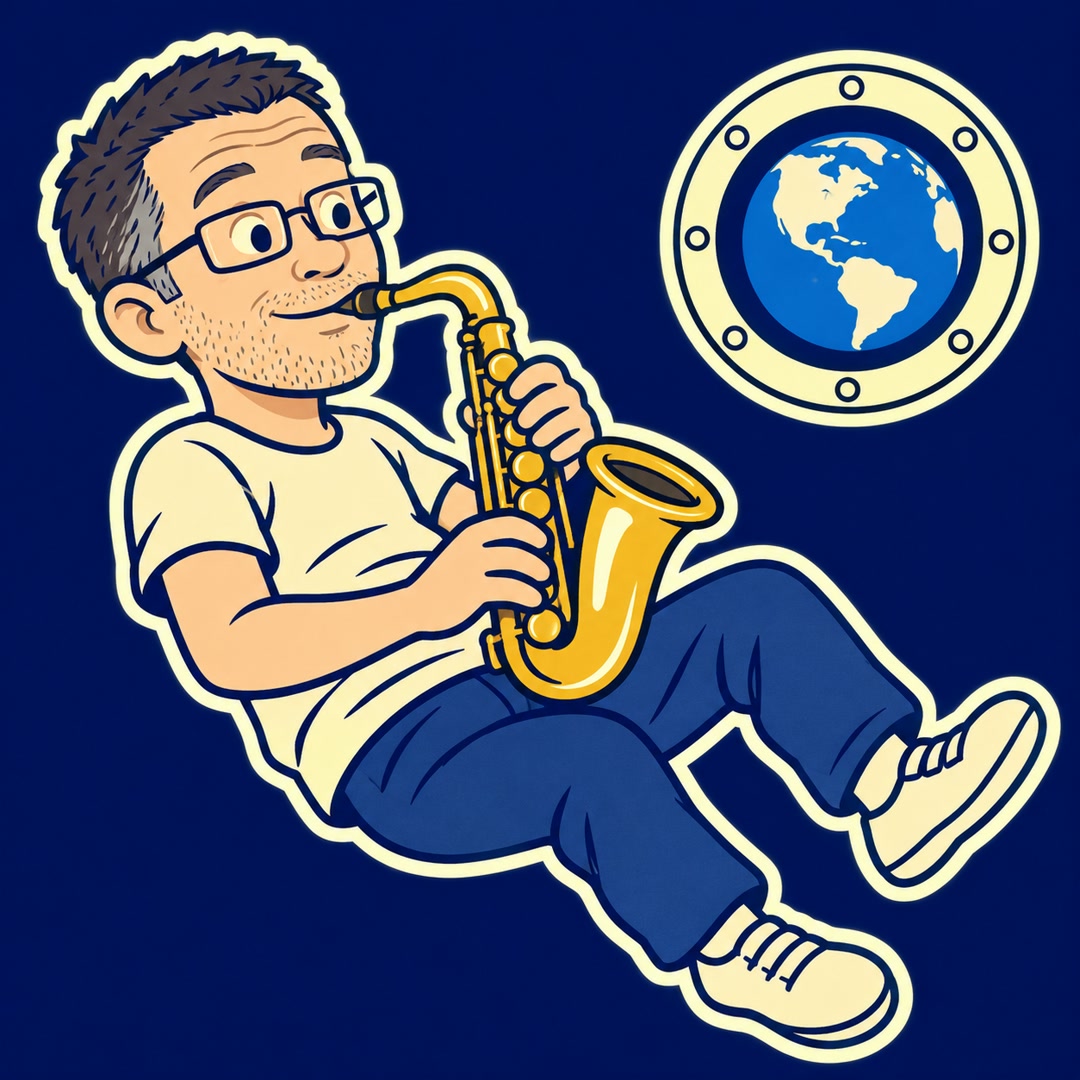
In February 1984, NASA astronaut Ronald McNair took his saxophone aboard the Space Shuttle Challenger. NASA still has the photograph, taken on February 8. The more surprising part is what he planned to do with it next.
NASA's caption says he plays "his saxophone while off-duty during the STS-41B mission," and the MIT Black History archive dates the same scene to "aboard the Challenger, February 1984." Wikipedia lists the flight as February 3 to 11, 1984, with McNair as a mission specialist and an accomplished saxophonist.
Before his second flight, he was working on a piece of music. SYOS reports he "had been working with the French composer and electronic music pioneer Jean-Michel Jarre," and that the plan was for McNair to record his saxophone solo in orbit. Wikipedia quotes Jarre's liner notes: "Ron was so excited about the piece that he rehearsed it continuously until the last moment."
If you have a hobby that doesn't fit your job, McNair is a good example. A shuttle mission specialist brought the thing he loved on a flight, and he didn't wait for a better time to make room for it.
The recording never happened. SYOS says plainly, "The recording was never made," after Challenger broke apart seventy three seconds after liftoff on January 28, 1986. Jarre still released the music with a dedication: "May the memory of my friend the astronaut and artist Ron McNair live on through this piece."
WinUDF teaches MS-DOS and Windows 95 to read DVD and Blu-ray discs...
A new driver called WinUDF reads the file system of DVDs and Blu-ray discs on computers running MS-DOS and old versions of Windows. Microsoft documented years ago that Windows 95 could not read the format those discs use, so this fills a gap Microsoft itself wrote down.
The format is UDF, the Universal Disk Format. Microsoft's archived knowledge base article says UDF "is not supported in any release of Windows 95." The same article says those discs "require a third-party program for playback" on a Windows 95 computer. That is why an old machine with a DVD drive could spin the disc and still show you nothing useful.
The WinUDF page on GitHub says the project handles "the file system of DVDs, Blu-ray discs, packet-written CDs and UDF-formatted USB sticks and disks." The README's title calls it an installable file system driver for DOS, Windows 1.0x through 3.x, and Windows 95, 98 and ME, so it reaches back before Windows 95 as well as through 98 and ME. The same README says the DOS program gives DOS and Windows 1.0x–3.11 drive letters for them. A disc that nothing on that machine could open becomes a drive letter you can type at a prompt, and that covers a lot of machines people still keep in a closet.
Do you keep an old DOS or Windows 95 computer around for games or old files? Then a DVD drive in it may finally be useful for moving files in and out. Back up your startup files before you install any driver on a machine you care about, and test it with a disc you can afford to lose.
Old software keeps gaining abilities when somebody cares enough to write them. For a DOS machine, a DVD is now just another drive letter.
Students Sent a Rubber Chicken Into a Solar Storm...
Camilla is the rubber chicken mascot of NASA's Solar Dynamics Observatory, and in March 2012 a high school club in Bishop, California flew her to the edge of space twice. NBC News said the second flight was a student experiment to observe the radiation from "the strongest solar tempest in nearly a decade." She flew the first on March 3, before the radiation storm, and the second on March 10, while it was raging, according to NASA Earth Observatory.
The students were Bishop Union High School's Earth to Sky group, and they split the gear between the payload and the chicken. NASA Earth Observatory describes a modified department store lunchbox full of instruments: four cameras, a cryogenic thermometer and two GPS trackers. Camilla herself wore a knit space suit, and Jalopnik described it as fitted with radiation badges. Student Sam Johnson, 16, told NASA, in a story reprinted by Lake County News, "We equipped Camilla with sensors to measure the radiation."
The storm came from sunspot AR1429, which NBC News reported unleashed more than 50 solar flares in the first two weeks of March. The balloon carried the chicken to 120,000 feet, NBC News said, and NASA's account, reprinted by Lake County News, quotes the students that at the top of the flight "the payload was above 99 percent of Earth's atmosphere." After the first flight, NASA Earth Observatory says, the payload was recovered intact from a landing site in the Inyo Mountains.
If you run a school club, a maker space or a class, this is a project you can borrow. A cheap balloon, a mascot and a handful of sensors got students a flight that NASA wrote up. When something interesting happens, like a storm, you can fly it again.
At the moment of the March 10 launch, NASA Earth Observatory says, satellites measured solar proton counts at approximately 30,000 times normal. A rubber chicken in a knit suit went up into that.
Today is World Television Day - 3 Facts!
• The UN General Assembly declared it in December 1996.
• November 21 marks the first World Television Forum in 1996.
• The UN cites TV's power to focus world attention on major issues.
(Source: United Nations)
On November 21, 1969, the first permanent ARPANET link was set up between UCLA and the Stanford Research Institute. Two nodes, one wire, and the seed of the internet. Every network starts small.
On this day in 2007, a viewer asked: buy the One Laptop Per Child and help another kid, or spend the same money on an Asus Eee for his daughter? Cheap little laptops were the new thing. Which would you pick today?
https://t.co/WxutxjfBEZ
The ThinkPad power-button routine IBM support used to give out...
In September 2007, Mike Masnick wrote on his own blog that his new ThinkPad died about an hour before he was due to speak at the Office 2.0 conference. An IBM support rep brought it back with a power-button routine he could not fully explain.
Masnick says he "discovered that my brand new laptop wouldn't work." The rep called the fix "static discharge," and when Masnick asked for more, the rep told him "dude, you know as much as I do… but your machine is working." Dave Farquhar, who writes about old PCs, describes the advice IBM support gave: "IBM support personnel used to tell people to briefly hit the power button 10 times."
The theory behind it is leftover charge. Farquhar says "residual amounts of power can remain in the computer's capacitors for a very long time," which can leave a machine stuck half on. He also says he thinks the ten quick presses are a placebo: "I think pressing the button rapidly 10 times is a placebo." That is his opinion, and he adds that the presses do no harm.
The repair guide on iFixit gives the version that holds up. It lists "Static or Residual Power Buildup" as a cause of a ThinkPad L460 that won't turn on and the fix as a hard reset: "Disconnect the battery and AC power." Then "Press and hold the power button for 30 seconds." Then "Reconnect the power adapter and try turning it on."
Do you have a laptop that is totally dead, with no lights at all? Before you pay for a repair, unplug it, pull the battery if you can, hold the power button for 30 seconds, and try again with only the charger. It costs you nothing but a minute.
A dead laptop is sometimes a stuck laptop. Drain it first, then worry.
Every demo Mac in the 1984 stores had a floppy named like keyboard mashing...
In the first week or so after the Macintosh launched in January 1984, the team visited computer stores and found that every demo Mac had a startup floppy with a garbage name. Bruce Horn, who wrote the Finder, says the cause was a design choice meant to make the Mac friendlier.
Horn tells it on Folklore. "Without exception, every Mac's floppy disk had a garbage name," he writes, and the names looked like ";lkakl;rt;klgjh," "as if someone had just randomly typed characters to see what would happen." Horn explains that "whatever anyone typed when they first came up to the Macintosh would end up renaming the disk."
The design behind it had a long history. Horn's own writing on Apple History credits "selection-based modeless text editing with cut and paste" to Larry Tesler, who created it for his Gypsy editor at PARC. In that model, typing always edits something instead of switching you into a command mode. On a store Mac, that meant whatever a shopper typed first became the disk's name.
The fix was small. Horn went back to the office and built a new Finder that, Folklore says, made people take an extra step before renaming a disk. He called the experience a "taste of humble pie." The Finder itself was tiny: Horn told TidBITS in 2004 that "the Resource Manager was 3K, and the Finder 46K," and that he left Apple "in the spring of 1984, after doing a 'final' version of the Finder."
If you build software, watch strangers use it in a public place before you ship it. The store floor found what the lab missed. If you run a kiosk or a demo machine, lock down anything a passerby can change by accident.
Add a speed bump where a stray keystroke can do real damage, and test it on people who have never seen the thing before.
Ductus builds a font from your own handwriting, one letter at a time on screen...
A web tool called Ductus asks you to write each letter of the alphabet yourself and turns the strokes into a font. The page's headline reads "Your handwriting, as a font." My own FontCrafter on Pirillo Arcade starts with a printed template, and Ductus skips the paper.
The Ductus page walks you through it with a prompt, "Write a small a, 1 of 26 lowercase," plus Back, Undo and Clear buttons, then Adjust and Export. Calligraphr takes a template route too. It says "With just a few clicks, you can compile your own customized template with exactly the character set you need for your font," and its fonts are "standard Font files (ttf or otf format)."
FontCrafter's first step is "Print the template at 100% scale," and it says it "turns your handwriting into a real, installable font." Both of those start from a template, which is the part Ductus removes.
Privacy matters when the input is your handwriting. FontCrafter says "Your scan never leaves your device." Ductus says a font you drop back in to reopen is checked on your own computer and is "never uploaded." Those are each site's own statements, so treat them as claims.
Want a font that looks like your own writing for slides, labels or a gift? Try Ductus if you have no printer, and a template tool if you want every character covered. The Ductus page does not list its file format or a price, so look at what Export gives you before you count on it.
Your handwriting makes the most personal font you can own. Check what a tool keeps before you hand it a page of it.
On this day in 2009, I shared the Chumby One, a little touchscreen gadget you could fill with widgets. A small screen earns its place when it gives you the few things you want at a glance. (Source: Chris Pirillo video archive)
https://t.co/sSJkxWuZlT
Today is World Children's Day - 3 Facts!
• The UN adopted its declaration on child rights in 1959.
• The UN adopted its child rights convention in 1989.
• Schools and landmarks light up or are painted blue on 20 November. The Eiffel Tower has joined in past years.
(Source: UNICEF)
On November 20, 1998, Zarya launched as the first piece of the International Space Station. It reached orbit in nine minutes. It could already do a job the rest of the station would need: provide temporary control. (Source: NASA)
Voting for the 2026 Bond AI Awards is officially open!
We're recognizing the organizers who brought their city's AI community together this year: hosting events, curating guest lists, lining up sponsors, and handling all the unglamorous work in between.
These are the rooms where people build new relationships, meet new customers, find future cofounders, and raise their next round.
Nominees span all seven Bond AI cities: SF, NY, Seattle, London, Paris, Berlin, and Amsterdam.
Cast your vote and celebrate your community leaders: https://t.co/IUqoYnQL2t
Voting closes Dec 10, with winners announced Dec 14. Follow @bondaicommunity to see who wins.
Congrats to all the nominees!