@JKSteinberger These murders this killing for its own sake by Israeli military forces, by Israeli men and women goes on still night and day. On and on. Not only crushing sadness and anger in the void but an alien pall of weirdness clings to each passing hour. This bold horror,
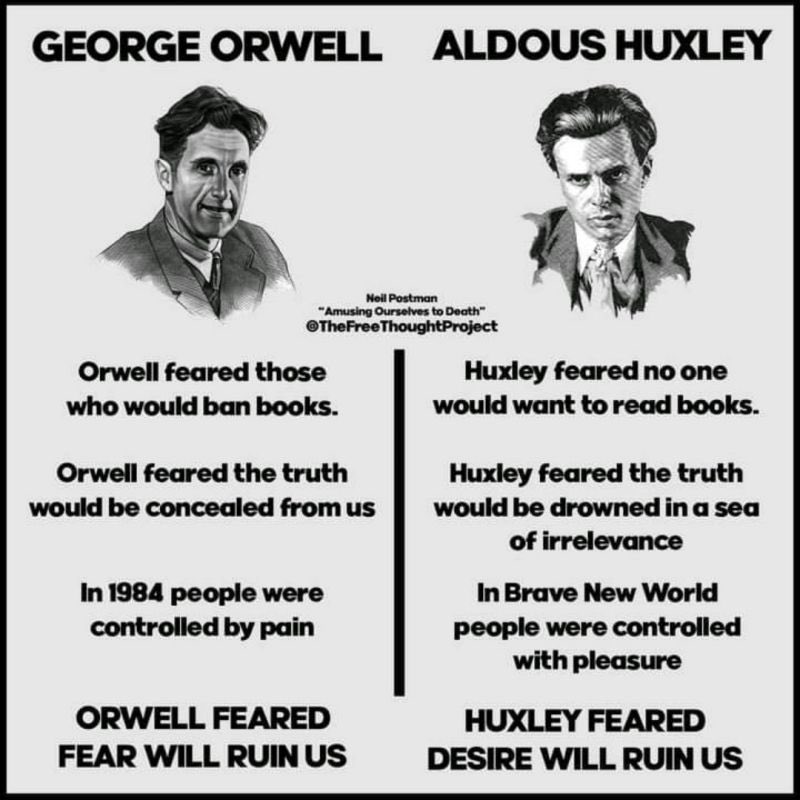
One of my longest-standing arguments is that we are not living in Orwell’s 1984, where truth is centrally suppressed and censored by force (that’s former communist societies, modern-day China, Russia, North Korea).
We are living in something much closer to Huxley’s Brave New World.
The truth is not hidden - it is almost always readily available. But it is buried beneath an industrial quantity of noise: propaganda, outrage, half-truths, conspiracy theories, influencer theatre, algorithmic rage bait and an endless stream of content designed not to inform us, but to keep us emotionally stimulated.
The modern information system does not need to censor the truth when it can simply drown it in noise.
A fact no longer has to be disproven - it only has to be surrounded by a hundred competing claims, stripped of context and nuance, turned into partisan ammunition and pushed into the same feed as celebrity gossip, memes and 15 second videos engineered to deliver the fastest possible dopamine hit. By the time the truth reaches us, it appears as just another piece of content competing for our attention.
That is the more sophisticated form of control: not preventing people from knowing, but exhausting their capacity to care.
Orwell feared a world in which people would be deprived of information. Huxley feared a world in which they would be given so much distraction, stimulation and triviality that they would lose the desire to seek it.
The defining struggle of our age is therefore not simply between truth and censorship, but between truth and indifference.
#Europe and the "Board of Peace" are on a collision course as Brussels prepares to host a pivotal #Gaza recovery conference, with #UNRWA at the center of the dispute. https://t.co/Hwl6XECs0L
"Thucydides repeatedly refers to, but never endorses, the idea that the strong have the freedom to do what they want: to the contrary, a careful reading of The Peloponnesian War suggests a rather different view. Among the principal lessons to learn from Thucydides is that the ambition of the strong can lead to their own undoing. Right after Thucydides reports the fateful words of the Athenian envoys and the subsequent destruction of Melos, he describes at great length the disastrous campaign Athens pursued in Sicily—an effort that eventually led to Athenian defeat and Spartan victory. In this light, the Melian Dialogue is not proof of the great virtue of strength in international relations but an illustration of pride before the fall."
https://t.co/fkJleeq1PK
🇱🇧 Hezbollah chief Naim Qassem, in his Ashura address, said the group’s restraint amid repeated Israeli strikes was due to of a deliberate strategy of “patience,” and not weakness. Drawing on the Karbala narrative, he championed endurance as the path to eventual victory.
“Our patience makes the future, overturns equations, and breaks the tyranny of the oppressor,” Qassem said, saying Israel must still withdraw “without retaining an inch.”
بدون تردید ایران بیشتر از هر طرف دیگری، دغدغه امنیت جمعی منطقه را دارد. اینکه شورای همکاری خلیج فارس، تصور کند راه حل رفع این دغدغه، پناه بردن به بزرگترین ناقض امنیت است، خود نقض غرض است و طنزی تلخ و نشانهای مأیوسکننده از عدم درسآموزی از تجربههای تلخ اخیر.
باید از همسایگان جنوبی پرسید چرا خود، با نقض اصل حسن همجواری و قواعد بنیادین حقوق بینالملل، در حمله تجاوزکارانه علیه همسایه مسلمان همراهی کردند و اجازه دادند که از قلمروی آنها علیه ایران استفاده یا از آنجا موشک شلیک شود؟
چرا آنها درباره مسابقه تسلیحاتی مخرب و خرید و ذخیرهسازی صدها میلیارد دلار انواع تسلیحات پیشرفته که هیچ توجیه دفاعی ندارند تغافل میکنند؟
چرا تجاوزهای مکرر رژیم صهیونیستی علیه کشورهای منطقه و اشغال سرزمین فلسطین و لبنان را نادیده میگیرند؟
چرا در قبال زرادخانه هستهای خارج از هرگونه نظارت بینالمللی رژیم اشغالگر سکوت اختیار میکنند، اما توان دفاعی متعارف کشوری که بارها هدف تهدید و حمله آن هم از قلمرو کشورهای همسایه قرار گرفته، «تهدید» معرفی میشود؟
باید برای همگان روشن باشد که توانمندیهای نظامی ایران، ضامن حق ذاتی دفاع مشروع ملت ایران در برابر تجاوز و جنایت است و همزمان تامین کننده صلح و ثبات در منطقه.
امنیت و عزت ملی کشور قابل معامله یا مشروطسازی نیست؛ همانطور که حق ذاتی دفاع مشروع به هیچ عنوان نمیتواند موضوع گفتگو باشد، ابزارهای آن هم نمیتواند موضوع مصالحه با هیچ طرفی باشد.
Lavrov reiterates #Russia's readiness to support peace efforts in the Middle East, with Moscow ready to implement previous suggestions for Tehran's enriched uranium stockpile. https://t.co/GLKLDJuydq
Lavrov reiterates #Russia's readiness to support peace efforts in the Middle East, with Moscow ready to implement previous suggestions for Tehran's enriched uranium stockpile. https://t.co/GLKLDJuydq
I disagree that we are in a "New Cold War".
Rather, we are in a continuation of what we might call the Long Cold War, or the Great Anti-Sovereignty War, which has been waged by the imperial core against liberation movements and sovereign-seeking states in the periphery that have sought to break from their subordination and exploitation within the imperialist world-system.
The Long Cold War encompasses Western attacks against the Russian revolution and the Chinese revolution, through the long series of invasions and regime-change operations that targeted Korea, Guatemala, the DRC, Brazil, Ghana, Indonesia, Vietnam, Chile, Burkina Faso, etc, continuing well beyond the fall of the USSR with the invasions of Iraq, Libya, Syria, etc., all the way to the strangulation of Cuba and the invasions of Venezuela and Iran in 2026.
As I see it, the usual claim that the Cold War runs from 1945-1991 doesn't work, the periodisation is wrong. The core states sought to destroy the USSR as soon as it was founded, long before 1945, and in any case their violence was never only just against the USSR, or just against USSR-aligned states, nor even just against socialism; it was fought against any sovereign-seeking state in the periphery - including non-aligned states - that threatened to escape the imperial arrangement.
The Long Cold War is, in other words, an imperialist backlash against the long struggle for liberation in the periphery. This aggression didn't end in 1991, it continues today, and it will continue well into the 21st century until it is defeated. And defeated it will be.
@ME_Observer_ Stop fucking waiting. More people are dying the more you wait. Just send at least one missile to show you're not messing around. All this fake "red lines" that keep getting crossed is what's emboldening the zionist regime to continue their genocide. They are limit testing.
The western story of Israel's creation was a lie from start to finish. As this short film shows, Israel's founders knew the story was a lie because they were the ones who invented it.
Understanding what happened then makes perfect sense of what is happening now, in Gaza.
Israel has destroyed Arch Almoulouk, a beloved landmark resort and restaurant owned by Lebanese chef Husen Fayad in Wadi al-Hujeir, southern Lebanon. The restaurant became known for providing free meals to displaced families during the war.
this is my friend Hussein, who has dedicated his life to rescuing animals in Lebanon. he lives humbly, giving everything he has to keep these animals safe.
zionist parasites are getting closer to the farm he rents for the animals, and danger is upon them. still, he refuses to leave them.
he's just one of many unsung heroes in Lebanon.
🚨 New study shows the New York Times, the Associated Press, the Washington Post, CNN, Politico, USA Today and Axios collectively used the term "savage" 16 times for the killing of Israelis, but never for the killing of Palestinians.
Likewise, "slaughter" appeared 120 times in relation to the killing of Israelis, but only once for Palestinians.
"Massacre" was used 344 times in relation to Palestinians killing Israelis, but never for Israelis killing Palestinians.
"Barbaric" was used 14 times to describe the killing of Israelis, but zero times in relation to the deaths of Palestinians.
The cable coverage displayed a similar pattern.
MSNBC, presenters and guests used
"massacre" 177 times, "barbaric" 46 times, "savage" 23 times and "slaughter" 102 times in relation to Israeli deaths.
They never called the killing of Palestinians "barbaric" or "savage". In relation to Palestinians, they only used “massacre" eight times and "slaughter" four times.
References to "savagery" and "barbarism" echo the logic of settler colonialism, identifying the uncivilised natives as a problem to be solved.
Credit: ‘How to Sell a Genocide: Media’s Complicity in Genocide’ by Adam Johnson.
Israel is destroying the most important sites of Christianity, right under your noses.
They hate Christians as much as they hate Muslims, even as they siphon your money and suck you dry.
One of the most deeply shocking scenes documented in this war.
Children in Gaza hospitals, their small bodies trembling in fear after the bombardment, unable to comprehend the terror they have experienced.
Do not stay silent…keep speaking about the children of Gaza.
🟥 30 MAY 2026 | THE BOARD OF PEACE HAS NO MONEY FOR GAZA. SO WHY IS SECURITY THE PRIORITY?🧵🧵
🔳Four months ago the world was sold a promise.
Governments lined up behind Dump Trump’s so-called Board of Peace and told the public that Gaza would be rebuilt. They spoke of reconstruction, recovery and stability. Billions of dollars were pledged. Press conferences were held. Headlines were written. Gaza was told help was coming.
Gaza is still waiting.
The most revealing detail came not from Gaza itself, but from the Financial Times. According to its reporting, the official World Bank-administered reconstruction fund linked to the Board of Peace remains empty despite approximately $17 billion in pledges from participating states. No major reconstruction programme has begun. Entire neighbourhoods remain flattened. Hospitals remain overwhelmed. Hundreds of thousands remain displaced. Families continue to live among the rubble of what were once their homes.
If billions were pledged for reconstruction, where is the reconstruction?
That question becomes even more important when placed alongside another development. Reports emerged that the UAE committed $100 million towards the creation of a new Palestinian police force under the Board of Peace framework. The reported plan involves approximately 27,000 personnel trained outside Gaza in Egypt and Jordan and eventually integrated into the wider governance structure proposed for post-war Gaza.
The question is no longer where the money is. The question is why the things moving forward are not homes, hospitals or reconstruction.
While homes are not being rebuilt, discussions continue about security structures. While hospitals struggle to function, discussions continue about policing arrangements. While the reconstruction fund remains empty, plans for new security forces continue to be discussed. The priorities appear difficult to ignore.
At the same time, Gaza’s existing police and civil security institutions continue to come under attack.
On 15 March, israeli war criminals killed police officers near Zawayda. On 7 May, israeli war criminals killed three police officers. On 10 May, a senior criminal investigations official and another officer were killed in Khan Younis during an israeli strike. On 23 May, five policemen were killed when israeli war criminals targeted a police post in northern Gaza. On 30 May, Gaza sources reported that a police station in Deir al-Balah was targeted, killing one policeman and injuring six others.
Taken alone, each incident can be explained away. Taken together, they form a pattern that becomes harder and harder to ignore. Existing Palestinian police structures continue to come under attack while discussion grows around building a new externally funded and externally trained force.
The contradiction does not end there.
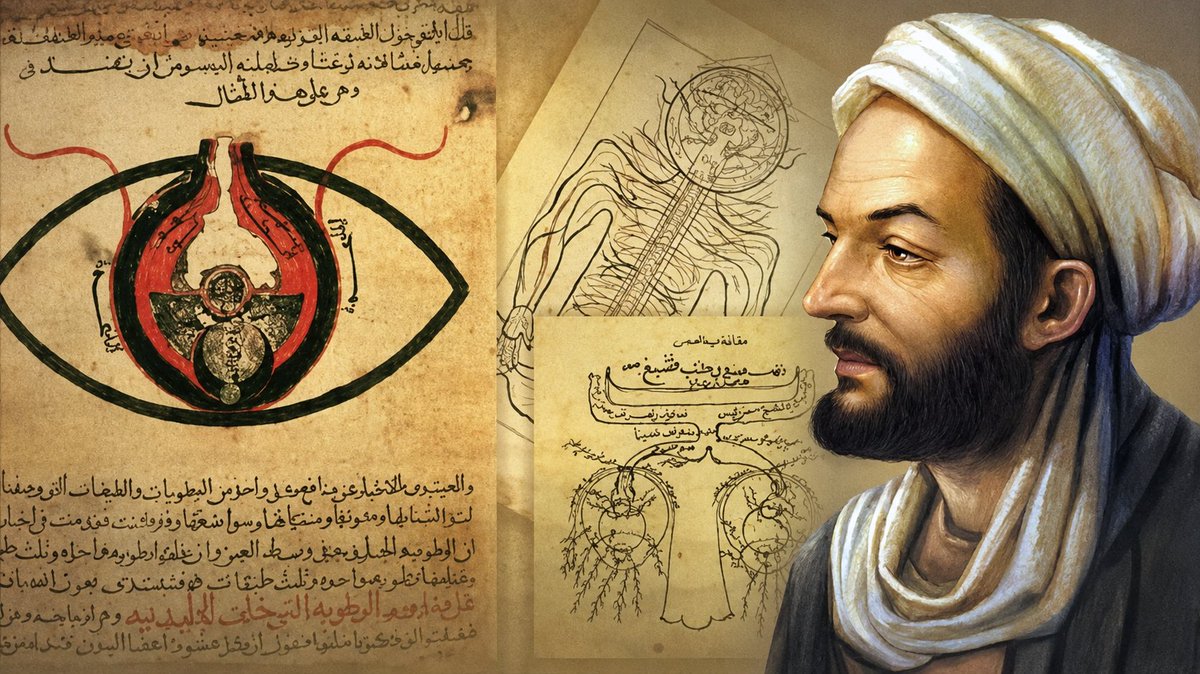
A Persian physician memorized the entire Quran by age 10 and was practicing medicine by age 16. By 18 he had cured a sultan that no other doctor could help. The textbook he wrote in his 30s became the operating manual for every European doctor for the next 600 years.
I started reading about him at midnight and could not believe one teenager had personally built so much of the foundation of modern medicine.
His name was Ibn Sina. The book is called The Canon of Medicine.
Every modern clinical trial. Every evidence-based drug protocol. Every pharmacology textbook. Every medical school curriculum that teaches doctors to observe before they prescribe.
All of it traces back to a Persian teenager who finished his medical education before most modern students finish high school.
Ibn Sina was born in 980 CE near Bukhara, in modern-day Uzbekistan. His father was an Islamic scholar who employed the best tutors money could buy. The tutors started failing to keep up with him almost immediately.
By age 10 he had memorized the entire Quran word for word. By 12 he was correcting his tutors on points of law. By 14 he had outpaced his teacher in mathematics and started learning on his own. By 16 he was treating patients in his neighborhood.
He later wrote, with no false modesty, that medicine was an easy subject and he had mastered it quickly.
He hit a wall around 17. He could not understand Aristotle's Metaphysics. He read the book forty times and still could not grasp it. Then he picked up a commentary on it by Al-Farabi in a Bukhara bookshop for a few coins, read it overnight, and suddenly the entire system of Greek philosophy snapped into place.
He went home and gave alms (money or goods) to the poor in gratitude that he had finally understood.
A year later the news of his medical skill reached the sultan of Bukhara, Nuh ibn Mansur, who was suffering from an illness no doctor in his court could cure. Ibn Sina was called in. He treated the sultan. The sultan recovered. The 18-year-old asked for one thing in payment.
Access to the royal library.
The library of the Samanid sultans in Bukhara was one of the greatest in the Islamic world at that time. Ibn Sina spent the next year inside it reading everything he could find.
He later wrote that by age 21 he had absorbed everything written by every major scholar before him, and that the rest of his career was just refining what he had already understood as a teenager.
He spent the next decade as a wandering physician and political advisor. Empires were collapsing across Persia and Central Asia. He moved from court to court, treating princes, drafting legal documents, escaping invasions, hiding from enemies who wanted to kill him for his association with rival rulers.
He wrote at night while moving between cities by day. He was imprisoned at least once. He kept writing.
In his 30s and 40s he produced The Canon of Medicine. A five volumes book at least a million words. A complete synthesis of every medical tradition he could find. Greek medicine from Galen and Hippocrates. Persian medicine from his own tradition. Indian medicine from Ayurvedic texts. His own clinical observations from thousands of patients.
The Canon was translated into Latin in the 12th century. It was reprinted more than 30 times in the 15th and 16th centuries alone. It was the standard reference text at the University of Paris, the University of Bologna, and Oxford well into the 17th century.
William Osler, one of the founding fathers of modern medicine, called it the most famous medical textbook ever written and said it served as a medical bible for a longer period than any other book in human history.
The part that most people miss is what was actually inside it.
He laid out clear rules for testing whether a drug works rules that still look like modern clinical trials. The drug must be pure, tested on a single condition, and checked against opposite conditions for consistent results. Effects must be seen repeatedly, with timing that matches the treatment. And it has to be tested on humans, since animal results don’t always carry over.
A thousand years before the modern clinical trial existed, he had written its protocol.
He defined medicine itself in a sentence that has never been improved on. Medicine is the science by which we learn the various states of the body in health and when not in health, the means by which health is likely to be lost, and when lost, is likely to be restored.
He insisted that prevention came before treatment. He argued that lifestyle, diet, exercise, and sleep mattered as much as drugs. He was right by a thousand years. He documented hundreds of conditions with such precision that European doctors were still using his diagnostic categories in the 1700s.
He died in 1037 at age 57. He was on a military campaign with one of the rulers he served when he developed colic. He treated himself with what he believed was the correct remedy. The remedy did not work. He died near the city of Hamadan in modern Iran. His tomb is still there.
His own assessment of his life is one of the most honest things any genius has ever written about themselves. He said he had lived a wide life rather than a long one and that he preferred it that way.
The Canon is digitized at the Library of Congress. The original Arabic version is preserved at multiple universities. Free English translations exist online.
The medical textbook that trained every European doctor for half a millennium is sitting one click away from you.
Most modern doctors have never heard the author's full name.
She was rejected 15 times, dismissed as unruly, and largely written out of the conversation. Then the science proved she was right — and changed everything we thought we knew about life itself.
In 1966, a twenty-eight-year-old biologist named Lynn Margulis sat down and wrote a paper that contradicted one of the most fundamental assumptions in all of science.
She was not a tenured professor. She was not working at a prestigious research institution. She was a young mother of two, recently divorced, completing her PhD while raising her sons largely on her own. The scientific establishment had no particular category for her and no particular interest in what she was proposing.
She proposed it anyway.
Her idea was this: that the story of evolution told through competition and conquest was incomplete. That somewhere in the deep history of life on Earth — billions of years ago, long before anything with a spine had appeared — something had happened that was not a battle but a merger. Two separate organisms, each unable to survive alone, had come together and become something neither could have been independently.
The mitochondria in every one of your cells — the structures that convert food into energy, the engine that powers every thought you are having right now — were once free-living bacteria. They did not evolve gradually inside cells. They moved in. They formed a partnership so deep and so permanent that over billions of years they became indistinguishable from the cell itself.
She called the theory endosymbiosis. She called the process symbiogenesis. What she was really saying was that cooperation, not just competition, was one of the engines of evolution — that life's greatest leaps forward had sometimes come not from one organism defeating another, but from two organisms becoming one.
Fifteen scientific journals rejected the paper before it was published in 1967.
Fifteen.
To understand what she was working against, you need to understand the scientific culture of the 1960s. Neo-Darwinism — the synthesis of Darwin's evolution with Mendelian genetics — was the reigning framework, and it was defended with the particular intensity of a field that had recently achieved hard-won consensus. The idea that a bacterium had simply moved inside another cell and stayed there, permanently, was considered not just wrong but somewhat absurd. Evolution happened through random mutation and natural selection, slowly, over generations. Not through dramatic mergers. Not through cooperation.
The reviewers who rejected her paper used words like speculative and insufficiently rigorous. One described the idea as the sort of thing that was interesting to think about but impossible to prove.
She was also described, more than once, as unruly.
It was the specific word that followed women who challenged scientific consensus — not wrong, not misguided, but unruly, as though the problem were her manner rather than her method.
She had been exceptional from the beginning in ways that made people uncomfortable. Born Lynn Petra Alexander in Chicago on March 5, 1938, she entered the University of Chicago at sixteen — intellectually restless, reading at a level that outpaced her coursework, drawn to the questions at the edges of what science had settled. At nineteen she married a young astronomer named Carl Sagan, who would go on to become one of the most famous scientists of the twentieth century. She would later say, without particular bitterness, that during their marriage she was primarily considered someone's wife rather than someone in her own right.
They divorced in 1964. She raised their sons — including Dorion Sagan, who would become her longtime collaborator — while completing her doctorate in genetics from the University of California, Berkeley. She did the work that would change biology while managing the entire domestic architecture of a life that offered her very little structural support.
When molecular biology caught up with her theory in the 1970s — when DNA sequencing technology became sophisticated enough to actually test what she had proposed — the results were unambiguous. Mitochondria contained their own DNA. That DNA was bacterial. The evidence was not suggestive. It was definitive.
The fifteen journals that had rejected her paper were now looking at proof.
The scientific establishment did what establishments eventually do when reality forces their hand — it incorporated her theory, celebrated it as a cornerstone of modern evolutionary biology, and credited her in terms that ranged from gracious to slightly grudging depending on who was doing the crediting. E.O. Wilson, the legendary sociobiologist, called her the most successful synthetic thinker in modern biology. Richard Dawkins — who disagreed with her on multiple other scientific questions — praised her sheer courage in holding to the endosymbiotic theory through years of institutional resistance until the evidence made denial impossible.
Science magazine, the most prestigious journal in American science, called her science's unruly earth mother.
They still couldn't let go of the word.
She was elected to the National Academy of Sciences in 1983. She received the National Medal of Science in 1999 from President Clinton — the highest scientific honor the United States government bestows. She collaborated with British scientist James Lovelock on the Gaia hypothesis — the provocative and still-debated theory that Earth itself, its atmosphere and oceans and living systems, functions as a single self-regulating organism maintaining the conditions necessary for life. It was another idea that the mainstream received with raised eyebrows, and another idea that has proven more durable than its critics expected.
She wrote books with her son Dorion that translated complex scientific concepts for general readers — believing that science belonged to everyone and that the story of life was too extraordinary to be locked inside academic journals. She co-founded a publishing imprint. She taught at the University of Massachusetts Amherst for decades and trained a generation of scientists who carried her framework into fields she never lived to see it reach.
She died on November 22, 2011, from a hemorrhagic stroke. She was seventy-three years old.
What she left behind was a redrawn map of life itself.
Every complex cell on Earth — every cell in your body, every cell in every plant, every cell in every animal that has ever lived — is a collaboration. It contains within it the descendants of bacteria that chose, billions of years ago, to stop competing and start cooperating. The boundary between self and other is not where we thought it was. It never was.
Lynn Margulis saw that when almost no one else did.
Fifteen journals said no.
The universe had been saying yes for two billion years.