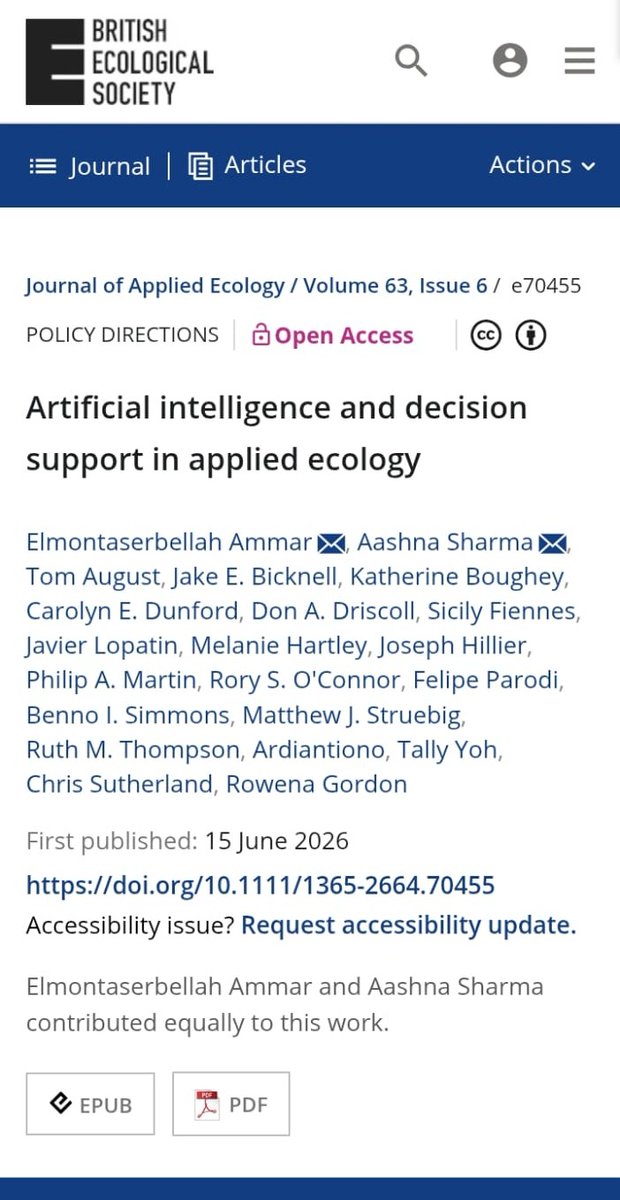
As AI becomes embedded in ecological decision-making, governance matters. Our new
@JAppliedEcology Policy Directions paper, explores how AI can support applied ecological decisions while remaining equitable and grounded in human expertise. Enjoy a read: https://t.co/uKNGre25fC
Fully funded @NETGAIN_DFA#phd for UK students:
Bridging policy and practice: Marine Net Gain metrics for sedimentary Blue Carbon and biodiversity
https://t.co/6tmD8ejLfa
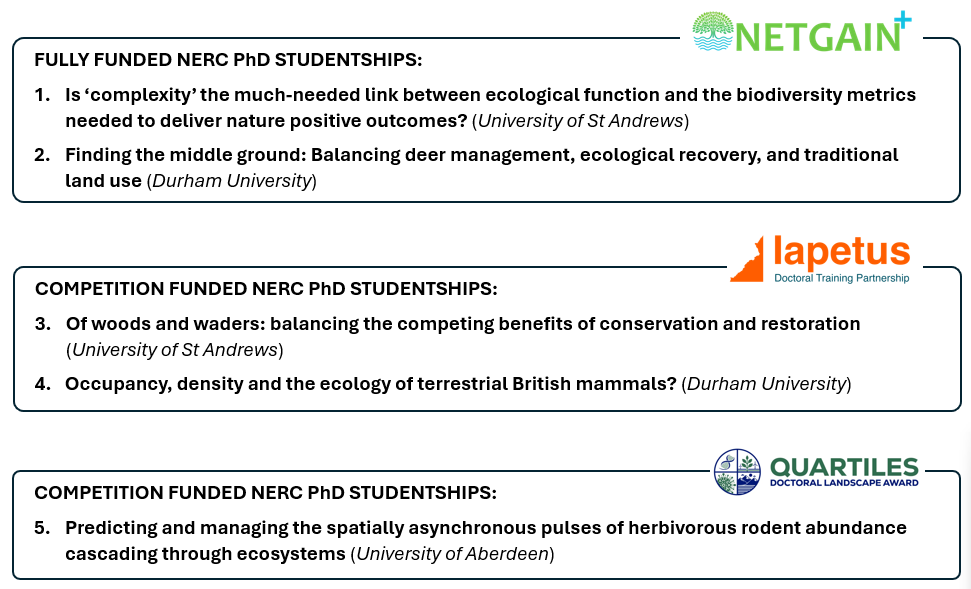
We are recruiting several PhD students. If you are interested in conservation conflicts, population ecology, quantitative ecology, or biodiversity, check these projects out (links in the thread, feel free to reach out):
We are recruiting several PhD students. If you are interested in conservation conflicts, population ecology, quantitative ecology, or biodiversity, check these projects out (links in the thread, feel free to reach out):
Predicting and managing the spatially asynchronous pulses of herbivorous rodent abundance cascading through ecosystems
🔗 https://t.co/YUf8Ehx4Zn
🏢 @aberdeenuni
👪 Xavier Lambin, Paul Caplat, Deon Roos, Me
We are recruiting several PhD students. If you are interested in conservation conflicts, population ecology, quantitative ecology, or biodiversity, check these projects out (links in the thread, feel free to reach out):
Exciting job opportunity in my research program at ODFW! I'm looking for a wildlife ecologist to help lead and develop research with a focus on analysis and writing. Perfect for wildlife bio with good quant skills who wants some time in the field!
https://t.co/1503v5fQh3
Congrats to @AmberCowans and @abonetb on this important contribution. It was an absolute pleasure watching you both operate, and terrific to see this work from your Stats Ecology MSc out! 💯
📝 Are you using multispecies occupancy models to investigate interactions in species occupancy (i.e. co-occurrence)? 🦁🦓
Check out our new paper for advice on the number of sites you need to reliably detect interactions under different scenarios https://t.co/tm8dzdq6cj
📝 Are you using multispecies occupancy models to investigate interactions in species occupancy (i.e. co-occurrence)? 🦁🦓
Check out our new paper for advice on the number of sites you need to reliably detect interactions under different scenarios https://t.co/tm8dzdq6cj
My first @ConversationUK article with @Jackbamberzool1 and Xavier Lambin:
"A surprisingly effective way to save the capercaillie: keep its predators well-fed – new research”
https://t.co/qV8teMZ9iv
New hope for the iconic capercaillie thanks to new research from @chrissuthy and team at the Centre for Research into Ecology and Environmental Modelling at the University of St Andrews
more here👇
https://t.co/2K69dPr6NM
#EverToExcel
🚨 New publication: https://t.co/2xijgHnhNa 📝
Out today in the @royalsociety proceedings B. We find that diversionary feeding boosts productivity of cappercaille from 0.82 to 1.90. Indicating that this impact based method can effectively reduce the influence of predation.