New working paper out!
When foreign investors buy local-currency bonds, they usually must buy the local currency too.
We show this simple fact has big implications for bond yields, exchange rates, and how policy transmits across markets. 👇
🚨 WARNING: THIS CHANGES EVERYTHING
UAE just left OPEC after 60 years.
NO oil production caps.
NO oil export limits.
NO oil quotas.
One of the world’s biggest oil producers is now free to pump at FULL SCALE.
And most people still don’t understand what this means for other markets.
Bonds.
Stocks.
Crypto.
YOU ARE UNDERPRICING WHAT HAPPENS NEXT.
OPEC’s power has always been supply control.
Supply control keeps prices elevated.
But when a major producer steps outside that system, the game changes.
More oil doesn’t create uncertainty.
It creates pressure on prices.
And oil prices move everything.
Energy is the foundation of global inflation.
When crude drops, transportation gets cheaper.
Manufacturing costs drop.
Shipping costs fall.
Consumer prices cool.
And when inflation cools, central banks move.
Now connect the dots:
→ More UAE oil hits the market.
→ Oil prices fall.
→ Inflation drops faster.
→ Rate cuts accelerate.
→ QE returns.
→ Liquidity expands.
And when liquidity expands, risk assets skyrocket.
Bitcoin.
Tech.
Growth stocks.
That’s where capital rotates.
But there are only two paths from here:
1⃣ US-Iran war ends.
Conflict cools down, sanctions ease, and upply routes normalize.
Massive oil supply floods the market.
That’s maximum supply expansion.
UAE pumps freely and Iran exports more.
Global inventories rebuild.
Oil drops hard → Inflation falls fast → The Fed pivots → Liquidity returns → Risk assets pump higher.
2⃣ War keeps escalating.
Regional tensions rise.
Supply routes stay threatened.
Iran stays restricted.
Middle East exports stay unstable.
UAE increases exports.
But UAE supply alone will not cover global demand gaps.
Not if regional disruption spreads.
Not if shipping lanes stay under pressure.
Not if infrastructure risk expands.
That changes everything.
Because if UAE cannot offset the supply shock:
→ Oil spikes higher.
→ Inflation surges again.
→ Rate cuts disappear.
→ Yields rise.
→ Liquidity tightens.
And when liquidity tightens, markets break.
That’s when capital leaves risk.
High-growth tech.
Small caps.
Crypto.
Everything reprices.
This is why the UAE leaving OPEC matters.
It’s not just an oil story.
It’s a macro story.
If war ends, oil crashes and liquidity explodes.
If war escalates and UAE can’t fill the gap, oil surges and liquidity disappears.
There is no middle ground.
Markets will price one of these paths.
And they will price it fast.
Pay attention NOW.
Because the next move in oil will decide the next move in everything.
I’ve studied markets for over 10 years, and I’ve called almost every major market top and bottom.
And I'll also call the next market crash.
Follow and turn notifications on.
I’ll post the warning BEFORE it's too late.
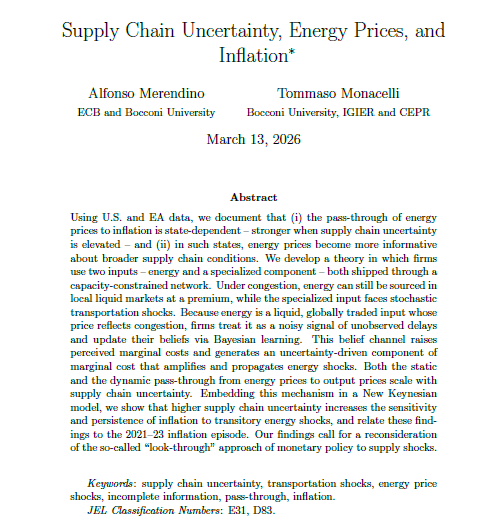
Should monetary policy "look-through" the current energy price shock?
➡️Old debate: energy shocks are "temporary" in nature. Central banks should look them through
➡️We argue in our work that the look-through doctrine does not hold when *supply chain uncertainty * is elevated👇
I have just posted my survey paper “Deep Learning for Solving Economic Models” on my webpage:
https://t.co/VntBsPcBLS
In one or two weeks, it will also circulate as a working paper at the NBER and CEPR. Still, I wanted to let people know already, since I am quite happy with the outcome, largely thanks to some fantastic early feedback I got.
As I have often argued, the ongoing revolution in deep learning is transforming how we solve dynamic equilibrium economic models. At its core, solving a model amounts to approximating unknown target functions (such as the value function of agents, a decision rule, or a best response function). Deep learning frequently does a fantastic job at that task.
In the paper, I emphasize that this success is not “magic,” but rather the direct consequence of deep learning’s ability to discover better representations of the relevant variables of a model (for example, the state variables). The layers of a neural network transform the input variables into informationally efficient representations that can be more easily approximated. Tom Sargent loves to say that finding the state is an art. Deep learning tries to automatize that art as much as possible.
This is why, in many cases, we can now solve high-dimensional problems that were computationally infeasible only a few years ago.
Furthermore, the structure of deep networks designed for solving these models, largely linear apart from the non-linearity encapsulated in the activation function, permits massive parallelization.
The survey paper is designed to start from the ground up. My intended audience is a first-year graduate student with only a very basic knowledge of solution methods, or even a motivated senior undergraduate.
I would very much appreciate feedback. Can you follow the arguments throughout? Are there steps that remain unclear? I have taught courses based on this material at Penn, the Bank of Spain, Cambridge, the ECB, Harvard, Johns Hopkins, Northwestern, Oxford, Princeton, UC Santa Barbara, and Stanford, but I am always looking for fresh eyes to suggest improvements.
All the slide decks, with links to the code, are available here:
https://t.co/aIOVy4gbFM
under “Machine Learning for Economists.”
Eventually, I may use this survey paper and the slide decks as the kernel for something longer, but first, I need to clear my desk of too many ongoing projects.
BREAKING🚨: Stanford University just launched a FREE AI tool for researchers!
It writes Wikipedia-quality reports with 99% accuracy & citations.
Here’s how to access it for free: