Very excited to see this out in the world!
New paper in @TrendsCognSci where we take on a few questionable assumptions made by many brain imaging investigations of brain-behavior relationships.
Most brain-imaging studies make 3 questionable assumptions: mental events are localizable, map uniquely to dedicated #brain circuitry, & are independent of larger context. These 19th-century views need an update. New #OpenAccess paper in @TrendsCognSci. 1/ https://t.co/97jSyxi3Dm
@Nancy_Kanwisher We were really pleased to see our paper ignite such vigorous discussion. Here’s a follow up thread to make a few points of clarification, since our core claims were sometimes lost in translation.
@Nancy_Kanwisher Let’s just be clear here. LFB @LFeldmanBarrett is on the right track. @Nancy_Kanwisher is not. Dr Kanwisher is an amazingly accomplished scientist, rightly honored, but the data has not gone her way.
Very excited to see this out in the world!
New paper in @TrendsCognSci where we take on a few questionable assumptions made by many brain imaging investigations of brain-behavior relationships.
Most brain-imaging studies make 3 questionable assumptions: mental events are localizable, map uniquely to dedicated #brain circuitry, & are independent of larger context. These 19th-century views need an update. New #OpenAccess paper in @TrendsCognSci. 1/ https://t.co/97jSyxi3Dm
Is the distinction between mental and physical illnesses as clear-cut as we think? In our new paper for Annual Reviews of Clinical Psychology, we cover allostasis, affect, and action in Major Depressive Disorder. Check it out below!
https://t.co/xFEm3j3XIZ
Machine learning is a powerful tool, but psychological scientists need to be VERY CAREFUL using it. You can easily end up embedding your assumptions in the model (producing a self-fulling prophecy) instead of actually testing your hypotheses. New paper. https://t.co/5O5Uz8KJkU
We’re hiring! The IASLab is seeking applications for a Research Technician position to work on an NIH-funded project examining how motivational and affective factors influence cognitive aging. Interested applicants should email [email protected]. Please spread the word!!
This holiday season, give yourself the gift of discovery... but watch out for subtle bias, especially when using machine learning. Shout out to Dana Brooks, Jennifer Dy, Zulqarnain Khan, and my other engineering colleagues at Northeastern U. https://t.co/9yzJDtXeAb
We are proud to release a 100 micron MRI scan of the human brain. Preprint on https://t.co/AdTGnRAkTx. Videos on https://t.co/8tGnur6Dn7. Dataset will be available in native space and MNI space at https://t.co/yUwEzUgpXq and integrated into https://t.co/AEnS7InDsA. [1/2]
“When I look at this picture, I see three completely different facial movements,” says @LFeldmanBarrett. “That’s beautiful. It demonstrates the variability of people’s experience and expressions in exactly the same situation.” https://t.co/JU6NHyfBrO
Our amazing RAs killed it today at the @affectivescilab undergrad poster session!! Such a great opportunity for them to show off all of their hard work this semester!
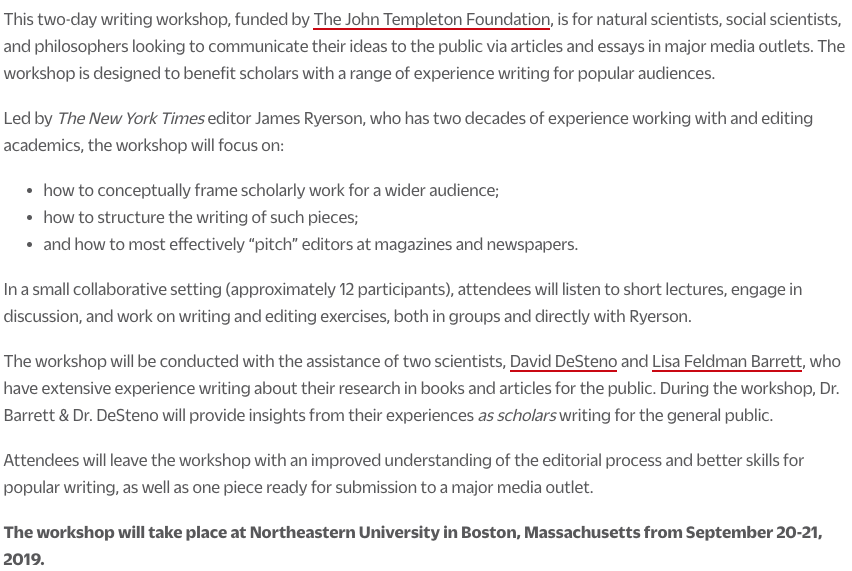
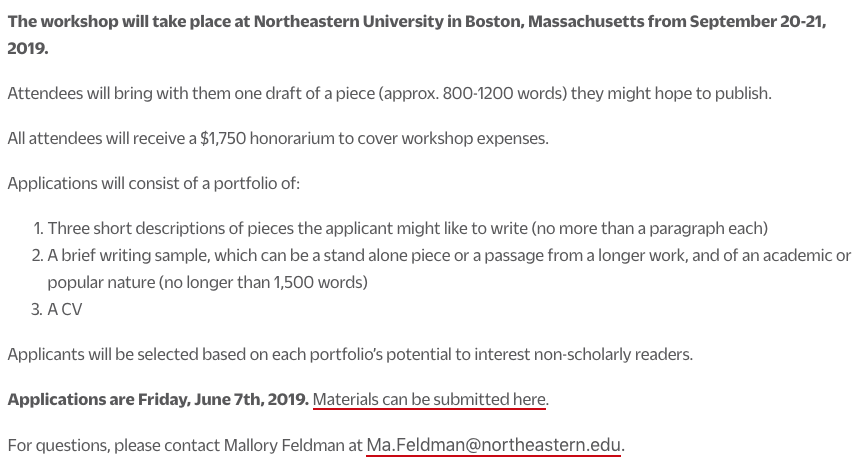
RT widely! Applications open 'til June 7: "Beyond the Ivory Tower: A Workshop for Scholars on Writing for the Public" on Sept 20/21 @Northeastern, led by James Ryerson (senior editor @nytopinion) with @daviddesteno and @LFeldmanBarrett.
Learn more/apply: https://t.co/880AGIz4lT