The candidates who ask about balance in the interview already know what happens without it. That's the experience you're filtering out. https://t.co/V3AE9WB39F
My biggest red flag when hiring is someone who asks about "work life balance" during the interview, because if you aren't obsessed with winning, you don't belong on my team.
If you want balance, go work a government job. If you want greatness, you sacrifice.
Steve Jobs once said, "A players hire A players, but B players hire C players."
In a large company, that slide can take years. In a small startup, it can happen in a matter of months. Early stage startups should have the least tolerance for mediocrity. It's easier said than done, but if a culture of high standards is established at the top and consistently reinforced across the organisation, it can increase the odds of success by an order of magnitude.
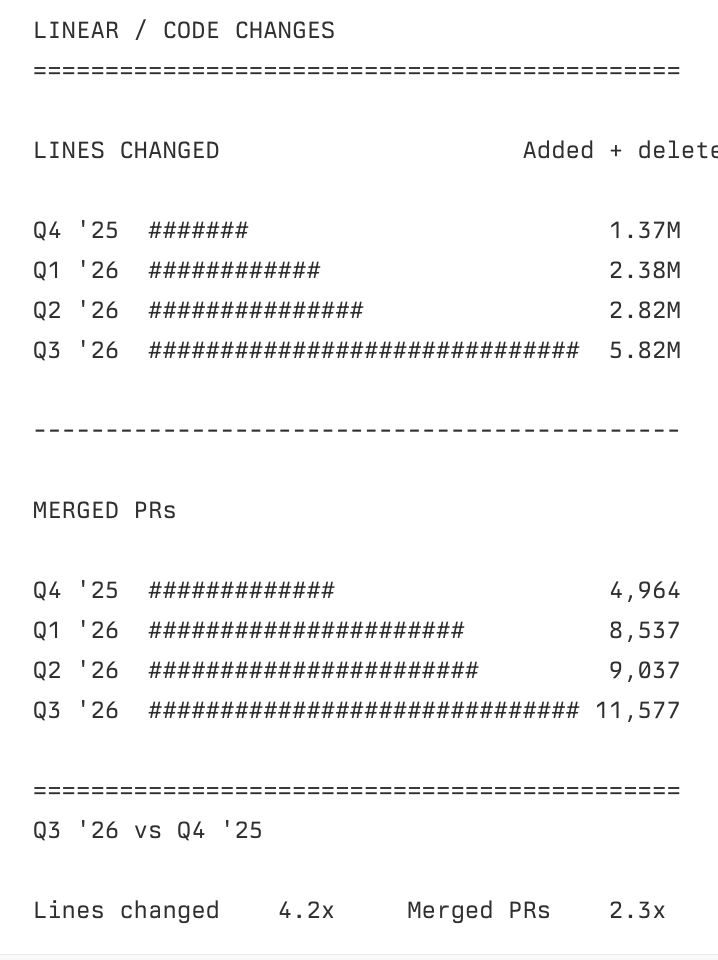
No secret SDLC, says the CEO of the tool company. The teams that ship just kept the boring part: engineers who can still read the diff.
https://t.co/yIFMr5uryT
People keep asking how companies like Ramp, Linear, and Anthropic ship so much software with agents.
There is no new SDLC or secret set of tools. The tools are increasingly available to everyone. You can build your own, use Linear, Claude, or whatever works.
The bigger difference is ambition. These companies encourage their teams to build more, experiment more, and let agents do more of the work. That's the main different between "AI native" or not. You try to use the technology to the max.
But don't get there by adopting a tool. You get there by changing what you believe your teams are capable of.
So in the very simplest way:
- let agents build
- make it easier and faster to contribute
- increase the ambition of what your teams attempt.
In practice, that means things like:
- Standardize around cloud agents. Most of our code (5M lines last quater) is now written in Linear with our Linear cloud coding agent. Cloud sandboxes make standardizing the system and environment easier for everyone and enables faster contributions
- Linear agent (with code access and cloud agent) operates in Slack too. If there is a discussion or someone notices a problem just say "@linear fix this" (decrease the time from something noticed to fixed)
- As bugs, errors etc arrive in Linear, send them to Triage, and have Loop to auto-investigate (connect to tools like Sentry, Datadog), and write a fix
- Let designers, PMs, non-technical people contribute code where useful. If they notice a problem, tell them they can submit a fix. If they want to try something, ask them to build a prototype.
- Set up code review agent and system to make sure PRs are safe to merge.
- Run security as an automation, have agents constantly try to find security issues in your codebase, as they find, send it to a coding agent
- Instead of working on issue level, increase ambition, make a whole project, ask the agent to ask questions, investigate code base, create issues and have the agent work on the whole project at once. Set up goals like "give me proof that what you build works". All our PRs now come with screenshots and videos and preview build you can
- Bring customer feedback to the system like Linear, and make it available for your team. At Linear every project now starts with 10-500 customer notes that influence the direction of the work, and which customers we should ask to test the solution first.
- Set up Loops/automations to constantly update reference documents for agents, like product area/code owners so work can be routed to right humans
Then what is left is how do you set direction for your teams (initiatives, projects they should work on) and how do you review results (better code review, Linear does it with Guided Reviews), how you maintain quality/cohesion which is not a new problem either.
Basically most of the problems you always had remain, but the execution bit is now more and more solved.
At @linear we can help with automation, cloud agents, and code review, customer feedback and planning bits.
But we can't change your mindset or how your company operates.
If your company is still spending energy debating jira workflow steps, you're probably solving the wrong problems.
You do not have an inclusive engineering culture. You have an HR escape room where every technical objection is reframed as a feelings incident. Meanwhile, the build takes 47 minutes and nobody is allowed to say why.
Você não foi promovido por capacidade técnica, foi porque o gestor precisava de alguém que dissesse sim na reunião. O "nunca fiz isso" ele ouviu e ignorou.
https://t.co/4DkCNUTAuy
Maluco eu comecei no novo emprego achando que eu ia ser só o macaco de task que eu semrpe fui
Chega a manager falando "cara tem um projeto que tá crescendo de escopo e a gente quer que você seja o líder técnico desse projeto. Vamos te dar uma equipe"
Eu nunca fiz isso to fudido
We are looking for engineers who:
Have built and operated real enterprise applications.
Understand financial transaction processing and the fintech ecosystem.
Can defend their architectural decisions with sound engineering reasoning.
Take ownership of production systems and business outcomes.
Understand the importance of testing, automation and operational excellence.
Are comfortable working with modern AI-assisted engineering tools.
Can operate independently and contribute meaningfully to a high-performance engineering culture.
OUR SELECTION STANDARD
Minimum requirements across all advertised positions:
6+ years of professional software engineering experience.
Proven experience building enterprise-grade applications that scale.
Previous experience working with a fintech platform – NON-NEGOTIABLE.
Demonstrable proficiency in the technical competencies relevant to the position.
Practical experience with automated testing and production software delivery.
Proficiency in using AI-assisted engineering tools.
Candidates will undergo technical evaluations covering coding, system design, architecture, testing, production engineering and practical problem-solving.
Send your CV and LinkedIn profile to [email protected]
Use the position you are applying for as your email subject:
Tech Lead – Backend Engineering
Tech Lead – Full-stack Engineering
Senior Backend Engineer
Senior Full-stack Engineer
If you know exceptional engineers who meet these standards, please share this opportunity with them.
Your VP calls it “engineering culture” because “people who ship without permission” sounds bad. The quarterly all-hands is not alignment; it is a hostage video with slide transitions.
Two résumés get called "engineering culture" — HoloLens hardware and billion-dollar volume. Neither says how the protocol reviews a single line of code. https://t.co/xCpqkJPqHl
I evaluate protocols by whether their engineering culture comes from enterprise tech or pure speculation.
@vangrid_io is leadership pairs Microsoft HoloLens hardware experience with a backend architect who previously handled billion-dollar volumes at https://t.co/60aEO9usML and ING.
Based out of Amsterdam, they are also an official member of NVIDIA Inception.
Being part of NVIDIA Inception is a clear indicator that their spatial capture architecture is designed to integrate straight into mainstream AI compute pipelines.
Founders with roots in tier-1 enterprise tech know how to ship real utility.
A project can have:
- 100% test coverage
- A clean architecture
- Perfect TypeScript types
…and still fail in production.
Real users always find a way to surprise you.
Cathedrals took 200 years to finish and the people who paid for them mostly never got inside. Six weeks for the feature is a bargain. https://t.co/Lu5Fr4Wuof
“When your manager asks you why the feature is taking 6 weeks, you explain that you don't build a cathedral with cinder blocks.”
When I was a young engineer, I pushed the ideas of carefully designing everything before it was implemented. Sure, it took longer, but think how much time we’d save by reusing the design!
Problem was, the time saving never seemed to materialize. And it was much harder to get something out the door.
Frustratingly, I’d look at code from academia and see the messiest crap you’d ever seen. But it always did cool stuff like using neural network to create an ideal palette for image dithering. (Have I ever mentioned, I’m old? 😅)
Eventually I remembered a bit of C code that had bugged me as a teenager. It was a BSP tree implementation. (Look up Doom if you don’t know what that is.) It bugged me because there was so little code. And it was so easy to read. It seemed… too simple.
So I did what most programmers do: ignore the hell out of it and look for a more complicated implementation!
Problem is, I was looking at what good code should be. The academic code was getting done quickly because they didn’t care about the “rules” or maintenance. They just wanted it to work. Clearly untenable, but at least they were shipping.
What I realized was, that BSP implementation? That was proper “clean code”. It was code written to the limitations of the machine and problem space. It didn’t care if it called out every detail of the abstraction in excruciating detail so you could autogenerate a book on the topic! It expected you to go learn the concept and then read the (precious few) lines of code.
What I learned was that clean code was about making code understandable and maintainable. Beyond that, you had to align with the machine. Because the machine doesn’t care about your abstractions. So if you want to get the job done, abstract only as much as necessary, no father.
OH from a GP last night:
“I have a company doing $15m revenue and I can’t raise capital. It is going to be a zero.”
And:
“ triple triple double double doesn’t get the Series A meeting anymore. I want 10-10-5.”
Founders: the bar for follow on capital has never been higher. If you don’t have the outlier traction that others are delivering get to profitability as fast as you can.
And compound some advantage
most underrated skill in software right now isn't prompting. it's knowing when to delete 400 lines of ai-generated boilerplate before it turns into tech debt you'll be debugging at 3am next tuesday
juniors use cursor to write more code. seniors use it to figure out why the code shouldn't exist in the first place
A migration plan that says "dual write indefinitely" is not prudence; it's cowardice serialized into production. Pick the cutover date or admit the system owns you.
I’ve been saying this a lot to my non-engineer friends. Not many people understand how messy and insecure the digital world around them is.
I’ve built software in 5 different industries over the last 30 years. Most code sucks. “Well designed and security hardened” is very very rare. Like unicorn rare.
AI programmers is the natural progression of tech for the simple reason that human programmers are slow, make a lot of mistakes, and are expensive.
70 years of tech debt is going to be paid off in the next couple years, and everyone will be safer, and it was a collaborative effort by humanity. How rare.
Every tech worker for the past 30 years has used forums, chats, Reddit, stackoverflow, Wikipedia, etc to fully document and provide information sharing amongst ourselves.
Other engineers trained large language models over all this documented knowledge while others made hardware that could train models faster. Then even more engineers put those models to use to patch vulnerabilities.
The machines are patching it now. It’s their problem. Relax. We’ll have more secure software.
We all did this together.
Be proud.