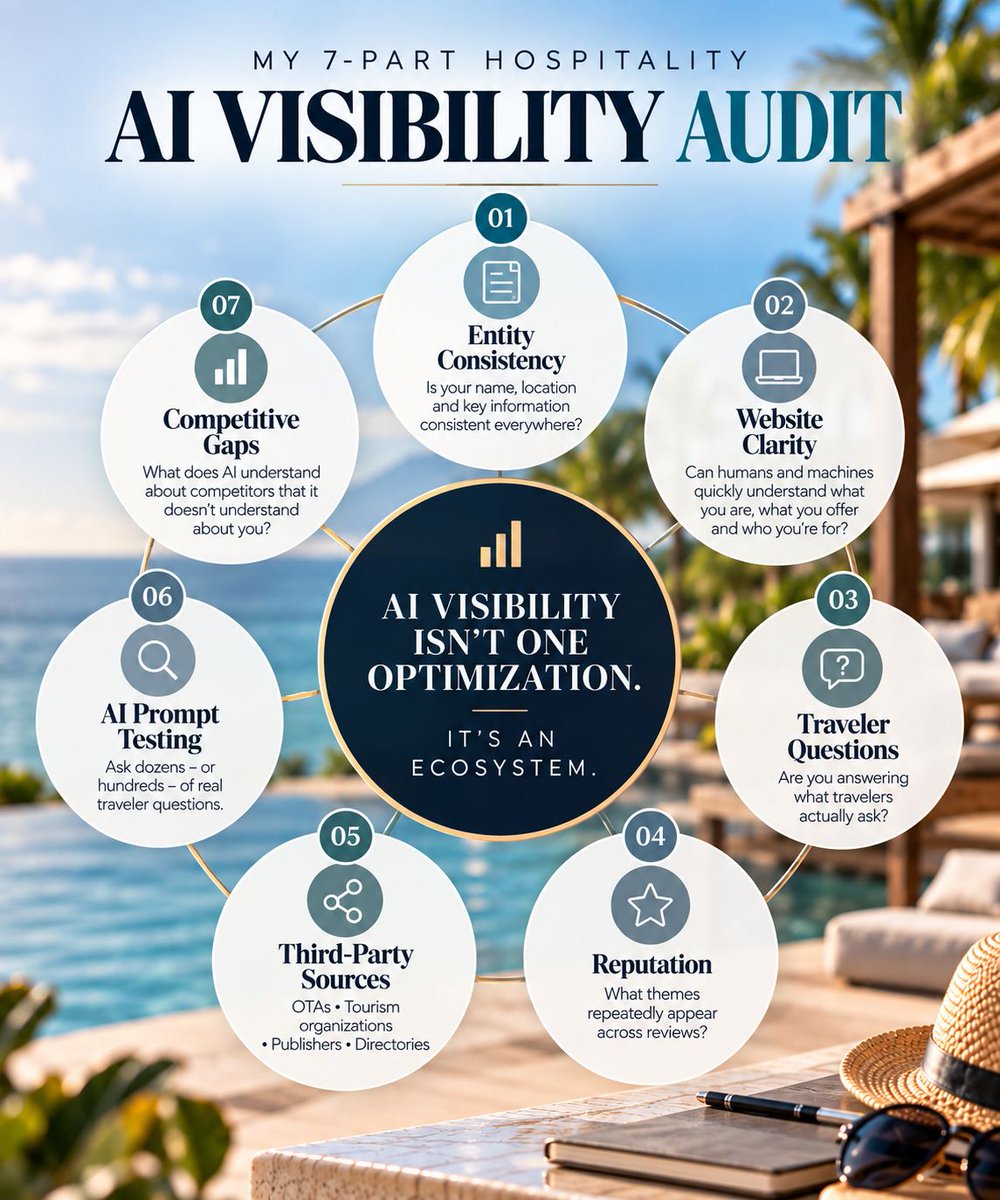
AI visibility testing shouldn't stop at:
“Did our brand appear?”
Also record:
How were we described?
Why were we recommended?
What sources were cited?
Which competitors appeared?
What facts were wrong?
A mention isn't automatically a win.
My current test for whether something should become an AI agent:
Is it repetitive?
Does it follow recognizable rules?
Does it consume meaningful human time?
Can the output be reviewed?
If yes, it's worth exploring.
Not every task needs an agent.
I don't really need AI to help me create 100x more marketing.
I'd rather have it help me:
find mistakes
spot patterns
surface opportunities
analyze repetitive data
identify what I missed
Less “create more.”
More “help me see.”
Before building an AI agent, answer 5 questions:
1.What repetitive job are we solving?
2.What information does it need?
3.What's the source of truth?
4.What decisions require a human?
5.What does “good output” look like?
Start with the process. Not the AI.
Building an AI agent taught me something:
The hard part isn't always the prompt.
It's defining:
the job
the inputs
the rules
the exceptions
the output
the human review
AI gets much better when the workflow gets clearer.
Words I increasingly question in hospitality copy:
“Unlimited”
“Complimentary”
“Always”
“All”
“Every”
“Guaranteed”
Not because they're bad marketing words.
Because they're absolute claims.
And absolute claims need to be absolutely true.
I used to think conflicting website information was a CMS problem.
I'm increasingly convinced it's a brand-governance problem.
The hard part isn't changing one page.
It's knowing everywhere else that same fact exists.
One lesson from building AI agents:
The AI shouldn't decide what's true.
Give it an approved source of truth.
Then ask it to identify conflicts.
AI is much more useful as:
“Find what doesn't match.”
than:
“Tell me which version is correct.”
When AI gets something wrong about your brand, don't stop at:
“AI is wrong.”
Ask:
Where could it have learned that?
Old page?
OTA?
Article?
Directory?
Review?
Sometimes an AI problem is really an information-ecosystem problem.
I built an AI agent whose job is to tell me when my own marketing is wrong.
Not bad copy.
Wrong facts.
Published URL → Source of Truth → Conflict → Evidence → Severity → Action
This is where AI agents are getting interesting for me.
I'm less interested in:
“How can AI create our marketing?”
And increasingly interested in:
“How is AI interpreting our marketing?”
Does it understand us?
Trust us?
Recommend us?
That's the hospitality AI conversation I want to keep exploring.
I don't think SEO is dead.
I think SEO is becoming part of something bigger.
Search engines.
Answer engines.
AI assistants.
Maps.
Reviews.
Social search.
Discovery is fragmenting.
Our strategies have to follow the traveler.
Marketing experiment I'd love every resort to run:
Ask AI 100 relevant travel questions.
Record every brand recommended.
Then calculate:
AI Share of Voice = prompts where your brand appears ÷ relevant prompts tested
Repeat monthly.
Now things get interesting.
If your resort says it has 10 pools on one website, 11 on another and 8 somewhere else... Which number should AI trust? Tiny information inconsistencies become much more interesting in an answer-engine world.
New hospitality marketing question:
What does AI believe about our brand?
Website + reviews + OTAs + Google + articles + directories + social all contribute to the picture.
Your brand guidelines aren't AI's only source of truth.
The hospitality martech stack keeps growing:
CRM
CMS
PMS
Booking engine
Analytics
Social
Email
Reputation
SEO
AI
Sometimes the best technology strategy isn't adding another tool. It's getting more from the 9 you're already paying for.
20+ years in marketing taught me:
The person with the most tools isn't necessarily the best marketer.
Knowing which problem is actually worth solving beats knowing 47 platforms.
One AI-search prediction:
FAQ content becomes strategically interesting again.
Not 100 keyword-stuffed questions.
Real traveler questions with clear, useful answers.
Useful for humans. Easier for machines to understand.