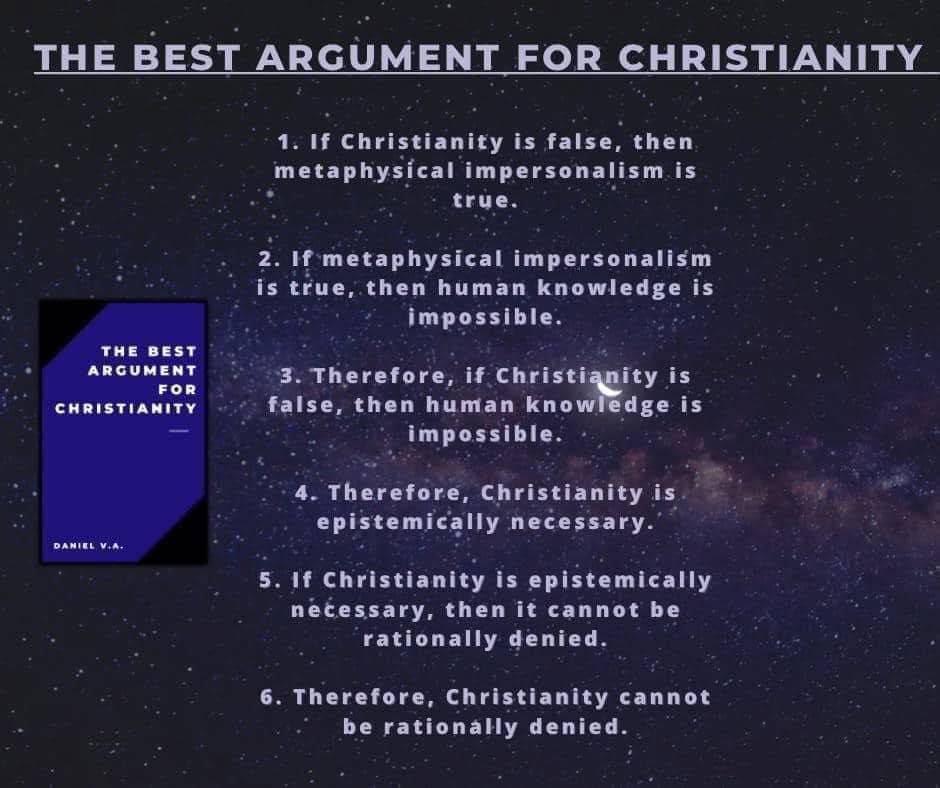
The Christian scheme is the only epistemological scheme conducive for human knowledge because it is the only scheme in which rationality precedes factuality.
God’s Word cannot be false because it is His Word that determines what is true.
The Bible isn’t inerrant because it coheres with the set of all truths. Rather, whatever is true is true because it coheres with God’s Word.
Traditional approaches to apologetics proceed upon the assumption that God's existence is not certain, or that there are things more certain than the existence of God. This assumption implies that God has not revealed Himself.
As a Reformed apologist it is not enough to know that the unbeliever’s worldview reduces to absurdity.
You must also be able to SHOW that it does.
The Folly of Unbelief equips you with the necessary tools for that: https://t.co/6rMEGneFnv
Non-Calvinists want to eat their cake and have it. They want to say that God can pre-determine certain facts of history (the Bible forces them to admit this), but not all facts.
But it is impossible to determine one fact without determining everything.
The transcendental challenge is something that must be undertaken by all - there cannot be any neutral bystanders or fence-sitters. Everyone must give account of the intelligibility of their experience.
“you make the claim, so you have to prove how Christianity is necessary.”
Bro, by participating in the debate while rejecting Christian theism you are making the implicit claim that Christianity is not transcendentally necessary.
Ergo, you shoulder an equal burden of proof.
Causality is explained by divine providence. “Cause” and “effect” are determined by God. It is God’s eternal counsel that establishes any kind of relation between temporal facts - including causal relations.
As Christians, we are called to proclaim biblical truths to all men.
When these truths are challenged, we must demonstrate the futility of rejecting a biblical outlook on life.
We must always be prepared to illustrate the folly of unbelief: https://t.co/6rMEGnfdd3
1. Christian theism precludes the possibility of coherent non-Christian god-concepts
2. Bare theism affirms the possibility of coherent non-Christian god-concepts.
3. Therefore, Christianity and bare theism are mutually exclusive.
Christian: this blade of grass is evidence for God.
Atheist: what? That's not evidence!
Moral of the story: what divides the believer and unbeliever isn't presence/absence of evidence, it's the interpretive schemes (worldviews) with which they interpret the evidence.
Non-Christian religions have more in common with atheism than Christianity.
All apparent agreement they have with Christian doctrine is merely cosmetic.
If God does not exist, then every single thing happens by Chance.
If everything happens by Chance, then scientific knowledge is impossible.
Scientific knowledge is possible.
Therefore, God exists.