Husband/Dad. Advocate for tackling climate change & accelerating the transition to a cleaner, more just & resilient world. Work at @CeresNews Personal account.
1/3 The SEC's proposal to rescind the federal climate disclosure rule would take us back, not forward. Investors have long called for clear, consistent, decision-useful climate-related data.
The Trump SEC’s push to end climate disclosure abandons investors who have spent more than a decade calling for consistent, comparable data to manage that risk. Even as this SEC sides with corporations over investors, I’ll keep fighting for the disclosure investors need to reduce risk in their portfolios. Climate risk is financial risk.
https://t.co/bim61NVgfO
A proposal to rescind the federal corporate climate disclosure rule will “take us back, not forward, in our efforts to bring more accountability and transparency to the marketplace,” said Steven M. Rothstein, Chief Program Officer at Ceres.
Read Rothstein's full statement: https://t.co/GnL7LlU19c
At a moment when climate policy is under attack and global economic upheaval is creating real uncertainty, this rulemaking is critically important for California. We have both an opportunity and a responsibility to lead with consistency.
A SEC proposal announced today to rescind federal corporate climate disclosure rules will “take us back, not forward, in our efforts to bring more accountability and transparency to the marketplace,” said Steven M. Rothstein, Chief Program Officer at Ceres. @CeresNews@SECGov
My latest for Bloomberg: "We are about to see the Great Clean Energy Acceleration 2.0 – a discontinuity in energy markets as profound as the oil shocks of the 1970s, and one that could bring forward peak fossil fuel use and emissions to this side of 2030." https://t.co/857eRwNea3
Four years after the U.S. insurance industry began standardized climate risk reporting, we've released a new report, which finds that while more companies than ever are reporting their climate-related financial risks, the quality of disclosure remains deeply insufficient, with the vast majority of carriers falling far short of the substantive, decision-useful reporting that regulators, investors, and policyholders want.
The 2026 Progress Report: Climate Risk Reporting in the U.S. Insurance Sector analyzes disclosures from 537 insurance groups submitted to the National Association of Insurance Commissioners' (NAIC) Climate Risk Disclosure Survey for reporting year 2024.
Download the free report here: https://t.co/uqmfPw6lPw
Chip Roy lost his bid for Texas attorney general last night. He was one of the solar industry's biggest opponents in Congress. And a group of clean energy investors decided there had to be a consequence.
They ran hundreds of thousands of dollars worth of attack ads calling him "not MAGA enough." The ads never mentioned clean energy once. They forced Roy into a runoff, which he lost yesterday.
I recently sat down with one of the lead donors to the campaign: Chris Larsen, the billionaire co-founder of Ripple, who is now investing heavily in climate.
Chris was one of the lead investors in crypto's Fairshake campaign that turned the industry from a regulatory target into one of the most feared political forces in Washington. It spent nearly half of all corporate political dollars in the 2024 cycle and won over 95% of the races it engaged in.
He thinks clean energy can do the same thing. And he does not mince words about what that requires: "This is political warfare. You talk about what works. You talk about what's going to take out that person."
I also sat down with his co-founder at the Clean Break Fund: Mike Brune, the longest-serving executive director of the Sierra Club.
"The next time someone votes against the solar industry, there's a lot of money that could come after them in the next primary or the next election," Brune said.
The clean energy industry has been historically focused on making the affirmative case by highlighting economic benefits, building coalitions, and telling a positive story. But Chris and Mike think that the industry needs to get more serious about delivering political consequences.
"The worst thing you want in a political fight is for your opponents to think you're weak," Chris told the room.
There's still a massive spending gap between renewables and fossil fuels. In 2024, the entire renewable energy industry donated $2.5 million to political campaigns. Oil and gas donated $75 million just to elect Trump.
That gap won't close quickly, but it's the first sign that the industry is serious about taking the gloves off.
"...scientists have little doubt that human-caused climate change - largely the result of the burning of coal, oil and gas - has supercharged the heat." https://t.co/eoZILPMD9U via @BBC
Twenty years ago today, An Inconvenient Truth made its debut in movie theaters across the U.S.
I’ll be honest: I was skeptical that my slideshow about the climate crisis could become a successful movie. But thanks to our immensely talented director, Davis Guggenheim, Jeff Skoll, who made the ultimate decision to make the movie, and the incredible team behind the film — Laurie David, Lawrence Bender, Scott Z. Burns, Lesley Chilcott, Ricky Strauss, Diane Weyermann, and so many others, the film was a huge success, and opened the eyes of millions around the world to the threat posed by the climate crisis.
While I wasn’t sure that there’d be widespread public interest in a science-based slideshow, I have never doubted humanity’s ability to solve this crisis.
We know we must act, and Mother Nature is making that clearer and clearer every day. We’re already feeling the rapidly worsening impacts of a warming planet. Those impacts are evidence that our cause is even more urgent than it was 20 years ago. And as a result, the global movement for climate action has grown into the largest morally-based movement in the history of the world.
We also know now that we can act. Indeed, in the past 20 years, we’ve made tremendous progress: The world came together in 2015 to forge the historic Paris Agreement, which despite the recent U.S. withdrawal, continues to drive global action and ambition. Incredibly, last year, renewables made up 86% of all the new electric power installed around the world. In the U.S., renewables were 92% of all new power capacity!
Electric vehicles are now 25% of all new car sales worldwide and the sales of gasoline-powered vehicles have been declining since they peaked in 2017.
Unfortunately, however, the crisis is still getting worse faster than we are deploying the solutions — solutions that are now way cheaper than the dirty and dangerous fossil fuels still spewing heat-trapping pollution into the sky as if it is an open sewer.
So, while this is a natural occasion to reflect on the 20 years since the movie came out, I’m focused much more intensely on what we need to do now in order to shape what our world will look like in the next 20 years.
I’m still presenting my updated slideshow all over the world, training grassroots climate leaders and working with partners in 194 countries and territories who are creating change in their communities, in their workplaces and schools, and in their nation’s policies.
From what I’m seeing and hearing, I have no doubt that we will win this struggle. But it is still not clear that we will win it in time to avoid catastrophic damage and the dangerous negative tipping points that the climate scientists have long been warning us we must prevent.
Will we muster the moral courage and political will to solve this crisis?
Well, if you ever doubt our ability to do so, just remember that political will is itself a renewable resource. It’s up to all of us to renew it.
Photos: Still from An Inconvenient Truth, 2006.
Climate Reality Project training in Nashville, TN, 2026.
Barney Frank was a trailblazer, not only for his work in Congress to improve our financial system, but as an openly gay Congressman and leader in moving the country forward on LGBTQ rights. My sympathies to his husband and family.
Local leaders are making environmental policy decisions that add up to waves of change. When one community takes bold action, it opens the door for others to follow suit.
More from @NPR 🔗 https://t.co/JYMADDjeAr
Four years after the U.S. insurance industry began standardized climate risk reporting, we've released a new report, which finds that while more companies than ever are reporting their climate-related financial risks, the quality of disclosure remains deeply insufficient, with the vast majority of carriers falling far short of the substantive, decision-useful reporting that regulators, investors, and policyholders want.
The 2026 Progress Report: Climate Risk Reporting in the U.S. Insurance Sector analyzes disclosures from 537 insurance groups submitted to the National Association of Insurance Commissioners' (NAIC) Climate Risk Disclosure Survey for reporting year 2024.
Download the free report here: https://t.co/uqmfPw6lPw
🚨 BloombergNEF’s annual flagship report, New Energy Outlook 2026, is now live.
Energy security is top of the global agenda after successive energy market shocks. This year’s outlook finds that countries continuing to deploy economically competitive clean technologies can reduce their reliance on imported fossil fuels and strengthen energy security.
📈 This chart shows how energy commodity import dependence evolves across major markets through 2050 under BNEF’s Economic Transition Scenario, which maps how the energy system is most likely to evolve over the next decade and through 2050.
Asian economies with high import liabilities, including Vietnam, Japan, Indonesia and India, have some of the most to gain.
Download the Executive Summary and Public Benchmark Dataset: https://t.co/7ytqfbVu6u
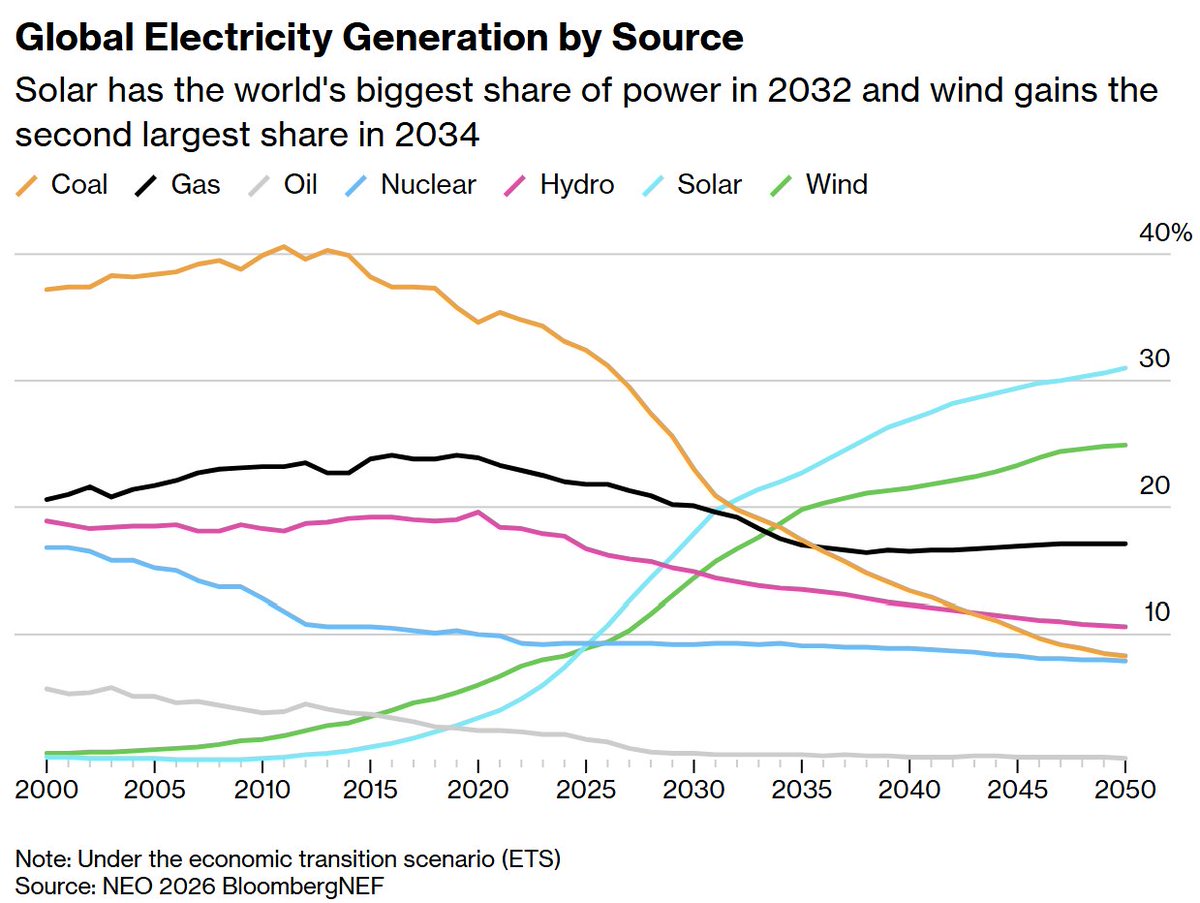
Renewables are unstoppable. BNEF's New Energy Outlook for this year says solar is set to be biggest source of electricity in 2032 and wind second biggest in 2034. Both coal and gas displaced from those thrones. This is the business-as-usual scenario.
🎁🔗 https://t.co/VqZ6GQ3gc0
Trump ran on lowering household bills. Instead, he's done the exact opposite: tariff wars, actual wars sparking massive oil supply disruption, scrapping tax credits that lowered the cost of new electricity supply at a time of soaring electricity demand... and now: forcing expensive coal plants to keep running even when their owners want to shut them down! Trump's Department of Energy has ordered multiple uneconomic coal plants to continue operating, forcing utility customers to pay hundreds of millions of dollars. How's that for an "affordability agenda"? 🤦♂️
https://t.co/yoE7q8Okj0
Progress on clean energy is unstoppable, in red and blue states alike.
The guy in the Oval Office may try to slow us down, but states have the power to decide our own laws, our own investments, and our own future.
https://t.co/Wh5IsF5ke5