Perfect 1v1 Drill For Finding Your LOCKDOWN Defenders!
@CoachLoGalbo
takes you through a drill that is perfect for finding your lockdown defenders that you can rely on when the lights turn on. As Nick LoGalbo says, it's a great way to find your "Rambo" which is a defender that you can rely on to defend your opponent’s best ball handler in the full court.
And, an added offensive benefit to this drill, is that it allows for offensive players to work on their ball handling in the face of defensive pressure!
This 1 on 1 Contain Drill is from Nick LoGalbo's Outer Third Defense (No Middle Defense) - on sale TODAY ONLY. That's why the goal of this basketball drill is to force the opponent's primary ball handlers to the outer thirds of the basketball court (and out of the middle!) as soon as they catch the ball. By doing this, it allows the defense to dictate the entry pass to one side of the floor.
By keeping the ball on the outer third of the basketball court, you can overload the backside of the defense which helps control the opponents passing lanes, deters easy passes and helps eliminate the dribble drive.
You can incorporate this drill every other day in practice to re-emphasize to your defenders the importance of keeping the ball handlers out of the middle of the basketball court.
Instructions and Keys to the 1 on 1 Contain Drill:
- Give the ball handler a cushion. This makes it easier to contain them in the outer thirds.
- Chest and contest a crossover to the middle. You do not turn your body. You must beat the offensive player to the spot and turn them back to the outer thirds.
- If you get beat, you sprint ahead of the ball. You do not continue shuffling.
- Keep the ball in the outer thirds the entire length of the court. It does not stop after the offensive player gets past half court.
- The goal of the drill is to simply keep the ball handler in the outer thirds.
- The defense should focus on beating the ball to the spot and chest to contest defense.
- As soon as the first group gets to halfcourt, the second group begins.
- After a group makes it all the way to the opposite baseline, they switch positions and get in line to repeat the drill going the opposite direction.
Coaching Tips
- Once a player gets chest to contest, they must spring back to get in front of the ball. Your goal is not to be running side by side. You must get in front of the offensive player. This prevents the offensive player from getting an angle to the basket.
- After running through the drill for a specified amount of time, switch directions so the offensive players must focus on using both hands as their primary dribbling hand.
- It is important to mix up players rather than like positions always competing against each other, so that players get used to guarding a wide variety of positions. It forces the players to adjust defensively regarding speed and skill.
- Another positive of this drill is it gives you the ability to assess who your Rambo is: players who can work the point guard up the floor.
[Today Only] Get the Outer Third Defense System — on sale, ends tonight: https://t.co/Ml1AdPbnKo
He made $100 million in a single day while cameras were rolling, then spent years trying to erase every copy of the film.
In 1987 a 32-year-old named Paul Tudor Jones was running $125 million out of a small New York office. A PBS crew followed him for months as he stared at one chart: the 1920s Dow overlaid on the 1980s. Correlation: 92 percent.
He told them the market would climb toward 3,200, then produce an “earth-shaking” crash that would dwarf anything in living memory. Ten months later Black Monday arrived. The Dow dropped 22.6 percent in one session. Almost the entire Street was wiped out.
Jones made roughly one hundred million dollars that day.
Afterward he did everything possible to kill the documentary. He bought every VHS copy he could find and demanded PBS stop airing it. For decades the only way to see *Trader* was through bootlegs that changed hands for hundreds of dollars among traders who treated it like sacred text.
Inside the footage he delivers the single rule that actually built the fortune: “I risk 10 cents to make eight bucks.” Everything else is noise.
The full hour is free on YouTube right now. Seventeen thousand views.
Almost no one currently managing serious money has ever watched it.
Mao Zedong killed roughly 45 million people between 1958 and 1962, and the backyard steel furnace campaign sits at the center of that catastrophe as a textbook case of central planning consuming itself alive.
The logic of the Great Leap Forward went like this: if the Soviet Union industrialized through state-directed production, China would do it faster and bigger. Mao ordered peasants across every province to smelt steel in small furnaces built on collective land. Party officials set output quotas with no reference to actual resources, actual skills, or actual demand. Farmers melted down their own plows, woks, and door hinges to hit the numbers. They stripped hillsides bare for fuel. What came out of those furnaces was overwhelmingly pig iron so brittle it had zero industrial use. The quotas got reported as fulfilled, the statistics traveled up the command chain, and Beijing celebrated a triumph that existed only on paper.
You have to understand what those farmers were abandoning to stand at furnaces all day. The 1958 harvest was, by most estimates, actually decent. But with the rural labor force diverted to smelting operations, crops rotted in the fields unharvested. Free market economists call this opportunity cost: every hour a farmer spent producing worthless slag was an hour not spent producing food. The price system, had anyone been allowed to use it, would have made this tradeoff immediately visible. Prices signal scarcity. Planners just issue directives and wait for reality to disobey them.
Local officials faced execution or labor camps for reporting shortfalls, so they reported surpluses. Beijing then exported grain abroad, partly to service debts to the Soviet Union, partly to project an image of socialist success, even as provinces like Anhui and Sichuan descended into mass starvation. The state had monopolized food distribution, so when the numbers were wrong, there was no private market, no informal trade network, no alternative channel to move grain to the dying. The apparatus designed to feed people became the mechanism that starved them.
This is what the elimination of private property and price signals actually produces in practice: 45 million corpses and a generation of Chinese children who grew up stunted by famine.
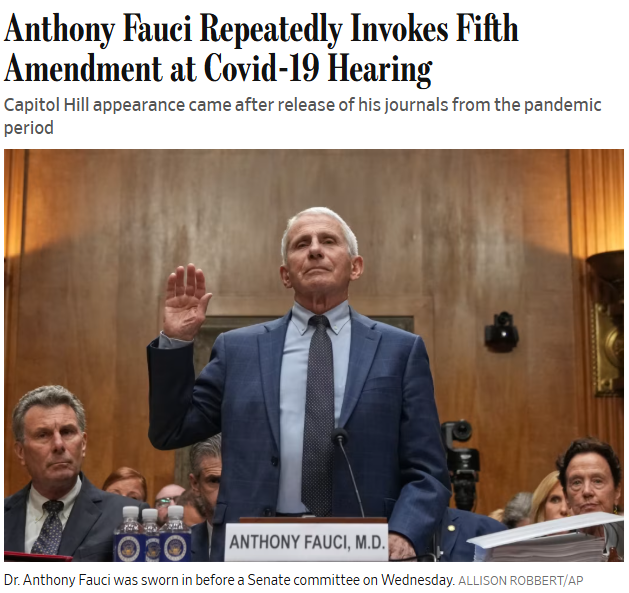
1) The NIH funded EcoHealth Alliance, which sent $600k of US taxpayer money to the Wuhan lab for experiments that genetically altered bat coronaviruses.
2) The research produced an engineered virus with enhanced growth & greater pathogenic effects in mice.
3) Under the ordinary scientific definition, that is gain-of-function research.
4) US intelligence now considers a lab-related origin of COVID-19 the most likely cause.
5) Ergo, Fauci headed the agency responsible for the grant to the Wuhan lab which ultimately lead to the deaths of over 1 million Americans from Covid-19. Then he lied about it under oath. Then he was pre-emptively pardoned by President Biden. And now he is pleading the Fifth.
Why Fauci is pleading the Fifth...
"The NIH has not ever and does not now fund gain-of-function research in the Wuhan Institute of Virology. No matter how many times you say it, it didn't happen." - Anthony Fauci, responding to Rand Paul under oath, May 11, 2021.
The AI Trade Is Becoming an Accounting Story
This chart shows one of the most important splits happening inside the AI trade.
The green line represents the check receivers. These are the semiconductor, memory, storage, networking, and hardware suppliers getting paid to build the AI infrastructure layer.
The red line represents the check writers. These are the hyperscalers funding the buildout. They are spending enormous amounts of capital on data centers, chips, power, cooling, land, and infrastructure before the market has fully seen the return on that spending.
That distinction matters.
The Market Is Asking Who Gets Paid
For a while, investors treated AI like one giant trade. If it had exposure to AI, it went up. Platforms, chips, software, data centers, power, cloud, everything was pulled into the same narrative.
Now the market is becoming more selective. It is asking a harder question.
Who actually captures the economics?
Right now, the answer is increasingly clear. The suppliers are getting paid first. The bottleneck assets have pricing power. Chips, memory, storage, networking equipment, and power related infrastructure are where the immediate cash flows are showing up.
The hyperscalers are in a more complicated position. They are making the necessary investments, but they are also absorbing the upfront cost. AI may be transformational, but transformation does not automatically mean every company funding the transition earns attractive returns for shareholders.
The Lesson From Past Buildouts
That is the lesson from past infrastructure booms.
Railroads were real. Fiber was real. Shale was real. Each one changed the economy. But in many cases, the first balance sheets that financed the buildout did not capture the best economics.
Suppliers, landowners, service providers, and bottleneck asset owners often got paid before the companies taking the biggest capital risk.
That is the phase AI appears to be entering now.
From Belief to Accounting
This chart is saying the market is moving from belief to accounting.
The dream phase rewarded everyone.
The buildout phase rewards suppliers.
The monetization phase will decide who actually owns the profit pool.
That is why hyperscaler earnings calls are going to matter so much from here. Investors will not just care about AI adoption, product demos, or engagement metrics. They will want proof that the spending is turning into revenue growth, margin strength, and durable free cash flow.
What Happens Next
The most likely outcome is that this divergence continues until the hyperscalers prove return on invested capital.
If they can show that AI capex is producing real monetization, the red line can stabilize. If the answers stay vague, multiples compress because investors will start treating AI capex as a margin risk instead of a growth engine.
The risk for the semiconductor side is different. As long as hyperscalers keep spending aggressively, the check receivers can keep leading. But if even one or two major buyers signal capex discipline, the market will immediately question how much demand has been pulled forward.
That is where the green line becomes vulnerable.
My Take
AI is still real, but the market is starting to separate the companies selling the infrastructure from the companies paying for it.
The chips are selling the picks and shovels.
The hyperscalers are digging the mine.
The question now is whether there is enough gold at the bottom to justify the size of the hole.
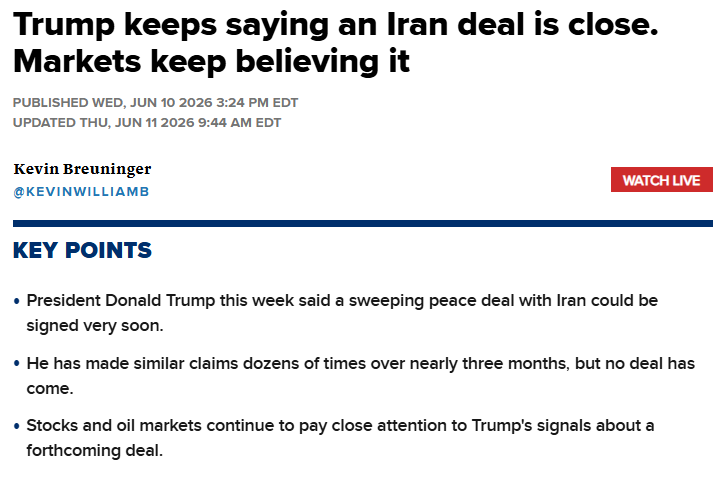
"Trump has signaled or stated outright more than 30 times that a deal is nearly at hand, according to a CNBC review of the president's social media posts and public remarks."
https://t.co/VeFZNByBqW
Just had someone ask me about $SPCX
The “accredited investor” type ;)
Selling the close 1st day, may come back in $QQQ admission for the squeeze.
Johnny Q is paying attention Wall Street, run!
Microsoft just banned its own engineers from using AI.
The tool was literally costing MORE than the humans it was supposed to replace.
They lied to you about AI adoption and now the whole narrative is blowing up:
Microsoft gave thousands of engineers access to Claude Code six months ago and encouraged them to use it.
Engineers loved it and adoption exploded. But then the invoices arrived.
Token-based pricing means every query, every code review, every debugging session costs money. At scale across 100,000 engineers, the numbers became so large that Microsoft issued an internal order to cancel nearly all Claude Code licenses by end of June and force everyone onto their own cheaper tool instead.
The company that invested $5 billion in Anthropic just told its own people to stop using Anthropic's product because it costs too much.
Uber's story is even worse...
Their CTO Praveen Neppalli Naga told The Information that the budget he planned for the full year was "blown away already" by April.
Uber had rolled out Claude Code in December 2025. By March, 84% of their 5,000 engineers were using it with 70% of all committed code coming from AI systems.
Heavy users were burning $500 to $2,000 per month each. Naga himself spent $1,200 in a single two-hour demo session.
The company had even built internal leaderboards ranking engineers by how much AI they used. They literally gamified the spending and then ran out of money.
Now look at what Nvidia's own VP of applied deep learning Bryan Catanzaro said to Axios last month. Direct quote:
"For my team, the cost of compute is far beyond the costs of the employees."
This is a VP at the company that SELLS the chips saying that using AI is more expensive than paying humans.
Think about what this means for the entire AI narrative.
Every CEO on every earnings call for the past two years has said the same thing:
AI will make us more efficient, reduce headcount, and cut costs.
The stock market rewarded every company that said it.
Fired workers, stock goes up. Announced AI adoption, stock goes up.
But the actual companies deploying AI at scale are discovering the math doesn't work. The MORE employees use AI, the HIGHER the bill.
Goldman Sachs forecasts a 24x increase in token consumption by 2030 as companies adopt AI agents. Gartner just published a report showing that even though individual token prices will drop 90% by 2030, total enterprise AI costs will go UP because agents consume exponentially more tokens per task than basic tools.
Meta built an internal dashboard called "Claudeonomics" to track which employees use the most AI. Amazon started pushing engineers to "tokenmaxx," their internal term for consuming as many AI tokens as possible.
Both companies are spending hundreds of billions on AI infrastructure this year alone.
And Microsoft, the company that bet its entire future on AI, just told 100,000 engineers to stop using the tool they liked best because the per-token bills got out of control.
The companies building AI are telling investors it saves money. The companies using AI are finding out it costs more than the humans it was supposed to replace. And even the company that makes the chips just admitted it through its own VP.
This is the gap nobody on Wall Street is pricing in.
$725 billion in AI infrastructure spending this year across Big Tech. And the first companies to actually deploy these tools at scale are already pulling back because the economics don't work.
What do you think?
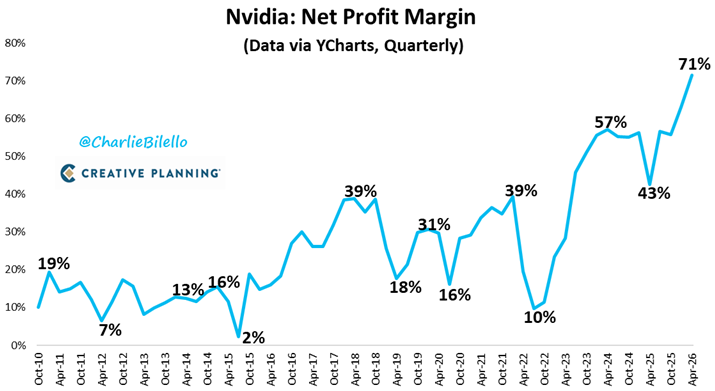
Nvidia Q1 revenues surged to a record $82 billion, up 85% over the prior year. Their revenue projection for Q2 2026 is $91 billion, which would be a 95% YoY increase. Net Income hit a record $58 billion, up 211% YoY. Net profit margins rose to 71%, an all-time high. $NVDA
I flew to Osaka with a 14-page activist letter, a translated copy of my proposed slate of independent directors, a slide deck on capital allocation reform, and what I believed, at the time, was a clear and reasonable demand: that the company, which was sitting on cash equal to 180% of its market cap, return a portion of it to shareholders through a special dividend. I had been working on this campaign for nine months. I had hired a Tokyo-based proxy advisor. I had built a 6% position through patient accumulation. I had, by every framework I understood, done the work.
The chairman, who was 81 years old, received me in a tatami room above the company's headquarters, which sat over a soba restaurant that had been in the same family for four generations. He was wearing a navy suit. He bowed at an angle I could not, with my Western training, accurately reciprocate. He gestured for me to sit on a cushion. I sat. A woman of approximately his own age entered, silently, and placed a small ceramic cup in front of me. The cup contained tea. The tea was lukewarm. I did not yet know that the lukewarm tea was the entire negotiation.
I began with the deck. I had prepared it carefully. I had translated the headers into Japanese. I walked him through the capital structure, the unproductive cash, the historical return on equity, the peer comparison, the proposed dividend. He listened. He did not interrupt. When I had finished, he said, in soft but clear English that I had not been told he spoke, "Thank you for traveling so far." Then he stood up, slowly, and gestured for me to follow him.
We walked down a set of wooden stairs that creaked in a way I cannot adequately describe, through a hallway lined with black-and-white photographs of men I did not recognize, and into a small workshop attached to the back of the building. In the center of the workshop was a lathe. It was old. It was, the chairman explained, the original lathe his grandfather had purchased in 1923 to manufacture the first product the company had ever sold, which was a specific kind of brass valve fitting used in steam locomotives. The locomotive industry had been gone for 60 years. The lathe was still running.
"My grandfather operated this machine," he said. "My father operated this machine. I operated this machine, as a child, before school. The factory you visited yesterday produces components that descend, in an unbroken line of design, from the work that began on this lathe. The cash you wish me to distribute is the result of one hundred and one years of refusing to do anything that would shorten the life of this company. I cannot distribute it. I am not, in the deepest sense, the owner of it. I am the custodian of it. The owner is not yet born."
I did not have a response. I had prepared for many possible responses from him. I had not prepared for this one. We returned to the tatami room. The tea was refreshed. It was, again, lukewarm. The chairman asked me about my family. I told him about my wife, my two children, my parents in suburban Connecticut. He listened with what appeared to be genuine interest. He asked the ages of my children. He nodded gravely when I told him. He asked whether I had ever shown my children the work I do. I had not. He asked whether I would, when I returned. I said I would consider it.
Four hours passed. I was served, at various points, three more cups of tea, a small dish of pickled vegetables I did not recognize, and a single piece of mochi that the chairman's assistant placed in front of me with both hands. Nobody mentioned the activist letter again. Nobody mentioned the dividend, the directors, the deck, the proposal, or the 6% position. We talked about the cherry blossom season, which was apparently late this year. We talked about American baseball, which the chairman had followed since 1962. We talked about a poet I had never heard of, whose work he recited a single line of in Japanese and then translated for me, slowly, into English, and which I have, in the three years since, been entirely unable to locate again.
At the end of the meeting, he stood. He bowed. He thanked me, again, for traveling so far. He said he hoped I would visit again, perhaps with my family, perhaps in the spring, when the city was at its best. He did not, at any point, acknowledge the proposal. He did not decline it. He did not engage with it. He simply, through a series of small and almost invisible movements that I am still trying to understand three years later, allowed the proposal to dissolve into the air of the room, until by the time I left the building, it had ceased to exist as a thing that had been said.
I flew home the next morning. I withdrew the campaign two weeks later, in a quiet letter to the proxy advisor that cited "ongoing discussions" and was technically not a withdrawal at all but was understood, by every party who received it, to be one. The position I sold over the following six months at a small loss. The chairman is still alive. The lathe is still running. The cash is still on the balance sheet.
I cannot, even now, explain what happened in that room. I went in as an activist, with a deck, a translator, and a six percent position, and I came out as a guest who had been thanked, very politely, for visiting a man's home, and who, somewhere in the four hours between the first cup of tea and the last, had been quietly, gently, irreversibly, and without a single raised voice or harsh word, defeated.
I think about him often. I do not think he thinks about me at all. This is, in some sense I am still working out, the entire lesson.