The problem is that the APC is preparing for war while the opposition parties are preparing to vote out the APC.
The opposition is waiting to implement their “rig and die” slogan while the ruling party is determined to disrupt the electoral process violently.
The Police has shown that it won’t protect the opposition.
The police is compromised beyond repair.
If the opposition parties do not urgently change their strategy, and put in place the needed machineries to counter the ruling party’s violent tactics, the outcome is predictable.
This is not the democracy that people died for. This is a dictatorship.
@AishaYesufu I suggested Kwanakwasia in every STATE but the more they kpai members, the more NDC do press release. NDC leadership should be serious for once over the life of your supporters, pls. 😡.
SmartBallot : Towards credible and Transparent Ballot
I have consistently believed that technology, combined with the creativity and resourcefulness of young Nigerians, can help reinforce our democracy and advance free, fair, and credible elections.
I am pleased to endorse SmartBallot (https://t.co/YgbAq2cLxE), a platform developed to facilitate grassroots mobilization, civic engagement, and election monitoring.
I urge our supporters and NDC candidates to register on SmartBallot and examine how its tools can assist them in organizing their communities, coordinating voters and polling unit agents, expanding grassroots engagement, and supporting transparent election monitoring.
Through the effective use of technology and collective action, we can reinforce our democratic institutions and help ensure that every vote is counted.
Credible elections require preparation, active participation, and peaceful vigilance. Let us make full use of every available resource to create a more organized, engaged, and empowered electorate.
A New Nigeria is Possible. -PO
For Those That Registered For Their PVC From January - April 2026.
Your PVC Is Now Available For Collection At INEC LGA Offices.
Please Pass This Round📌
For three years, Reno Omokri pandered to Northern Nigerians by praising Islam, posting jumat mubarak, and wearing Islamic regalia. In fact, he almost become a Muslim just because he wanted to woo Northern Muslims for Tinubu in order to fulfil his personal political gains.
Las Las Northern Nigerian Muslims are stoning Tinubu 🤣🤣
Lmao.
Lessons.
🚨 ATTENTION TO EVERYONE WHO REGISTERED FOR THEIR PVC BETWEEN JANUARY AND APRIL 2026!
Your PVCs are ready for collection at INEC LGA offices.
This is not the time to relax. Get ready for the battle ahead. Prepare for war. Mobilise, collect your PVCs and stay vigilant. Nobody should be caught sleeping in 2027!
PLEASE SHARE WIDELY. 🇳🇬✊🏽
@nafiumohammad I urge the managers of Tinubu media to avoid that at all cost. If they allow that to happen, we may see the last disgrace before leaving office 😂😂.
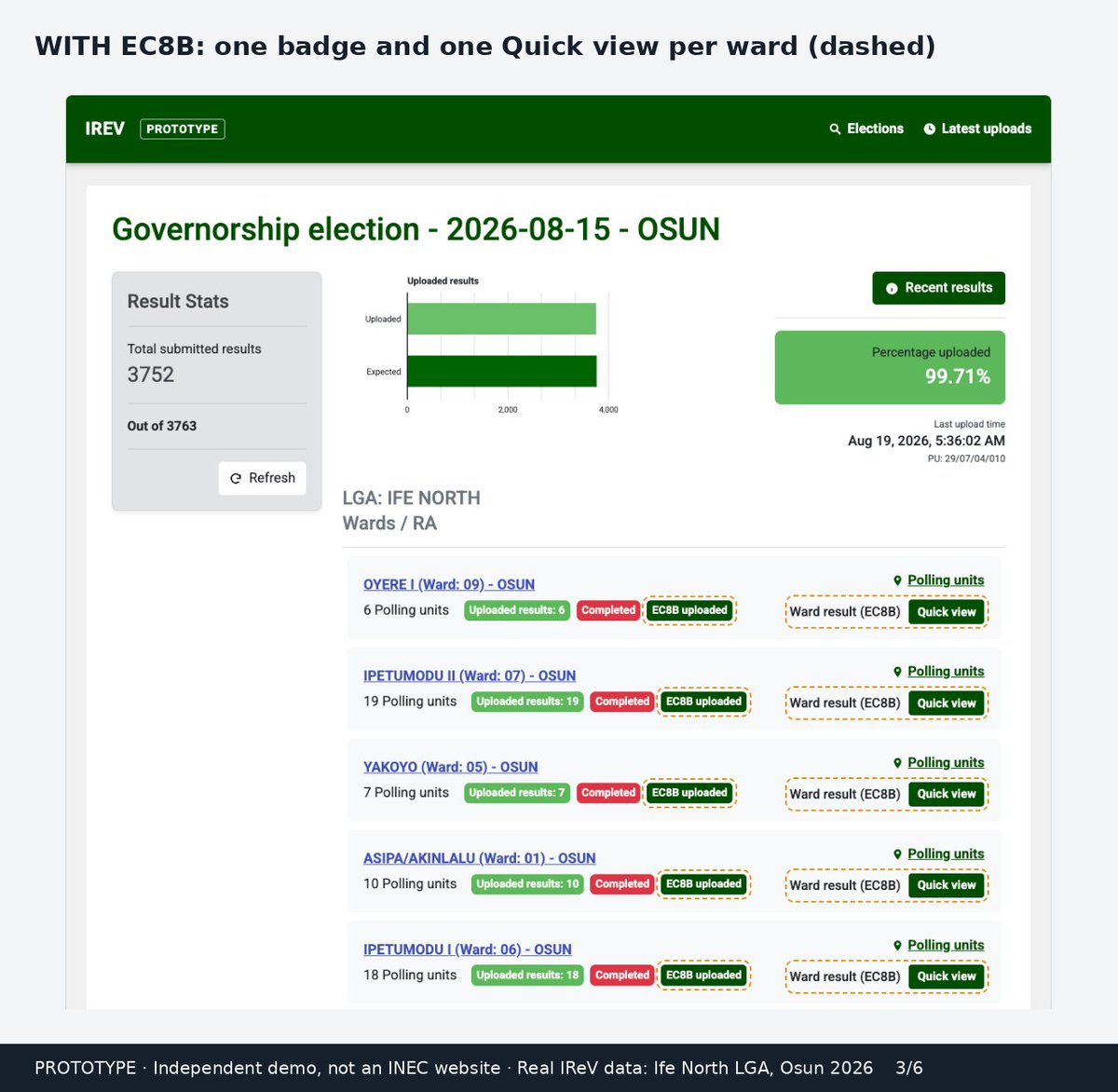
Yesterday, @inecnigeria said ward collation results can’t go on IReV because the feature hasn’t been built or tested, and that it would take a while.
We disagree.
It’s not rocket science, so we built it. In one evening. On IReV’s own data.
Left: IReV today.
Right: IReV with Form EC8B. 🧵👇
One year after the State Department designated Nigeria as a country of particular concern for the violent persecution of Christians, the attacks continue. America must use all the tools at our disposal to deliver on our promise to stand up for the Christians of Nigeria.
NIGERIANS, GO AND VERIFY (1)
Introduction: Governance as a Public Trust
Peter Obi
When I took office as Governor of Anambra State, our beloved state was at a critical juncture. Leadership had become increasingly disconnected from the people, and many of the essential institutions needed to support a modern society were weak, ineffective, or absent altogether. We understood that governance could not continue according to established habits. It needed to be reconceived as a solemn public trust founded on transparency, prudence, accountability, and demonstrable results.
Our governing philosophy rested on four principles: character, competence, capacity, and compassion. We understood that leadership was not a platform for self-promotion, political slogans, or the pursuit of personal acclaim. Its purpose was to improve the circumstances of ordinary citizens. It meant converting public resources into concrete benefits and ensuring that government’s foremost responsibility was to serve the people. Achieving this demanded more than good intentions; it required a clear vision, careful planning, and disciplined execution.
Among our earliest findings was that the state lacked a unified development plan to direct its priorities and determine how resources should be allocated. We therefore promptly created the Ministry of Economic Planning to establish the institutional foundation for deliberate, coordinated, and sustainable development. After completing the necessary groundwork and consultations, we launched the Anambra Integrated Development Strategy (ANIDS).
At that time, the Millennium Development Goals (MDGs) were being pursued worldwide across eight clearly defined priorities: eliminating extreme poverty and hunger; achieving universal primary education; advancing gender equality and empowering women; reducing child mortality; improving maternal health; combating HIV/AIDS, malaria and other diseases; promoting environmental sustainability; and fostering a global partnership for development.
We adopted ANIDS as our overarching development philosophy and strategic framework for advancing these objectives, tailoring them to the distinctive circumstances, needs and development priorities of Anambra State. Instead of viewing the MDGs as remote international benchmarks, we worked to convert their aims into practical policies, programs and measurable results that would produce tangible improvements in the lives of our people.
We also undertook a deliberate effort to redefine the state’s identity, changing its public image from ‘Home for All’ to ‘The Light of the Nation’. This was not merely a change in slogan; it reflected our resolve to restore public confidence in government, renew civic pride and show that Anambra could serve as a model of purposeful leadership and development.
The ANIDS Blueprint: A Comprehensive Framework for Development
ANIDS served as the foundation for our commitment to broad-based and balanced development. We did not accept the idea that government could focus on a single sector while leaving others behind. We recognized that education, healthcare, infrastructure, security, agriculture and capable public institutions were mutually dependent. Advancement in one area could not be sustained without commensurate progress elsewhere. Accordingly, we pursued development across every sector, guided by defined priorities, disciplined planning and prudent stewardship of public resources.
Central to this vision was the restoration of the dignity of the Anambra person. We understood that dignity could not be restored through rhetoric alone. It was evident in the condition of roads and other infrastructure, the availability of healthcare, the quality of education, the performance of public institutions and the way government treated its workers, pensioners and traditional institutions.