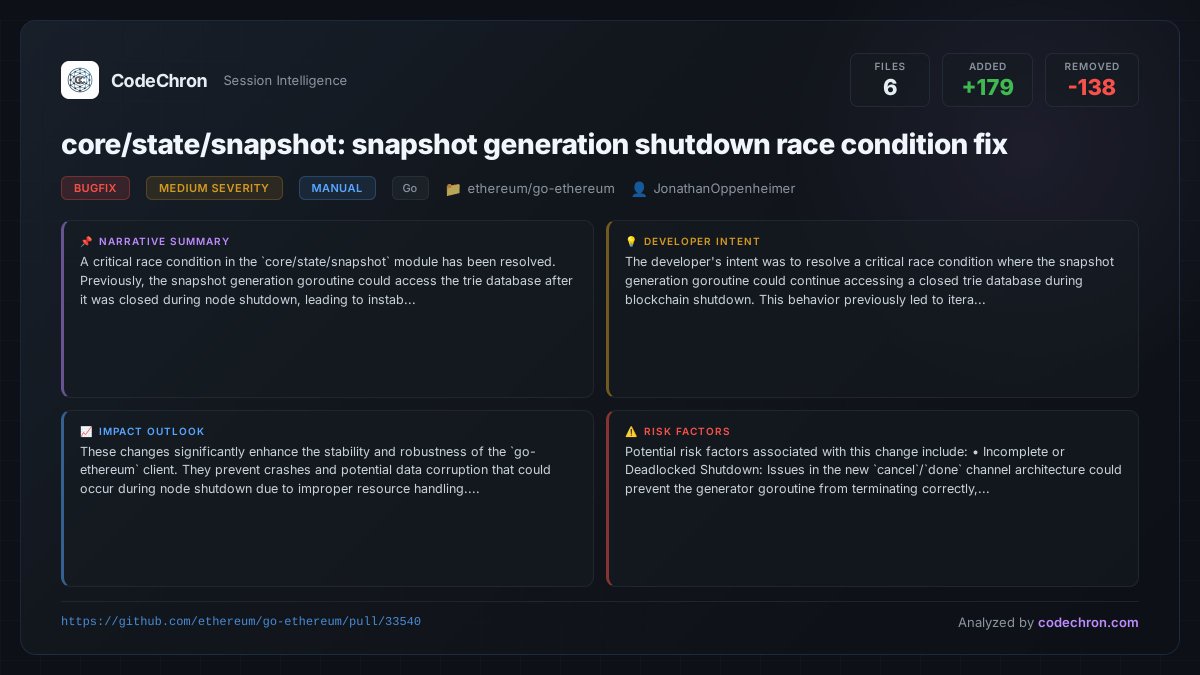
⚠️ Risk Factors
Potential risk factors associated with this change include:
• Incomplete or Deadlocked Shutdown: Issues in the new `cancel`/`done` channel architecture could prevent the generator goroutine from terminating correctly, potentially causing hangs or deadlocks during node shutdown.
• Unintended Database Access: Despite the fix, subtle bugs in the new concurrency primitives might still allow the generator to access the database after it has been closed, reintroducing the original race condition or similar issues.
• Performance Overhead during Shutdown: The blocking nature of `stopGeneration()`, which waits for the generator goroutine to fully exit, could introduce unexpected delays if the goroutine's termination process becomes prolonged.
📈 Impact Outlook
These changes significantly enhance the stability and robustness of the `go-ethereum` client. They prevent crashes and potential data corruption that could occur during node shutdown due to improper resource handling.
By ensuring the proper termination of snapshot generation goroutines, the risk of accessing already-closed databases is eliminated. The introduction of a dedicated goroutine leak test also establishes a higher standard for future code changes, improving the long-term reliability and maintainability of the snapshot module.
⚠️ Risk Factors
Potential for unforeseen regressions or new incompatibilities introduced by other changes within the updated `llama.cpp` version `b9509`.
📈 Impact Outlook
This update directly resolves a known runtime crash, significantly improving the stability and compatibility of Ollama for users leveraging the Gemma 4 12B multimodal model on affected operating systems and hardware. Users who previously encountered the 'integer division by zero' error with this model should now be able to use it without issues. The risk of unforeseen regressions from other changes in the updated `llama.cpp` version `b9509` remains, but the direct benefit of fixing a critical crash outweighs this for now.
⚠️ Risk Factors
A potential risk factor is the rejection of malformed transactions that might have previously been accepted due to the absence of this specific validation. However, this outcome is an intended consequence of the change, as it prioritizes data integrity and prevents invalid states from propagating within the network.
📈 Impact Outlook
This modification enhances the robustness of the transaction unmarshalling process within the `go-ethereum` client. By enforcing that the `BlobVersionedHashes` field must contain at least one hash, it directly prevents the propagation of invalid blob transaction data within the network. This improves the overall data integrity of core transaction types, leading to a more reliable and secure system for handling blob transactions.
⚠️ Risk Factors
Several risk factors are identified with this integration.
• Unexpected behavior or errors may occur during Qwen auto-installation due to platform differences or changes in external installer scripts.
• Configuration conflicts could arise if existing Qwen settings are not correctly merged or preserved, potentially disrupting user workflows.
• Security risks are present when executing external installer scripts (`curl | bash` or PowerShell commands) if the source (`https://t.co/N0lu0xLTcV`) were compromised, despite modifications to prevent auto-launch by Ollama.
• Runtime errors or incompatibilities might occur if Qwen Code's expected environment or API changes, affecting its interaction with Ollama's OpenAI-compatible provider settings.
📈 Impact Outlook
This change introduces a new functional integration, enabling Ollama users to easily set up and utilize Qwen Code. The `ollama launch` command's capabilities are expanded, now including robust auto-installation logic. This logic adapts to various operating systems and is designed to preserve existing Qwen configurations during the setup process.